



We’ve all felt it—that knot in your stomach before a big presentation or the racing heart on a first date. That’s anxiety in its most basic form: your body’s built-in response to perceived stress or danger. It’s a normal, even helpful, human emotion.
But what happens when those feelings stick around, becoming so persistent and overwhelming that they start to run your life? That’s when everyday apprehension can cross the line into an anxiety disorder.
Understanding What Anxiety Really Is

To really get to grips with anxiety, it helps to think of it as your body’s internal alarm system. It’s the ancient “fight or flight” mechanism that’s hardwired into our brains to keep us safe from threats. When an anxiety disorder takes hold, however, that internal alarm becomes far too sensitive.
Imagine your smoke detector screeching at full volume every single time you make toast. It’s supposed to warn you about a house fire, but instead, it’s treating a minor, harmless event like a full-blown emergency. This is exactly what living with an anxiety disorder feels like—your mind and body are in a constant state of high alert, reacting to everyday situations as if they were life-threatening.
When Worry Becomes A Disorder
Everyone worries. The key difference between a fleeting concern and a clinical disorder is how that worry functions. Normal worrying is temporary and tied to a specific, real-world problem. As soon as you solve the issue, the worry tends to fade away.
Anxiety disorders are a different beast entirely. They involve intense, excessive, and persistent fear that feels completely out of proportion to the actual situation. This feeling doesn’t just disappear; it lingers, disrupting your work, your relationships, and your ability to simply enjoy life.
A deeper understanding of anxiety involves recognizing how it can affect daily functions, such as the impact of anxiety on decision-making. When your internal alarm is constantly sounding, even simple choices can feel overwhelming and fraught with perceived risk.
This is a huge mental health challenge here in the UK. In fact, recent NHS data showed that around 6 million people in England were dealing with generalised anxiety disorder (GAD). GAD is defined by that relentless, excessive worry that interferes with daily activities and often brings on physical symptoms, too.
Normalising The Conversation Around Anxiety
The first step to getting a handle on anxiety is simply recognising it for what it is. Because it can show up in countless ways—through your thoughts, your actions, and even your physical health—it’s very easily misunderstood.
It’s helpful to keep a few things in mind:
- It’s incredibly common. You are far from alone. Millions of people across the UK are living with and managing anxiety every single day.
- It’s treatable. There is a wealth of effective support available, from therapy and medication to simple lifestyle changes that can help you feel in control again.
- It is not a weakness. Anxiety is a medical condition, not a flaw in your character. It’s a complex result of your genetics, brain chemistry, and life experiences all interacting.
Realising that anxiety is more like a faulty alarm system than a personal failing is empowering. It allows you to shift your focus from self-criticism to finding the right support. By learning to spot your triggers and symptoms, you can start the process of recalibrating that alarm and finding your way back to a calmer, more balanced life.
What are the symptoms of anxiety?
Thinking of anxiety as a faulty alarm system is a great starting point. The next step is learning to spot the specific signals that alarm sends out. So, how do you really know if it’s anxiety you’re dealing with? The signs are often much more widespread than just a feeling of worry.
Anxiety doesn’t just live in your head; it shows up in your thoughts, your actions, and even your physical body. Learning to recognise these patterns is the key to understanding what’s going on and figuring out when it’s time to get some support.
The Inner World: Psychological and Emotional Symptoms
The signs we’re most familiar with are the internal ones. This is the mental chatter that goes far beyond everyday stress, often feeling relentless and completely out of your control. Living with this constant internal noise is exhausting and can make it incredibly difficult to concentrate or ever feel truly at ease.
These feelings aren’t just reserved for high-stakes situations. They can creep in during the quietest moments, leaving you with the sense that your mind is always switched ‘on’, scanning the horizon for the next thing to worry about.
Some of the most common emotional flags include:
- Persistent Worry: A constant, nagging sense of dread about anything and everything—from work projects to your health. The worry feels bigger than the situation warrants and is incredibly difficult to switch off.
- Irritability: Feeling snappy, on-edge, or easily frustrated by others. This often stems from the sheer mental exhaustion of being anxious all the time.
- Restlessness: That “keyed-up” feeling of being unable to settle down or relax, as if you’re driven by an inner motor that won’t stop running.
- Difficulty Concentrating: Your mind might feel like it’s racing with a dozen different thoughts, or it might just go completely blank. Either way, focusing on a task or even following a conversation can feel like a monumental effort.
These psychological symptoms often feed each other. For example, you might start worrying that you can’t concentrate, which, in turn, makes it even harder to focus. It’s a frustrating cycle that can quickly spiral.
Anxiety symptoms can be broadly categorised into how we feel, how we act, and what happens in our bodies. The table below summarises some of the most common signs to look out for.
Common Symptoms of Anxiety
| Symptom Category | Examples |
|---|---|
| Psychological | Persistent worrying, feeling on-edge, difficulty concentrating, restlessness, irritability, a sense of dread. |
| Behavioural | Avoiding social situations, procrastination, seeking constant reassurance, changing routines to avoid triggers. |
| Physical | Racing heart (palpitations), shortness of breath, dizziness, sweating, trembling, headaches, stomach issues (nausea, IBS). |
Recognising these symptoms is the first step towards understanding and managing anxiety. If you notice a persistent pattern of these signs, it may be time to seek support.
The Outer World: How Anxiety Changes Your Behaviour
Anxiety rarely stays hidden. It almost always starts to influence how you act, prompting behavioural shifts that are essentially well-intentioned—but ultimately unhelpful—coping mechanisms. They are your brain’s attempt to manage or avoid overwhelming feelings.
Recognising a pattern of avoidance is one of the clearest signs that anxiety is impacting your life. While skipping a feared situation gives you a moment of relief, it teaches your brain that the only way to cope is to run. Over time, this makes your world feel smaller and far more threatening.
You might notice yourself, or someone you care about, starting to:
- Avoid Situations: Actively ducking out of things that trigger anxiety, whether it’s a work social, a busy supermarket, or a public speaking opportunity. This can mean turning down invitations or completely rearranging your daily routine.
- Procrastinate: Putting off important tasks, especially if you’re worried about not doing them perfectly. The anxiety you feel just thinking about starting is often too much to handle.
- Seek Reassurance: Constantly checking in with others to be told that everything is okay, that you haven't made a mistake, or that nothing bad is going to happen.
These behaviours are all driven by a powerful need to feel safe and regain a sense of control. The paradox is that, in the long run, they do the opposite, limiting your life and stopping you from learning that you can handle difficult things.
Can anxiety cause physical symptoms?
Yes, absolutely—and this is often the most frightening part of the experience. The mind-body connection is incredibly powerful. When your brain’s alarm system goes off, it doesn’t just send a mental signal; it floods your body with stress hormones like adrenaline and cortisol. The physical response that follows is very real and can be deeply unsettling.
Many people who experience the physical side of anxiety first worry that they have a serious underlying medical condition, like a heart attack. It’s incredibly common for people to end up in A&E with a pounding heart and shortness of breath, only to be told their symptoms are "just" anxiety. While medically accurate, that phrase can feel dismissive, but it truly highlights how intense and convincing these physical sensations can be.
Common physical symptoms include:
- A racing or pounding heart (palpitations)
- Shortness of breath or a feeling of being smothered
- Dizziness, light-headedness, or feeling faint
- Stomach problems like nausea, indigestion, or irritable bowel syndrome (IBS)
- Muscle tension, especially in the neck, shoulders, and jaw
- Headaches and migraines
- Sweating, trembling, or shaking
- Tingling or numbness in your hands and feet
These symptoms are all direct, physiological results of the "fight or flight" response. Your body is gearing up to face a predator, even when the "predator" is just a thought in your head. Understanding that these very real physical feelings can be caused by anxiety is a crucial step toward getting them under control.
Anxiety Attacks Versus Panic Attacks
In everyday conversation, you’ll often hear the terms “anxiety attack” and “panic attack” used as if they’re the same thing. While both are incredibly distressing, they are fundamentally different experiences. Understanding what sets them apart is the first step towards knowing how to handle them.
Think of it like this: an anxiety attack is like a pot of water slowly heating up on the stove, bubbling and simmering for a while. A panic attack, on the other hand, is like a sudden, unexpected geyser erupting from the ground. Both involve heat and pressure, but their onset and intensity are worlds apart.
This diagram helps to illustrate the many ways anxiety can show up in our minds and bodies, connecting the dots between our feelings, physical sensations, and actions.
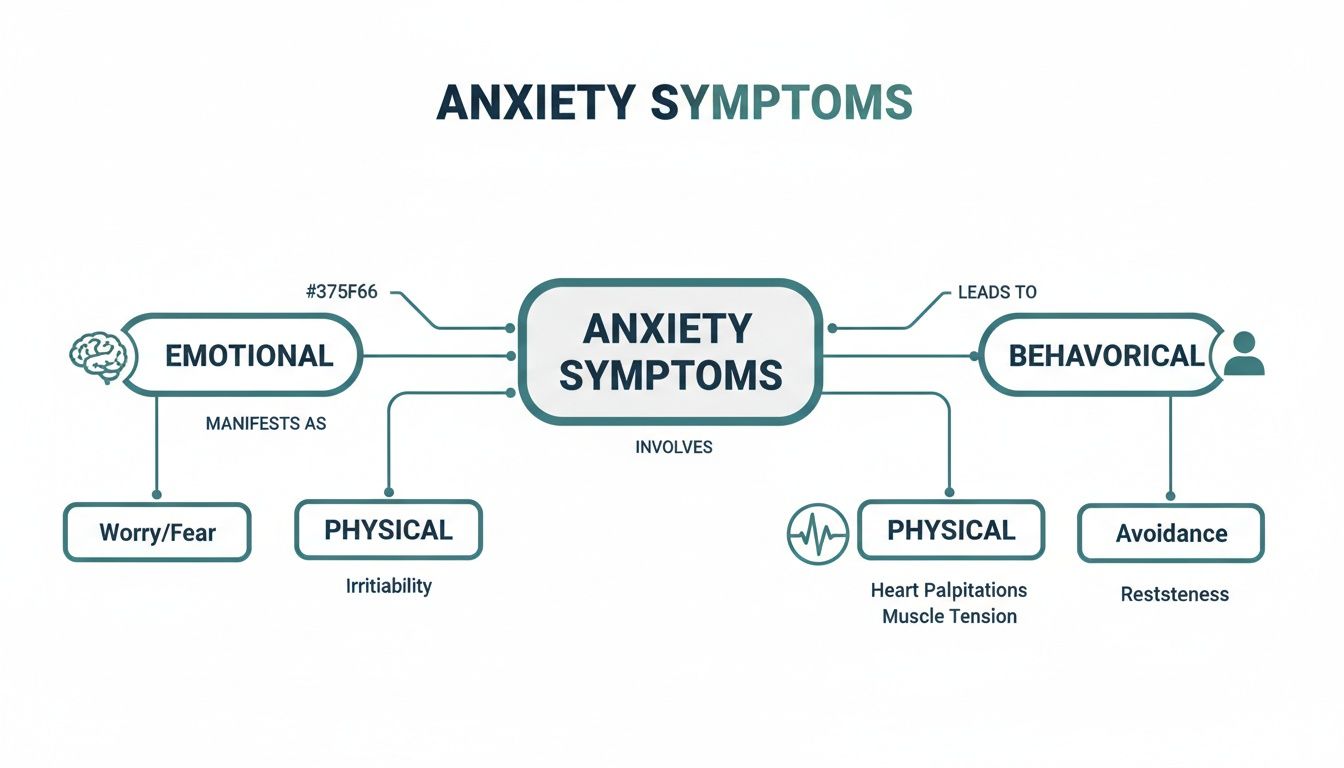
As you can see, the experience of anxiety isn't just in your head; it’s a full-body event that branches out into emotional, physical, and behavioural symptoms.
What is an anxiety attack?
An anxiety attack is a period of intense fear and worry that gradually builds over time. It doesn't just appear out of the blue; it’s almost always connected to a specific stressor that you can see coming. You might feel one creeping up for hours, or even days, before a big presentation, a doctor's appointment, or a confrontation you’ve been dreading.
The symptoms are real and can feel awful—a racing heart, tense muscles, a churning stomach, and an overwhelming sense of apprehension. The intensity, however, often rises and falls. It’s that simmering pot of water, threatening to boil over but not quite erupting with the explosive force of a panic attack.
It's important to know that "anxiety attack" isn't a formal clinical diagnosis found in the Diagnostic and Statistical Manual of Mental Disorders (DSM-5). Instead, it’s a common phrase people use to describe an episode of anxiety that feels much more severe than usual, but isn't as sudden or acute as a true panic attack.
Because these episodes build slowly, you often have a window of opportunity. You can recognise the signs and use coping techniques to turn down the heat before it becomes completely unmanageable. The duration can also vary widely, lasting for minutes, hours, or as long as the stressful situation persists.
What’s the difference between anxiety and a panic attack?
A panic attack is a completely different beast. It’s an abrupt, overwhelming tidal wave of terror that strikes without any warning. One moment you might be fine, and the next, you are engulfed by a feeling of intense fear that peaks within minutes, leaving you feeling utterly out of control.
While anxiety is usually tied to a specific worry, panic attacks can feel entirely random, sometimes even waking a person from their sleep.
The physical symptoms are so severe and terrifying that many people genuinely believe they are having a heart attack, suffocating, or dying. The experience itself is mercifully brief but brutal, typically subsiding after 10 to 20 minutes. The after-effects, however, can leave you feeling shaken, drained, and on edge for hours.
To make these distinctions clearer, let's look at a side-by-side comparison.
Anxiety Attack vs Panic Attack Key Differences
This table breaks down the core differences to help you identify what you or a loved one might be experiencing.
| Characteristic | Anxiety Attack | Panic Attack |
|---|---|---|
| Onset | Builds gradually over time in response to a stressor. | Sudden and abrupt, often without an obvious trigger. |
| Intensity | Varies from mild to severe, can wax and wane. | Overwhelmingly intense and severe, peaking within minutes. |
| Duration | Can last for an extended period (minutes to hours). | Brief, typically lasting less than 30 minutes. |
| Trigger | Usually linked to a specific worry or situation. | Can occur unexpectedly, with no clear cause. |
| Primary Feeling | Pervasive worry, dread, and apprehension. | Intense terror, a sense of impending doom, or fear of losing control. |
Getting to grips with these differences isn’t just an academic exercise. Knowing whether you’re dealing with a build-up of anxiety or a sudden panic attack empowers you to use the right strategies in the moment and seek the most effective long-term support for your needs.
Exploring The Causes And Risk Factors
Why do some people struggle with persistent anxiety, while others seem to weather life’s storms more easily? There’s rarely a simple answer. Figuring out the roots of an anxiety disorder isn’t about finding a single cause; it’s more about understanding how several different factors can overlap and interact.
This isn’t a case of assigning blame. Instead, it’s about appreciating the complex dance between our biology, our personal history, and our current environment. Recognising this complexity is the first real step toward finding a path to feeling better that actually works for you.
Your Genetic Blueprint
Your family history can certainly play a part. If a close relative—like a parent or sibling—has an anxiety disorder, your own risk does increase slightly. Think of it less like inheriting anxiety itself, and more like inheriting a more sensitive internal “alarm system.”
This absolutely does not mean you’re destined to have an anxiety disorder. It just suggests a genetic predisposition might be there, making you naturally more reactive to stress or quicker to enter that “fight or flight” state. It’s when this genetic foundation meets certain life experiences that an anxiety disorder often begins to take shape.
The Chemistry Of The Brain
Our brains run on a delicate balance of chemicals called neurotransmitters. These are the messengers that carry signals between brain cells, and they have a huge influence on our mood and emotions. When they’re out of sync, it can directly affect how we feel.
Three key players in the anxiety story are:
- Serotonin: Often known for its role in mood, serotonin also helps regulate sleep and appetite. When levels are low, it’s frequently linked to both anxiety and depression.
- Dopamine: This is all about reward and motivation. An imbalance here can drain your sense of pleasure and drive, which often fuels the avoidance that’s so common with anxiety.
- Gamma-Aminobutyric Acid (GABA): GABA is the brain’s brake pedal. It has a calming, inhibitory effect. Without enough of it, the brain can get stuck in an overexcited state, leading to feelings of anxiety and restlessness.
When these chemical signals are disrupted, the brain’s fear circuits—especially in an area called the amygdala—can become hyperactive. The brain starts to perceive threats that aren’t really there, keeping your body’s alarm system switched on.
Life Experiences And Environmental Stress
While your genes and brain chemistry set the stage, it’s often your life experiences that write the script. The world we navigate every day is a powerful force in shaping our mental health.
Think of your resilience as a bucket. Chronic stress, difficult life events, and ongoing adversity are like a steady drip of water filling it up. For some, a single traumatic event can make the bucket overflow in an instant. For others, it’s the constant, slow drip of daily pressures that eventually becomes too much to hold.
Some of the most common risk factors include:
- Trauma: Experiencing or even witnessing something deeply distressing (like abuse, an accident, or violence) can fundamentally rewire the brain’s response to fear.
- Chronic Stress: Juggling a high-pressure job, dealing with financial worries, or caring for a sick family member over a long period can exhaust your coping resources.
- Major Life Changes: Even positive changes—moving house, starting a new job, having a child—are major stressors that can sometimes act as a trigger.
- Childhood Environment: If you grew up feeling unsafe or in a home where others were constantly anxious, your brain may have learned early on that the world is a dangerous place.
In the UK, the impact of anxiety is huge. Historically, anxiety disorders have affected over 10 million adults. More recently, the NHS reported that 8.3% of the population met the criteria for mixed anxiety and depressive disorders, with rates peaking among young people aged 16-24. You can discover more data and insights on anxiety statistics at ADAA.org.
Your Path to Getting Professional Help
Taking that first step to get help for anxiety can feel like the hardest part. It’s a huge, courageous move, and it’s where your journey back to feeling like yourself truly begins. The great news is that anxiety is very treatable, and there are several evidence-based paths to getting better.
It can feel a little daunting trying to figure out your options at first. But getting to grips with the main approaches—therapy, medication, and supportive lifestyle changes—puts you back in the driver’s seat. A professional diagnosis is the key to creating a treatment plan that’s tailored specifically for you.
Therapy: The Foundation of Lasting Change
For most people, therapy is the cornerstone of effective anxiety treatment. It’s a completely confidential space where you can get to the bottom of your anxious thoughts and behaviours and, most importantly, learn practical skills to manage them. One of the most effective and well-researched therapies for anxiety is Cognitive Behavioural Therapy (CBT).
CBT is built on a simple yet powerful idea: our thoughts, feelings, and actions are all interlinked. When you learn how to spot and challenge negative or unhelpful thought patterns, you can change how you feel and, in turn, how you react.
Think of it this way. Your anxious brain might instantly jump to a worst-case scenario: “If I stumble over my words in this meeting, everyone will think I’m incompetent.” CBT helps you press pause on that thought, examine it, and reframe it into something more balanced and realistic: “Stumbling over a word or two is human. It doesn’t define my competence. I’ve prepared well, and I’ll do my best.” This simple act helps break the exhausting cycle of worry.
Other highly effective therapeutic approaches include:
- Acceptance and Commitment Therapy (ACT): This helps you accept difficult thoughts and feelings without letting them run the show, so you can commit to actions that truly matter to you.
- Mindfulness-Based Therapies: These teach you to ground yourself in the present moment and observe your thoughts without judgement, which loosens their grip on you.
- Exposure Therapy: A gentle, gradual process of facing feared situations in a safe environment. It’s particularly powerful for phobias and social anxiety, as it teaches your brain that you can handle it.
The Role of Medication in Treatment
For some, medication can be an incredibly helpful tool for managing anxiety symptoms, especially when they’re so severe that they get in the way of daily life or even therapy itself. It isn’t a magic wand, but it can create the stability you need for the deeper work of therapy to take hold.
It’s crucial to understand that medication for anxiety should only be prescribed and managed by a qualified medical professional, such as your GP or a psychiatrist. They can assess your specific symptoms, medical history, and needs to determine if medication is a suitable option for you.
Antidepressants, specifically a class known as Selective Serotonin Reuptake Inhibitors (SSRIs), are often the first choice for treatment. They work by helping to balance brain chemistry, particularly the neurotransmitter serotonin, which can dial down the intensity of fear and constant worry.
It’s important to know that finding the right medication and the right dose can sometimes take a bit of trial and error. It should always be part of a comprehensive plan that includes therapy and other support.
Lifestyle Strategies That Support Recovery
While professional treatment is vital, never underestimate the power you have to support your own recovery through daily habits. These aren’t a replacement for clinical treatment, but they work hand-in-hand with it to build your resilience from the ground up.
- Regular Physical Activity: Exercise is one of nature’s best anti-anxiety tools. It helps burn off stress hormones like cortisol while releasing mood-boosting endorphins.
- Mindfulness and Meditation: Practising mindfulness pulls you out of worrying about the future and anchors you in the here and now. Even just 5-10 minutes a day can make a world of difference.
- Prioritising Sleep: Anxiety and poor sleep often go hand-in-hand, creating a vicious cycle. A calming, consistent bedtime routine can help regulate your sleep and, in turn, lower your anxiety.
The need for this kind of support is more apparent than ever. In the UK, we’ve seen a sharp rise in anxiety among young people post-pandemic, with recent data showing that a staggering 1 in 4 (25.6%) of those aged 18-24 now screen positive for severe anxiety. This underscores how vital it is to equip people with a full toolkit for coping – therapy can provide long term skills and tools to help young people navigate their adult lives.
How Haven Medical Can Help You Find Your Way Forward
Learning about anxiety, what it feels like, and how it differs from a panic attack is an important start. But figuring out what to do next—and actually reaching out for help—can feel like the hardest part. At Haven Medical, we work to make getting support for your mental health a clear, reassuring, and positive experience.
You are not on your own in this. We have a team of consultants ready to create a personalised plan that helps you understand what’s happening and find the right strategies to feel more like yourself again. Think of us as your partners in health, here to provide expert care in a genuinely supportive setting.
Your First Step: A Private GP Consultation
For most people, the process begins with a private GP consultation. This first appointment is simply a quiet, confidential chat about your symptoms, your worries, and the ways anxiety might be impacting your day-to-day life.
Our GPs are here to listen. They’ll conduct a thorough initial assessment and, crucially, rule out any physical health problems that could be causing or worsening your symptoms. This conversation lays the groundwork for a care plan that’s built specifically around you, allowing us to guide you toward the specialist support that will help most.
At Haven Medical, our consultant-led model means you see the right expert at the right time. We connect you directly with specialists in psychology and psychiatry to provide a precise diagnosis and a targeted, evidence-based treatment plan.
Specialised Psychology and Psychiatry Services
After your GP assessment, we can arrange a smooth referral to our team of expert psychologists and psychiatrists. These specialists conduct in-depth diagnostic assessments for anxiety disorders and any related conditions, such as ADHD, that can sometimes go hand-in-hand with anxiety.
Our team is experienced in a range of proven therapeutic techniques, with a particular focus on Cognitive Behavioural Therapy (CBT). When medication is considered a helpful option, our consultant psychiatrists can also provide expert management, prescribing and monitoring your treatment with care.
Choosing this integrated approach gives you several clear advantages:
- Prompt Appointments: We make it a priority to see you quickly, helping you avoid the long waiting lists that can often make stress and anxiety worse.
- Personalised Plans: We don’t do one-size-fits-all. Your treatment strategy is designed around your specific symptoms, background, and personal goals.
- Expert Diagnosis: Our specialists bring clarity. They can provide a definitive diagnosis, including assessments for conditions like ADHD that may be influencing your anxiety.
- Collaborative Care: Our GPs, psychologists, and psychiatrists all work in concert, ensuring your care is joined-up and comprehensive from start to finish.
Take Control of Your Wellbeing Today
Living with anxiety can make you feel trapped, but the right support can open up your world again. Whether you’re just starting to ask questions about your mental health or you’re seeking a more effective treatment approach, our team is ready to help.
Ready to take the next step? You can call to book a private GP consultation, click to book an appointment online, or visit website to learn more about our mental wellness services. Let us help you find your path to feeling better.
Frequently Asked Questions About Anxiety
It’s natural to have questions when you’re trying to get to grips with anxiety. Below, we’ve answered some of the most common ones we hear, offering clear explanations to help you understand what you or a loved one might be going through.
How do I know if I have anxiety?
This is often the very first question people ask. The real difference between everyday worry and a potential anxiety disorder comes down to two things: impact and persistence.
Everyone gets stressed or worried from time to time. But if those feelings of dread, fear, or unease are sticking around, feel too big to handle, and are getting in the way of your life—affecting your work, your relationships, or even just your ability to relax—it’s a sign that something more is going on. The only way to know for sure is to chat with a healthcare professional, like your GP, who can help you figure it out.
Can anxiety cause physical symptoms?
Yes, absolutely. The mind and body are deeply connected. When your brain senses danger (whether real or perceived), it hits the “fight or flight” alarm, releasing stress hormones like adrenaline. This isn’t just a feeling; it’s a powerful physiological event that can cause very real, and sometimes frightening, physical symptoms.
Many people are surprised to learn that these sensations are tied to anxiety:
- A racing or pounding heart (palpitations)
- Feeling breathless or like your chest is tight
- Dizziness and light-headedness
- Stomach problems, from nausea to symptoms of irritable bowel syndrome (IBS)
- Tense muscles, shaking, or trembling
- Headaches and other unexplained aches and pains
Recognising that these physical feelings are a direct result of anxiety—and not a sign of a different medical emergency—is a huge step towards regaining control.
While self-help strategies are valuable for managing mild symptoms, moderate to severe anxiety often requires professional support. Seeking help from a therapist or GP is a sign of strength that significantly increases your chances of long-term recovery and building resilience.
What is an anxiety attack?
You’ve probably heard the term “anxiety attack” used to describe a moment when anxiety becomes incredibly intense and overwhelming. Unlike a panic attack, this isn’t something that comes out of the blue. It tends to build up slowly, often over hours or even days, usually tied to a specific stressor you can identify—like a looming deadline, a big presentation, or a difficult family situation.
During an anxiety attack, you’ll likely feel extremely distressed and worried, and you’ll experience some of the physical symptoms we talked about. However, it generally lacks the sudden, sheer terror and sense of impending doom that defines a panic attack.
What’s the difference between an anxiety attack and a panic attack?
The simplest way to tell them apart is to look at the onset, intensity, and duration.
- Anxiety is often a slow burn. It can creep up in response to a perceived threat and simmer for a long time, filling your days with worry and apprehension.
- A panic attack is more like a sudden explosion. It strikes unexpectedly, peaks within minutes, and brings an overwhelming wave of terror and intense physical symptoms. People often feel they are losing control, having a heart attack, or even dying.
Here’s a helpful analogy: general anxiety is the long, dark build-up of a storm on the horizon. An anxiety attack is when the storm finally arrives, with heavy rain and wind. A panic attack, on the other hand, is the sudden, terrifying crack of lightning and thunder directly overhead. They’re all related to the same storm, but they are very different experiences.