


You might be reading this after a flutter in your chest, a smartwatch alert, a spell of dizziness, or a conversation with a relative that left you thinking more seriously about family history. Often, the hardest part isn’t the test itself. It’s the waiting, the uncertainty, and not knowing whether what you felt matters.
A private ECG can help when you want a clearer answer sooner. But speed isn’t the whole story. Its true value is getting a proper recording, having it interpreted well, and knowing what happens next if something isn’t quite right. That’s where many people need more guidance than a booking page usually gives.
Understanding the Need for a Private ECG
A common situation in general practice goes like this. Someone has a few episodes of palpitations, feels anxious, cuts down on caffeine, and hopes it settles. A week later it happens again. They’re not collapsed. They’re not in immediate danger. But they’re not comfortable ignoring it either.
That middle ground is exactly where many people look for an ECG private appointment.
For some, the concern is symptoms. For others, it’s context. A parent has had heart disease. You’re starting a new training plan. Your employer or school wants a cardiac check as part of a wider health process. Or you want a baseline because “probably fine” doesn’t feel reassuring enough.
Why people choose private access
Private care doesn’t replace emergency care, and it doesn’t compete with the NHS in any simplistic way. It gives you another route when your priority is timely assessment, flexibility, and a more direct path from concern to review.
People usually want three things:
- Reassurance with substance: Not vague reassurance, but a proper test and a clear explanation.
- A simpler route in: Many private services let you arrange assessment directly, rather than waiting for several stages of triage.
- Clarity about next steps: If the tracing shows something unexpected, you want to know what that means in real terms.
A good ECG service doesn’t just record the heart. It helps the patient understand what the recording means for their life, symptoms, and next decision.
There’s also an emotional side to this that matters. Waiting can amplify worry. Some patients sleep badly, stop exercising, or become hyper-aware of every heartbeat. When that’s happening, an organised assessment can reduce uncertainty, even if the result turns out to be normal.
When a private ECG makes sense
A private ECG is often reasonable if you have:
- Palpitations or fluttering: Especially if they’re recurring or unsettling.
- Chest symptoms that need checking: Mild or intermittent symptoms still deserve proper review. Severe or urgent symptoms need emergency care.
- Family history concerns: If close relatives have had cardiac problems, many people prefer a more proactive approach.
- Screening needs: This comes up for sport, employment, schools, and personal health checks.
The key point is simple. If you’re worried enough to keep thinking about it, it’s worth getting a proper answer.
What Is a Private ECG Service
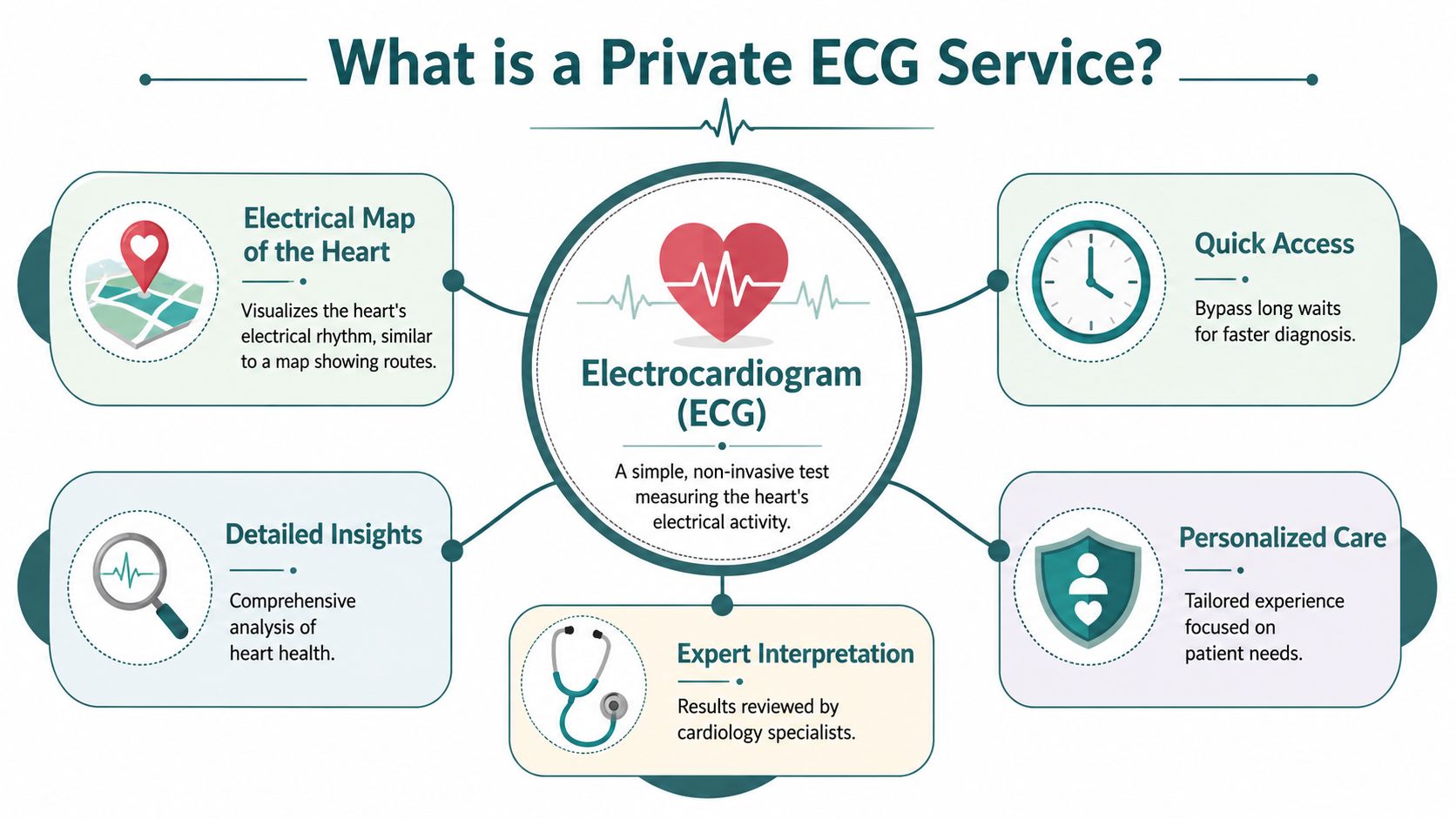
An ECG, or electrocardiogram, is a recording of the heart’s electrical activity. I often describe it as an electrical map of the heart. It doesn’t show thoughts or feelings, and it doesn’t read stress directly. It records the signals that coordinate each heartbeat.
That matters because many heart problems leave electrical clues. Some affect rhythm. Others affect conduction, recovery patterns, or signs that need further assessment in the right clinical context.
What “private” means in practice
A private ECG service usually means you can arrange the test directly, choose a suitable appointment, and receive a report through a clinic outside the standard NHS route. That doesn’t make it a lesser test. It instead changes access and workflow.
In practical terms, private access often suits:
- People with symptoms who want assessment without a long chain of appointments
- Those seeking a baseline check because of family history, training, or peace of mind
- Schools and businesses arranging structured screening for groups
- Patients who value appointment flexibility around work, childcare, or travel
What a private ECG can and can’t do
It’s common for people to get confused. An ECG is useful, but it isn’t magic. It can detect important abnormalities, support decision-making, and help a clinician decide whether more testing is needed. But a normal ECG doesn’t automatically rule out every heart problem.
That’s why a responsible service doesn’t present the test as a standalone “all clear” machine. It should fit into an actual clinical pathway.
Here’s how it works:
| What an ECG can do | What it may not do on its own |
|---|---|
| Record heart rhythm at the time of testing | Capture symptoms that only happen intermittently |
| Show conduction or repolarisation changes | Explain every cause of chest discomfort |
| Support referral or follow-up decisions | Replace clinical judgement |
| Feature | Private Pathway (Haven Medical) | Typical NHS Pathway |
|---|---|---|
| Access route | Often direct booking | Often starts through NHS triage or GP process |
| Appointment flexibility | Usually more choice around time and date | Depends on local service capacity |
| Speed of arranging the test | Often faster | Varies by area and clinical priority |
| Continuity of communication | Often more direct with the clinic | Can involve several stages and services |
| Suitable for proactive screening | Commonly available | Usually guided by NHS clinical criteria |
| Cost to patient | Self-funded or insurer-dependent | Usually NHS funded where clinically indicated |
Is private care a shortcut
It shouldn't be a shortcut in the bad sense. It should be a different access model with proper clinical standards.
Clinically credible ECG services use devices with high performance standards. Literature notes that clinical ECG devices generally recommend a sampling frequency of at least 500 samples/second, and diagnostic ECG standards also emphasise factors such as electromagnetic compatibility, signal storage, and transmission characteristics, as reviewed in this diagnostic ECG performance paper.
For patients, the practical meaning is straightforward:
- Better signal quality: Subtle waveform features are easier to capture.
- Fewer misleading artefacts: Good equipment is less vulnerable to environmental interference.
- More confidence in the trace: The recording is suitable for clinical review, not just casual screening.
When each route may suit you
The NHS pathway often suits patients who are happy to follow standard referral routes and whose situation fits routine timelines. Private access often suits those who want more control over scheduling or who are prepared to self-fund for quicker assessment.
Speed matters, but standards matter more. A quick appointment only helps if the recording quality and interpretation are good enough to support real decisions.
That's the balance to look for. Not merely faster. Faster with proper clinical substance.
Understanding Your Private ECG Results
The moment most patients really care about isn't the electrodes going on. It's the report. “What did it show?” quickly becomes, “Should I be worried?” and “What happens now?”
Those are fair questions. An ECG tracing is a technical document. On its own, it can be intimidating. The value of a private service is turning that tracing into something understandable and actionable.

Normal doesn't always mean “nothing to discuss”
A normal ECG is often reassuring, and that reassurance matters. But interpretation still depends on why the test was done. If symptoms are intermittent, for example, a normal resting ECG may be only one piece of the puzzle.
That's why a proper review includes context:
- what symptoms you had
- when they happened
- whether they're ongoing
- whether other tests or follow-up are sensible
Abnormal doesn't always mean disaster
This is the point many readers need to hear clearly. An abnormal ECG result is not automatically a diagnosis of a major cardiac event. Sometimes it reflects a benign variation. Sometimes it points to something that needs more assessment. Sometimes it means a specialist should look more closely.
ECG findings can carry real prognostic meaning. A large peer-reviewed study found that certain repolarisation abnormalities were associated with a higher future heart failure risk, with hazard ratios ranging from 1.48 to 3.37 depending on the ECG pattern, as reported in this peer-reviewed heart failure risk study.
The practical takeaway isn't that every abnormality predicts a bad outcome. It's that ECGs shouldn't be reduced to a simplistic pass-or-fail label.
If an ECG is abnormal, the next question isn't “How bad is it?” It's “What does this finding mean in my case, and what should we do next?”
What good follow-up looks like
Patients usually need more than a PDF full of technical terms. They need someone to translate the result into plain language.
A thoughtful follow-up process often includes:
- A clear report with the main findings described plainly
- Interpretation in context, especially if symptoms prompted the test
- Advice on next steps, which might include reassurance, GP follow-up, cardiology review, or additional testing
That “what happens after an abnormal result” piece is often the most overlooked part of the whole service. Yet it's the part that determines whether the ECG proves useful.
Questions worth asking when you receive the result
If you're reviewing a private ECG report, ask:
- Is this definitely normal, or just not showing anything urgent?
- Do my symptoms still need follow-up even if the ECG is reassuring?
- Does this finding need repeat ECGs, monitoring, or specialist review?
- Should this result be shared with my GP?
Those questions move the conversation from raw data to clinical care. That's where patients feel less lost.
Workplace and School Cardiac Screening Programmes
Private ECG services aren't only for individual appointments. Schools, employers, and sports organisations often need a structured way to support cardiac screening as part of their wider duty of care.
In those settings, the discussion is slightly different. The issue isn't only one person's symptoms. It's how to provide an organised, clinically sensible process for a group, without making the experience feel impersonal.
Why organisations consider screening
For schools and businesses, screening can support:
- Duty of care: Especially where physical activity, sport, or demanding roles are involved
- Access to early assessment: Some participants or staff may not otherwise seek help promptly
- Health culture: Offering screening can encourage people to take symptoms seriously
The strongest programmes are clear about scope. An ECG can be part of a responsible screening pathway, but it shouldn't be presented as a blanket guarantee that every future cardiac issue will be prevented.
What organisations should ask providers
Before arranging a programme, decision-makers should ask practical questions such as:
- Is the service based on proper 12-lead acquisition where appropriate?
- Who interprets the recordings?
- How are abnormal results escalated?
- How are participants informed and supported afterward?
For schools, this is particularly important when young athletes are involved. For employers, it matters in wellness programmes and executive health settings where people expect both clinical quality and confidentiality.
A well-run programme should feel medically organised, not like a box-ticking exercise.
Your Private ECG Questions Answered
Is a private ECG painful or risky
No. A standard ECG is painless and non-invasive. The electrodes sit on the skin and record electrical activity. They don't put electricity into the body.
Some people feel self-conscious about the setup, especially if they're already anxious, but the test itself is straightforward and usually over quickly.
How much does a private ECG cost
Costs vary by provider, location, whether interpretation is included, and whether the ECG sits inside a wider consultation. The most sensible approach is to call to book or visit website for the current fee structure and to check what the service includes after the trace is taken.
Price alone isn't the only question. Ask what kind of report you'll receive and what support is available if the result is not clearly normal.
Is my ECG data private
This is one of the most important questions, and it deserves a serious answer. ECG data shouldn't be treated as harmless anonymous paperwork. Research summarised by Help Net Security reported that in a 2025 re-identification study using 109 participants across several public datasets, researchers correctly matched ECG signals to individuals 85% of the time, showing that “de-identified” heart traces can still behave like biometric data, as outlined in this ECG privacy risk summary.
That means you should expect strict handling of your ECG record.
Ask providers:
- Who can access my ECG?
- How long is it retained?
- Will it be shared with insurers, apps, employers, or schools?
- How is de-identified data managed, if used at all?
A trustworthy provider treats ECG records as sensitive health data, not as a casual digital file. That's especially important in workplace and school settings, where privacy concerns can be just as important as clinical ones.
If you're considering an ECG private appointment and want a clearer route from symptoms to answers, the next step is simple. Call to book, click to book, or visit website to check availability and decide whether a private ECG is the right fit for you.