




If you’re reading this, there’s a fair chance you’ve been feeling off for a while. Not dramatically unwell. Just not right. You wake tired, lose your train of thought mid-sentence, rely on caffeine to get through the afternoon, and keep wondering whether stress, poor sleep, hormones, diet, or something else is catching up with you.
That uncertainty is often the hardest part. Vague symptoms can be real and still be difficult to pin down. A full vitamin and mineral blood test in the UK can sometimes help turn that foggy picture into something more usable, especially when the question isn’t “Am I ill?” but “Why don’t I feel like myself?”
Feeling Tired and Unsure Why? You Are Not Alone
A very common story in clinic goes like this. Someone says they’ve been tired for months, their concentration is poor, their hair feels thinner, and they’ve started to assume it’s just modern life. They may already be trying to eat better, sleep earlier, and combat energy crashes naturally with sensible food choices, but the improvement is partial at best.
That doesn’t mean the problem is trivial. It means symptoms like fatigue and brain fog are broad. They can overlap with low iron stores, low B12, low folate, low vitamin D, poor sleep, stress, thyroid issues, medication effects, or several of those at once.

Why more people are investigating nutrient status
Blood testing for potential deficiency is now a routine part of how many people in the UK look for answers. A large UK primary care study found that the rate of vitamin D testing increased by more than 50-fold between 2005 and 2015 (UK primary-care vitamin D testing study).
That doesn’t mean everyone needs broad testing. It does show how often clinicians and patients now use blood tests to investigate persistent, non-specific symptoms.
Many people don’t need a dramatic diagnosis. They need a clearer starting point.
What a test can and can’t do
A full nutrient panel isn’t a shortcut to perfect health. It won’t explain every symptom, and it shouldn’t replace a proper clinical assessment. But it can help answer useful questions.
For example, is tiredness likely to be nutritional, partly nutritional, or probably unrelated to vitamins and minerals? Is there one obvious deficiency, or a pattern of borderline issues that makes sense in the context of your symptoms, diet, and health history?
That’s where this kind of testing has value. Not as a wellness gimmick, but as a practical way to reduce guesswork.
What a Full Nutrient Blood Test Actually Measures
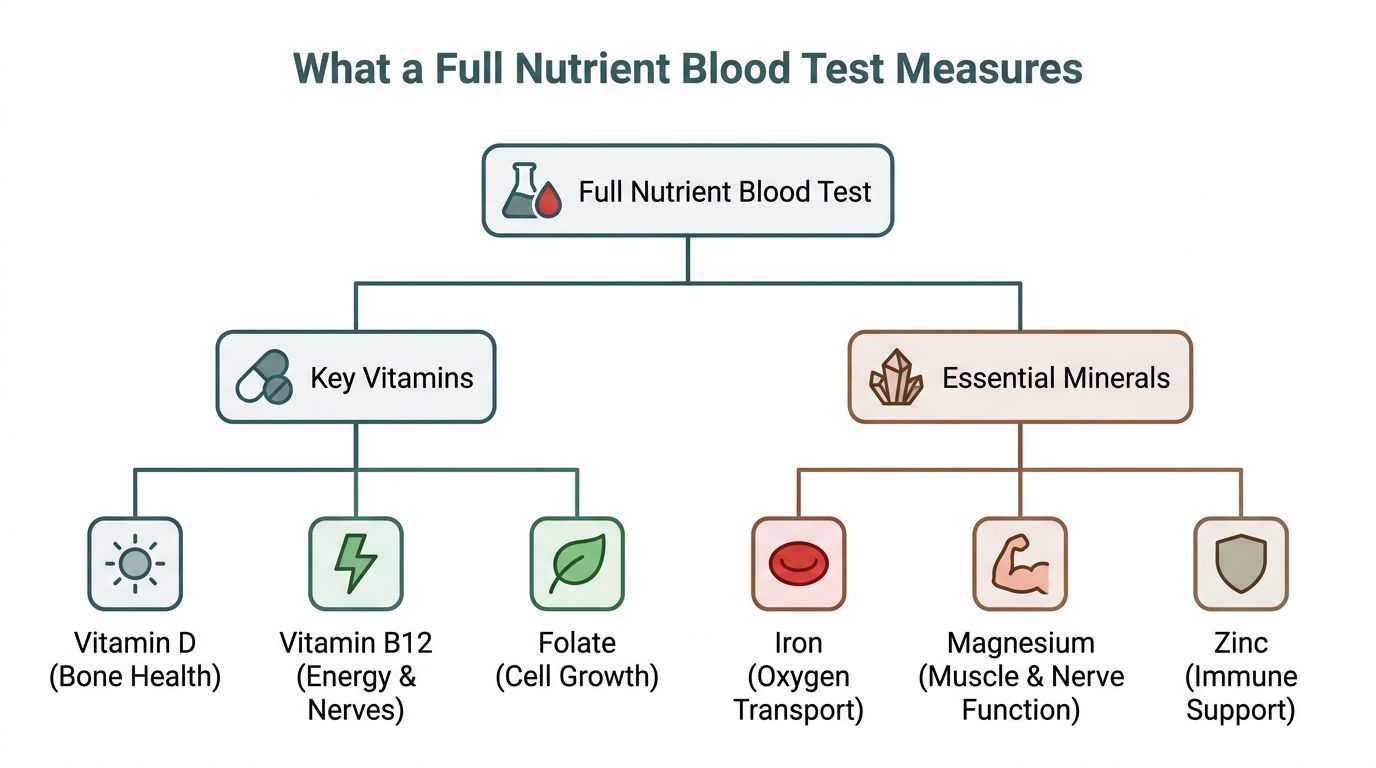
The phrase full vitamin and mineral blood test UK sounds as if there’s one universal panel that checks everything. In practice, that’s not how it works. A “full” test is usually a composite panel made up of several separate markers chosen to answer different clinical questions.
The simplest way to think about it is a car dashboard. If the warning light comes on, you don’t inspect only one part and assume you’ve solved it. You look at fuel, oil, battery, temperature, and diagnostics together. Nutrient testing works in a similar way. One symptom can have several nutritional explanations.
The markers commonly included
In UK practice, nutrition panels often group together the markers most likely to help with everyday symptoms and common deficiency patterns. As noted by Vitall’s overview of vitamins and minerals testing, panels commonly include iron, B12, folate, calcium, magnesium, and vitamin D because fatigue and related symptoms can stem from more than one deficiency.
A broad panel may include:
- Vitamin D. Often checked when someone has fatigue, low mood, musculoskeletal aches, or clear risk factors for deficiency.
- Vitamin B12. Relevant for tiredness, poor concentration, mouth changes, dietary restriction, and nerve-related symptoms.
- Folate. Often interpreted alongside B12 rather than in isolation.
- Ferritin and iron-related markers. These help assess iron stores and iron handling, which matters when hair loss, fatigue, breathlessness, or heavy periods are part of the story.
- Magnesium and calcium. Sometimes useful when muscle symptoms, diet issues, or absorption concerns are present.
- Zinc, selenium, albumin, or related markers. These may be added in broader private panels, depending on the clinical question.
If you’re also trying to understand the wider nutritional context, this overview of vitamin D and C benefits is a useful general read, though blood testing should still be specific to symptoms rather than built around supplement trends.
Why single-marker testing often misses the point
A common mistake is assuming one test equals one answer. It doesn’t. Ferritin can be useful, but on its own it may not tell the full story. B12 can matter, but interpreting it without the wider clinical context can be misleading. Calcium can be normal while other relevant markers are not.
Clinical reality: a symptom like fatigue isn’t specific enough to justify guesswork. It usually needs pattern recognition across several results.
That is why private clinics often offer a panel rather than a single “vitamin test”. The panel isn’t better because it’s bigger. It’s better only when the added markers answer a real question.
What a blood test doesn’t measure well
This part is often glossed over in consumer marketing. A blood test does not provide a flawless map of total nutritional status. Some nutrients are difficult to assess meaningfully in blood, and some tests are only worth doing when there’s a specific reason.
So when you see “full” on a website, read it as “broader snapshot”, not “complete nutritional truth”. The most useful panel is usually the one that is broad enough to be informative, but focused enough to stay clinically relevant.
Key Signs You Might Need a Vitamin and Mineral Test
People often wait until symptoms are severe before seeking help. That’s understandable, but not always helpful. Nutrient testing is most useful when there is a recognisable pattern, not just a crisis.
A UK-focused review reported that about 20% of the population has vitamin D deficiency and roughly 60% has insufficient vitamin D levels, while a consumer survey cited by LloydsPharmacy found that 50% of 500 surveyed UK adults felt they weren’t getting the vitamins and minerals their bodies require (UK vitamin and mineral deficiency statistics overview). That doesn’t mean everyone needs testing. It does show why this isn’t a niche concern.
Symptoms that justify a closer look
Some symptoms come up repeatedly in practice when testing is worth considering:
- Persistent fatigue that doesn’t improve with rest or better sleep habits
- Brain fog or poor concentration
- Hair shedding or brittle nails
- Low mood or feeling flat
- Frequent minor illnesses
- Muscle aches, cramps, or general weakness
None of these symptoms proves a deficiency. What matters is persistence, pattern, and context.
Risk factors matter as much as symptoms
Sometimes the stronger reason to test isn’t how you feel today, but what increases your risk of deficiency over time.
Consider testing if you have any of the following:
- Restrictive or exclusion diets such as vegan, vegetarian, or very limited eating patterns
- Heavy periods, especially if tiredness or hair loss is also present
- Digestive conditions or ongoing gut symptoms that may affect intake or absorption
- Pregnancy or menopause, where symptoms overlap with common deficiency patterns
- Long-term medication use, particularly if it may affect stomach acid, absorption, or appetite
A good reason to test is simple: your symptoms have lasted long enough, or your risk factors are clear enough, that guessing is no longer helping.
When not to default to a broad panel
If you feel well, have no clear risk factors, and are mainly looking for reassurance, broad testing may not give you much that changes your care. In that situation, targeted advice on diet, routine supplementation where appropriate, and watchful review may be more sensible than ordering a large panel.
NHS vs Private Testing Options in the UK
This is usually the practical fork in the road. Do you start with your GP, or do you arrange private testing?
Both routes can be appropriate. The right option depends on urgency, complexity, budget, and whether you need a narrow investigation or a wider nutritional review.
How the NHS route usually works
In the NHS, testing is generally driven by symptoms, signs, and risk factors, not by general screening. That’s clinically sensible. If your story strongly points towards one issue, your GP may begin with a focused set of tests rather than a broad nutrition panel.
The strengths of the NHS route are obvious. Your GP has access to your medical record, can rule out non-nutritional causes, and can decide when a symptom needs a wider medical work-up rather than a nutrient screen.
The limitations are also real. Appointments can be short. Testing may be more targeted than some patients expect. If your symptoms are broad but not urgent, it can take time to work through one line of investigation and then another.
How private testing differs
Private care tends to offer faster access, more choice over the breadth of testing, and more flexibility around appointments. That can help if you’ve already tried the NHS route and still feel your symptoms haven’t been fully unpacked, or if you want a more detailed discussion before choosing which markers to run.
The useful version of private care isn’t merely “more tests”. It’s better alignment between symptoms, bloods, and interpretation. A consultation first is often what prevents wasted testing.
One example is Haven Medical, which offers vitamin and mineral deficiency blood testing including markers such as vitamin D, vitamin B12, folic acid, magnesium, iron, ferritin, calcium, albumin, transferrin, transferrin saturation, and total iron binding capacity, with in-clinic and home test options through its service information on the Haven Medical website. That sort of model is often most useful when a clinician helps decide whether a broad panel, a narrower panel, or a different investigation is the smarter first step.
NHS vs Private Vitamin and Mineral Testing at a Glance
| Feature | NHS Pathway | Private Pathway (e.g. Haven Medical) |
|---|---|---|
| How access starts | Usually through a GP appointment | Often self-referral or direct booking |
| Reason for testing | Symptom-led and targeted | Can be targeted or broader, depending on consultation |
| Speed of access | Variable | Usually more flexible |
| Range of markers | Often focused on what is clinically indicated first | Wider choice of panels and add-on markers |
| Interpretation | Tied to routine GP review | Often paired with dedicated results discussion |
| Best for | Clear medical concerns, ongoing NHS management | Faster access, broader review, personalised discussion |
| Potential downside | May feel limited if symptoms are non-specific | Easy to over-test if no clinician guides selection |
Which option makes sense for you
Choose the NHS route if your symptoms are new, significant, or could reflect a wider medical issue that needs standard medical investigation first.
Choose private testing if you want quicker access, more control over panel choice, or a fuller conversation about mixed symptoms such as fatigue, hair loss, heavy periods, diet restriction, menopause, or digestive concerns.
Private testing works well when it adds clinical clarity. It works badly when it becomes a shopping list of markers with no plan for what happens next.
How to Book Your Test and Prepare for the Appointment
Once you've decided to arrange a private assessment, the process is usually straightforward. The key is not to start with the blood draw. Start with the question you need answered.
The most useful first step is a short clinical discussion about symptoms, diet, medical history, medication, supplements, and any previous blood results. UK guidance generally supports testing when symptoms or risk factors are present, and LloydsPharmacy Online Doctor's advice on blood tests for vitamin deficiencies reflects that targeted approach.
A sensible booking sequence
A practical pathway looks like this:
- Book an initial consultation. This can help decide whether you need a broad nutrient panel, a smaller panel, or a different investigation altogether.
- Confirm the test scope. Ask exactly which markers are included. "Full" means different things in different clinics.
- Check preparation instructions. Some clinics may ask you to attend at a certain time of day or to follow specific guidance beforehand.
- Attend for the blood draw. Typically, this is a routine venous sample from the arm.
- Arrange follow-up before you leave. Results are most useful when review is already planned.
How to prepare properly
Preparation doesn't need to be complicated, but details matter.
- Bring a medication and supplement list. This helps the clinician judge whether a result may be influenced by what you're already taking.
- Don't guess about fasting. Some panels may require it, others won't. Follow the clinic's own instructions rather than online general advice.
- Stay hydrated unless told otherwise. It often makes the blood draw easier.
- Write down your symptoms. Include how long they've been present and what you've already tried.
The part many people skip
People often focus on booking the blood test and forget to book the interpretation. That is backwards.
If you're ready to proceed, call to book an appointment with a clinician who can decide which markers are worth testing. If you'd rather review options first, visit website pages that list the markers included and whether the service offers in-clinic or home sampling. If you prefer a quick next step, click to book once you've confirmed the consultation includes results review, not just a laboratory report.
Interpreting Your Results and Creating an Action Plan
A lab report can look reassuring and still leave you confused. You may see several markers within reference range, one borderline result, and no obvious answer to the symptom that brought you in. In this context, interpretation matters most.
A "normal" result on paper does not always mean "nothing relevant is going on". It may mean the result is not clearly abnormal by laboratory standards. That isn't the same as saying it is meaningful, optimal, or unrelated to your symptoms.

Why self-diagnosis goes wrong
Many people receive a report, see a low-normal marker, then order several supplements online and hope for the best. That approach can be ineffective and occasionally unhelpful.
Clinical guidance is more cautious than many consumer websites. As noted in Boots' MyHealthChecked vitamins and minerals profile information, broad panels can provide a useful snapshot, but many nutrients aren't easily measured in blood, and national guidance tends to favour targeted testing. That means a result only becomes actionable when someone interprets it in context.
What a clinician looks for
A good review doesn't just ask whether each marker is inside range. It asks:
- Does this result fit the symptom pattern
- Do several borderline results tell a combined story
- Could medication, diet, inflammation, or supplementation be affecting interpretation
- Is treatment appropriate, or is further investigation needed
Sometimes the answer is simple. Increase dietary intake, use a targeted supplement, and repeat selected tests later if clinically appropriate. Sometimes the answer is not nutritional at all, and the test is useful because it helps rule out one avenue and redirect attention.
Practical rule: never start high-dose supplements simply because a result is flagged without discussing dose, duration, and whether the marker actually explains your symptoms.
Building an action plan that works
The best plans are specific and restrained.
You may need:
- Dietary changes if the issue is likely intake-related
- Targeted supplementation rather than a broad "everything" product
- Further GP or specialist review if the bloods don't explain the symptoms
- Selective repeat testing only when it would change management
The report is not the finish line. It's the point where a clearer plan should begin.
Frequently Asked Questions About Nutrient Testing
Should I stop taking supplements before the test
Don't make that decision on your own. Ask the clinic when you book. Some supplements can affect results, but the right instruction depends on what you're testing and why.
How often should I repeat a vitamin and mineral blood test
There isn't one schedule that suits everyone. Re-testing only makes sense if the original result was relevant, treatment was started, or symptoms changed in a way that makes another check useful. Repeating tests too often can create noise rather than clarity.
Is the blood draw painful
It is generally described as brief and tolerable. A standard venous sample is usually quicker and more reliable than people expect. If you're nervous around needles, tell the nurse or phlebotomist before the appointment.
Are home kits as good as a clinic blood draw
They can be convenient, but they aren't automatically the better option. The important question is whether the sample method is suitable for the markers you need and whether a clinician is reviewing the results with you.
What if my results are normal but I still feel unwell
That matters. Normal blood results do not mean your symptoms are imaginary. They mean this particular test may not have identified the cause. At that point, the next step is proper clinical review, not random supplementation.
If persistent fatigue, brain fog, hair loss, or diet-related concerns have been lingering in the background, a carefully chosen full vitamin and mineral blood test in the UK can be a sensible next step. The key is choosing a pathway that includes interpretation and a plan, not just numbers on a screen.