



You may be reading this after another missed deadline, another argument that began with “you never listen”, or another evening spent staring at a simple task that somehow turned into six half-finished ones. Many adults and families reach the point of looking into a private adhd diagnosis uk route not because they want something “extra”, but because they want clarity.
That need is understandable. ADHD can affect focus, planning, memory, emotional regulation, organisation, and follow-through. It can also be misunderstood for years, especially in adults who learned to mask, overcompensate, or blame themselves.
A careful diagnosis can bring more than a label. It can explain patterns that never made sense before, guide treatment, and help schools, employers, and GPs understand what support is needed. The difficult part is knowing where to start, and how to make sure a private assessment is valid.
Why a Formal ADHD Diagnosis Matters
You may already know the feeling. A bright teenager keeps being told they have “so much potential” but cannot hand work in on time. An adult holds down a job yet misses bills, loses keys, forgets meetings, and ends each day wondering why ordinary tasks take so much effort. After a while, families stop asking, “What is going on?” and start asking, “Do we need a proper assessment?”
For many people, the answer is yes.
A formal ADHD diagnosis does more than put a name to a pattern. It gives you a clinically grounded explanation that can be used in real-world settings. That matters if you later need your GP to consider medication, your school or university to arrange support, or your employer to understand what adjustments may help. It also matters because not every private clinician is qualified to produce a diagnosis that will be accepted for those next steps.

ADHD is more than hyperactivity
In adults, ADHD often shows up in quieter, less recognised ways. It may look like chronic lateness, mental clutter, difficulty prioritising, impulsive spending, emotional overwhelm, or only being able to start work when the pressure becomes intense.
Many people first recognise themselves in everyday descriptions rather than in a clinic. This guide to signs, challenges, and support for adults with ADHD can help you compare your experience with common adult ADHD patterns. That kind of self-recognition is useful, but it is still only a starting point.
A diagnosis separates personal suspicion from clinical judgement. ADHD symptoms can overlap with anxiety, depression, trauma, sleep disorders, autism, thyroid problems, and other causes of poor concentration or disorganisation. A trained clinician looks at the full picture, including what started in childhood, what affects daily functioning now, and what else could explain the same symptoms.
What a diagnosis can change
A good assessment answers a practical question. Is ADHD the clearest explanation for the difficulties you have across work, study, home life, and relationships?
If it is, a formal diagnosis can help in several ways:
- Self-understanding: It often replaces years of self-blame with a clearer explanation.
- Treatment planning: It helps you discuss medication, coaching, therapy, and practical strategies in a focused way.
- Access to support: A written report may be needed for workplace adjustments, school support, or university accommodations.
- Family communication: Relatives often find it easier to understand repeated difficulties when they are explained clinically.
- Credibility with other professionals: GPs and other services usually need a documented assessment, not a self-test or online checklist.
The report itself matters too. It works like a passport. If the clinician is appropriately qualified and the assessment is done to an accepted standard, that report is far more likely to be useful later. If the provider is poorly qualified or unclear about their role, you may pay for an assessment that creates more stress because a GP, employer, or school will not rely on it.
A good diagnosis does not shrink a person to a label. It gives long-standing difficulties a clear clinical context and a safer basis for treatment and support.
Why timing matters
Many adults seek assessment only after years of avoidable strain. They may have coped through intelligence, effort, or masking, then reached a point where work demands, parenting, finances, or study pressures became too much. By then, the cost is often emotional as well as practical.
Recorded diagnosis rates in UK primary care remain much lower than expected population prevalence, so many people are still going unrecognised. That gap leaves people stuck in uncertainty and adds pressure to assessment services.
Early clarity can prevent years of trial and error. Just as important, it gives you time to choose the right provider carefully. In the UK, the question is not only “Do I have ADHD?” It is also “Is this clinician legally and professionally able to diagnose it in a way that will be accepted when I need help next?”
NHS vs Private Diagnosis The Two UK Pathways
Your GP agrees that ADHD may explain years of missed deadlines, mental overload, or school and work struggles. The next question is practical, not philosophical. Which route gets you to a formal assessment that is timely, affordable, and usable later?
In the UK, there are two main pathways to that assessment. You can go through the NHS, or you can pay for a private assessment. In England, some patients also have a third option through Right to Choose, which can shorten waiting times without the full upfront cost of private care.
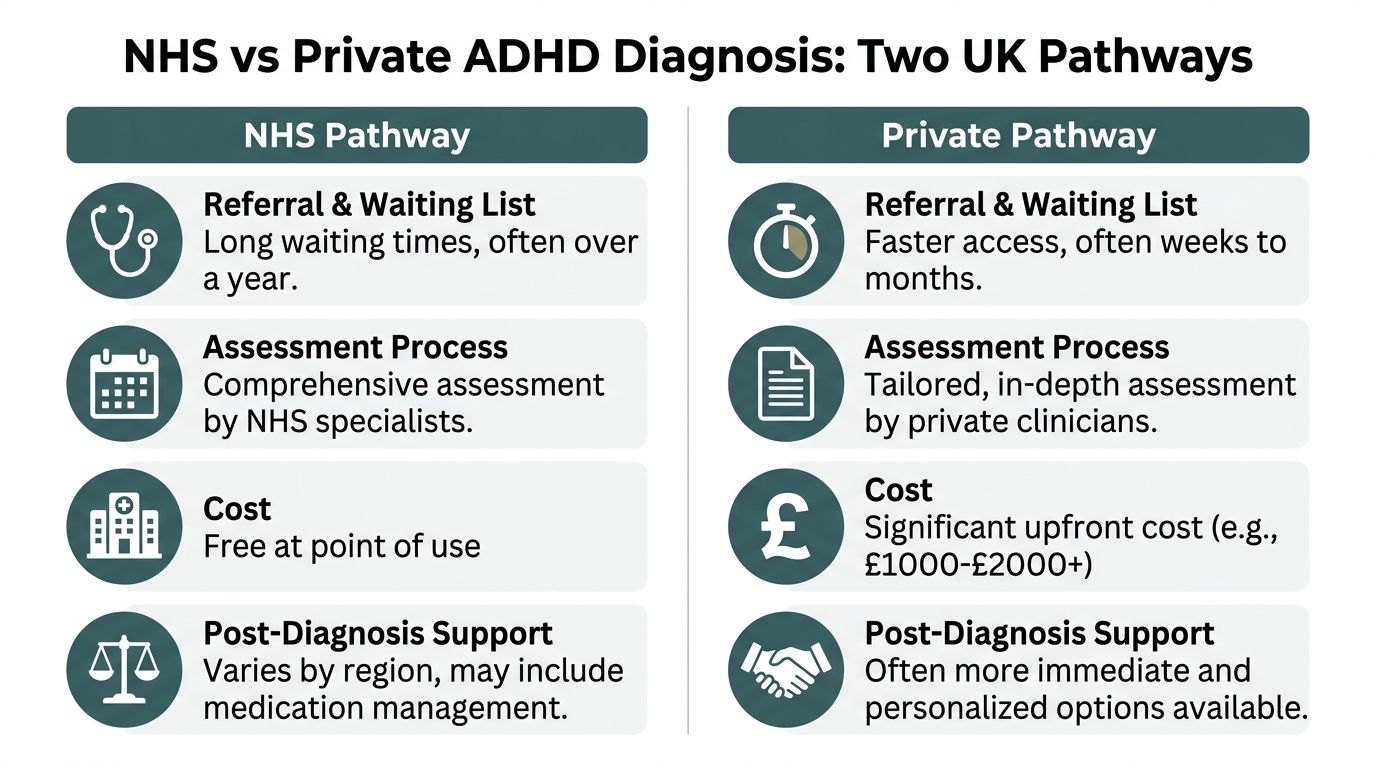
The easiest way to compare them is to treat each pathway like a different queue for the same destination. The destination is a formal assessment. What changes is how long you wait, who you see, what you pay, and how much control you have over the process.
NHS pathway
The NHS route usually begins with your GP. You explain the problems you are having, give examples from daily life, and ask whether a referral to an ADHD service is appropriate.
The main benefit is clear. You do not pay for the assessment itself.
The main drawback is time. Waiting lists vary widely by area, and in some parts of the UK they are very long. That delay is one reason many families and adults start looking at private options.
The NHS route may suit you if cost is the biggest concern and you can wait, or if your GP feels the local service is moving at a reasonable pace.
Private pathway
Private assessment usually gives you faster access and more choice over who assesses you. Some providers accept self-referrals. Others ask for GP involvement, especially if you hope your NHS GP may later consider shared care for medication.
You pay the provider directly. That often covers the assessment itself, but not always the whole process after diagnosis. Follow-up appointments, medication titration, letters for work or university, and prescription costs may be billed separately.
This is often where people feel caught out. A clinic may advertise an assessment price, but the price on the front page is not always the price of the full treatment pathway.
Private care may be a sensible option if you need answers soon, want a clinician with specific experience, or need paperwork within a shorter timeframe. It also asks more of you as the buyer. You need to check not only the appointment date, but whether the clinician’s qualifications and prescribing setup will work for your next step.
Right to Choose in England
If you live in England and are registered with a GP, Right to Choose may be available. This allows eligible patients to ask for referral to certain providers outside the usual local NHS service.
It helps to picture Right to Choose as an NHS-funded referral with more flexibility over provider. You are not directly booking private care on your own. Your GP still plays an important role, and the rules depend on where you live and which provider accepts Right to Choose referrals.
Ask your GP one direct question: “Can I use Right to Choose for an ADHD assessment?” That question can save time, money, and a great deal of uncertainty.
NHS vs Private ADHD Assessment at a Glance
| Factor | NHS Pathway | Private Pathway |
|---|---|---|
| How you start | Usually via GP referral | Often self-referral or GP referral |
| Cost | Free at point of use | Paid by patient |
| Wait time | Often longer, depending on area | Often faster |
| Choice of clinician | Limited by local service | Wider choice |
| Assessment setting | NHS specialist service | Clinic or online private service |
| Medication pathway | Through NHS service if diagnosed | Depends on whether the provider has a qualified prescriber and whether your GP will accept shared care |
| Paperwork for work or school | Usually available after diagnosis | Usually available after diagnosis, but the report quality and clinician's status matter |
| Main trade-off | Lower cost, less control over timing | Faster access, higher personal cost |
One point is easy to miss. Speed is not the only difference.
For many patients, the key fork in the road is administrative. With NHS care, the diagnosis usually sits inside an established NHS pathway for records, prescribing, and follow-up. With private care, you need to check whether the assessment will be accepted by your GP for medication discussions and by employers, schools, or universities if you later ask for adjustments.
That does not mean private diagnoses are less valid. It means the provider has to be the right kind of provider, using an accepted assessment process and issuing clear documentation. That question becomes even more important than price if you may need medication or formal support later.
How to Choose a Reputable Private Provider
Finding a reputable private provider is where many people get stuck. They are ready to book, but they are not sure whether the clinician is qualified to give a diagnosis that a GP, employer, university, or school will accept.
That concern is justified.
Who can legally provide a formal diagnosis
A common point of confusion is qualifications. NICE guidance states that only UK-registered psychiatrists, specialist ADHD nurses, or other appropriately qualified healthcare professionals can provide a diagnosis valid for Equality Act protections. A 2023 ADHD UK survey found 40% of private diagnosis seekers questioned the legitimacy of their provider after assessment (ADHD UK).
That is the number to pay attention to. Not because private assessment is unreliable, but because many patients do not know what to check before paying.
The practical difference between clinicians
Here is the simple version:
- Psychiatrists: Medical doctors. They can diagnose and prescribe medication.
- Specialist ADHD nurses: Can diagnose when appropriately trained and working within scope.
- Psychologists: May assess and contribute diagnostic work, but they do not prescribe medication.
- Counsellors or therapists without the right clinical qualification: They may be helpful for support, but they do not provide a formal ADHD diagnosis accepted for medication pathways.
This matters if your goal includes medication, a Shared Care Agreement, or formal adjustments at work or in education.
Questions to ask before you book
You do not need to sound like an expert. You just need to ask clear questions.
- Who will assess me: Ask for the clinician’s name, professional role, and registration details.
- Are your clinicians UK-registered: If it is a psychiatrist, ask for their GMC number.
- Can this report support medication decisions: If yes, ask who handles prescribing and titration.
- Will I receive a full written report: You need more than a brief letter.
- Do you assess developmental history and evidence from different life settings: ADHD diagnosis should not be based on a quick chat alone.
- What is included in the price: Ask whether the fee covers questionnaires, the interview, the report, and any follow-up.
- What happens if ADHD is not diagnosed: A good provider should still explain findings and next steps.
Red flags that deserve caution
Some warning signs are easy to miss when you are desperate for answers.
- Instant diagnosis promises: ADHD assessment should be thorough, not rushed.
- Unclear clinician identity: If you cannot tell who is assessing you, pause.
- No mention of report quality: Employers, schools, and GPs usually need proper documentation.
- Vague treatment pathway: If medication is mentioned, ask exactly who prescribes and when.
- No developmental history: ADHD is a neurodevelopmental condition. Childhood patterns matter.
A reputable clinic should welcome careful questions. If a provider becomes evasive when you ask about qualifications, prescribing, or report acceptance, treat that as useful information.
One practical way to compare providers
Make a short checklist and compare clinics line by line. Include clinician credentials, assessment length, whether prescribing is available, whether shared care is discussed, and what written documentation is included.
Haven Medical is one example of a provider offering consultant-led psychiatry assessments and prescribing as part of a broader private healthcare service. That kind of integrated model can be useful if you want assessment and treatment planning in one place. It is still worth checking the individual clinician credentials yourself.
Your Private ADHD Assessment A Step-by-Step Guide
The assessment itself is often less intimidating than people expect. Most adults worry they will be “tested” or caught out. In reality, a good assessment feels like a structured clinical conversation.

Before the appointment
You will usually complete questionnaires first. For adults, private services often use tools such as the Conners Adult ADHD Rating Scale (CAARS).
You may also be asked for:
- School reports or old records: These can help show childhood patterns.
- A partner, parent, or family questionnaire: Collateral history can add useful context.
- A summary of current difficulties: Work, relationships, finances, study, driving, daily routines.
- Mental and physical health history: This helps the clinician consider overlap and alternatives.
Do not panic if you cannot find every document. Missing school reports do not automatically stop an assessment. Clinicians can still build a developmental history through interview.
During the appointment
A standard private adult ADHD assessment in the UK lasts about 90 minutes and involves a clinical interview with a GMC-registered psychiatrist. Diagnosis is based on DSM-5 criteria and often supplemented by psychometric tools like CAARS, looking at symptoms across work, relationships, and personal functioning (reference).
The conversation usually covers more than attention span. Expect questions about:
- Childhood behaviour: School, homework, forgetfulness, restlessness, daydreaming.
- Adult life: Workload, time management, missed appointments, emotional control.
- Relationships: Listening, interrupting, conflict, forgetfulness.
- Daily functioning: Bills, paperwork, tidiness, cooking, driving.
- Other conditions: Anxiety, depression, trauma, sleep problems, substance use, autism traits.
A proper assessment looks for patterns across multiple life domains. That is important because ADHD should not be diagnosed from one narrow problem alone.
After the appointment
You should receive a written report. The exact format varies, but it usually includes:
- Whether you meet diagnostic criteria
- The clinical reasoning behind that decision
- Relevant background history
- Consideration of other possible explanations
- Recommendations for next steps
If ADHD is diagnosed, the next stage may be a treatment discussion. If it is not diagnosed, a good clinician should still explain what they think is happening and what support may help.
Bring notes to the appointment. Many adults forget examples under pressure, especially when talking about a lifetime of difficulties.
What if you feel emotional
That is common. Some people feel relief. Others feel grief for years lost without support. Some feel both at once.
A careful clinician expects this. You do not need to perform or prove your distress. You only need to answer truthfully.
From Diagnosis to Treatment Your Next Steps
You open your report, feel relieved to finally have an answer, and then hit the next question straight away. What happens now?
Treatment usually works best as a series of clear steps, not one big decision made in a rush. The first job is to understand what your diagnosis allows you to do next, and whether the clinician who diagnosed you can also support prescribing or shared care paperwork. That point is often missed, and it can affect whether your GP will accept the plan.
Medication and follow-up
If medication is being considered, diagnosis is only the first part of the process. You also need a qualified prescriber to assess whether medication is appropriate, start it safely, and review you while the dose is adjusted.
That adjustment period is called titration. It works like getting the focus right on a camera lens. The first setting may be too strong, too weak, or helpful in some situations but not others. A prescriber reviews benefits, side effects, blood pressure or pulse where needed, and day-to-day functioning before deciding whether to change the dose.
The usual pathway looks like this:
- Assessment
- Diagnosis
- Discussion of treatment options
- Titration with an appropriate prescriber
- Possible Shared Care Agreement with your GP
Private clinics often charge separately for each stage. That means the assessment fee may not include medication follow-up, prescription costs, or review appointments. Ask for a full price list before you commit, so there are no surprises halfway through treatment.
Understanding Shared Care Agreement
A Shared Care Agreement means the specialist starts treatment and stabilises it, then your GP may agree to take over repeat prescribing while the specialist remains involved for periodic review.
This can make long-term treatment more affordable and easier to manage. It is not automatic.
GPs do not have to accept shared care from every private provider. In practice, many surgeries want to see that the diagnosis came from a clinician with the right training, registration, and prescribing arrangements. This is why provider qualifications matter so much. A diagnosis can be clinically sound, yet still lead to delays if the paperwork comes from a service your GP is not comfortable working with.
Ask these questions early:
- Who exactly made the diagnosis, and what is their professional registration
- If medication is offered, who prescribes it
- Does the clinic regularly arrange shared care with NHS GPs
- What documents will be sent to my GP
- Who reviews treatment after the dose is stable
If a clinic gives vague answers, treat that as a warning sign. Clear services can usually explain their process in plain English.
Treatment is bigger than medication
Medication helps many people, but it is not the only effective support. Many adults also need practical systems, better self-understanding, and changes to the environment around them.
Useful support can include:
- ADHD coaching: help with routines, planning, accountability, and finishing tasks
- CBT adapted for ADHD: help with procrastination, self-criticism, and emotional overwhelm
- Psychoeducation: learning how ADHD affects attention, memory, motivation, and stress
- Lifestyle changes: sleep, meal planning, reminders, exercise, and boundaries are also important parts of a support system
For practical day-to-day ideas, Effective Time Management for Adults with ADHD is a helpful companion to formal treatment.
A sensible first month after diagnosis
Many people feel stuck after the assessment process ends. Relief and uncertainty often show up together.
Keep the first month simple:
- Read the report fully
- Check what follow-up is included
- Decide whether you want a medication appointment
- Contact your GP to ask about their shared care position
- Tell one trusted person what support would help right now
- Choose one daily problem to address first
One problem is enough. For example, if mornings are chaotic, work on mornings before trying to fix work, finances, sleep, and relationships all at once.
Small, repeatable changes usually last longer than a burst of effort in the first week.
Support at Work and School with Your Diagnosis
You hand over your report to HR, a university disability team, or a school SENCO, and the same question often sits underneath the conversation. Is this diagnosis clear, formal, and from a clinician whose opinion will be accepted?
That question matters because a diagnosis is not only about understanding yourself. It is also a document that helps other systems respond properly.
Why formal documentation helps
Many adults and young people with ADHD spend years being seen as disorganised, inconsistent, or not trying hard enough. A formal diagnosis changes the conversation from opinion to evidence.
As noted earlier, ADHD is still under-identified in the UK, especially in adults. In work and education settings, that often means people have genuine difficulties with attention, planning, memory, or deadlines, but no paperwork to explain why those difficulties keep happening.
A clear report works like a translation tool. It takes an invisible struggle and puts it into terms an employer, school, or university can act on.
The provider’s qualifications matter here. A detailed report from an appropriately qualified clinician is more likely to be accepted by a GP, occupational health team, university support service, or employer. That is one reason it helps to check credentials before you book, not after problems appear.
Reasonable adjustments in real terms
Support should match the actual difficulty, not a stereotype about ADHD. Someone who loses track of verbal instructions may need written follow-up. Someone who becomes overwhelmed by noise may need a quieter workspace or permission to use noise-cancelling headphones.
A good diagnostic report can support requests such as:
- At work: Written instructions, regular check-ins, clear priorities, protected focus time, flexible scheduling, quieter seating, task management tools
- At university or college: Extra time, rest breaks, note-taking support, a separate room, deadline planning support
- At school: Seating changes, movement breaks, visual prompts, help with transitions, stronger home-school communication
Small adjustments can have a large effect. For many people, a written summary after meetings helps more than a dramatic change to the whole job or course.
How to ask for support
Keep your request brief and practical. You do not need to present every detail of your history.
A simple four-step approach often works well:
- Share the diagnosis or a summary page from the report
- Explain the main difficulty in day-to-day terms
- Ask for one or two specific adjustments
- Review what is helping after a few weeks
For example, instead of saying, “I have ADHD and need support,” you could say, “I have a formal ADHD diagnosis. I find verbal instructions hard to retain, so I work better if key actions are sent to me in writing.”
That kind of request is easier for a manager, tutor, or school lead to act on.
If a workplace or education setting seems unsure, check whether they need the full report, a summary, or confirmation of the clinician’s role and registration. This is another overlooked part of the process. Acceptance often depends not only on the word “diagnosis,” but on who made it, how clearly it is documented, and whether the report explains the functional impact.
Common Questions on Private ADHD Diagnosis
Will my NHS GP accept a private diagnosis
Often yes, but not automatically. Acceptance depends on the provider, the quality of the report, local policy, and whether the clinician is appropriately qualified.
This is why credentials matter so much. Before booking, ask whether the clinic uses UK-registered psychiatrists or other appropriately qualified professionals, and whether they routinely provide reports suitable for GP review.
Can my GP refuse Shared Care Agreement
Yes, that can happen. A Shared Care Agreement is not guaranteed.
If a GP says no, ask why. Sometimes the concern is about the provider’s credentials or the level of information supplied. Sometimes it is a local prescribing policy issue. You can then ask the diagnosing clinic whether they can provide additional documentation, continue private prescribing, or advise on alternatives.
Is an online ADHD assessment valid
Online assessment can be valid if it is carried out properly by the right clinician using accepted diagnostic standards.
The key question is not whether it is online or face to face. The key question is whether the provider uses a thorough process, gathers developmental history, applies recognised criteria, and issues a report from an appropriately qualified clinician.
Can a psychologist diagnose ADHD privately
A psychologist may carry out assessment work and contribute to diagnosis if appropriately qualified, but psychologists do not prescribe medication.
That distinction matters. If medication is something you may want to consider, ask how prescribing works before you book.
How long does a proper assessment take
For adults, a standard private assessment is commonly around 90 minutes, with questionnaires and evidence gathering before or around the appointment, as noted earlier in the article.
Be cautious about any service that appears to reduce the process to a very brief call with no developmental history.
Does diagnosis alone mean I can get medication
No. A diagnosis is one part of the pathway.
Medication usually requires follow-up with a qualified prescriber, further clinical review, and titration. If you are comparing private clinics, check whether they are assessment-only or whether they also offer prescribing and monitoring.
Do I have to tell my employer
No. You are not required to disclose your diagnosis to an employer unless you choose to.
That said, if you want workplace adjustments, disclosure is often necessary at least to the relevant manager, occupational health service, or HR contact. Many people choose to share only what is needed to arrange support.
What if the assessment says I do not have ADHD
That outcome can still be useful. A strong assessment does not just hand out diagnoses. It considers other explanations and should point you towards more appropriate support if ADHD is not the right fit.
I feel overwhelmed and do not know where to start
Start with three checks:
- Who is the clinician
- What is included
- What happens after diagnosis
If you want a consultant-led route, you can visit website, click to book, or call to book with a provider that clearly states its clinician credentials and treatment pathway. The important thing is not to rush into the first available appointment without checking who is assessing you.
A careful private adhd diagnosis uk pathway can be a practical and legitimate route to answers. The safest approach is simple. Check qualifications. Ask how prescribing works. Make sure the report will stand up to real-world use. Then book with confidence.