




Blocked ears rarely arrive at a convenient time. You notice the television creeping louder, voices sounding woolly, or one ear feeling stubbornly full after a shower, flight, or cold. Many people worry that something serious is wrong. Often, it’s ear wax doing what it normally does, then building up in a way that stops it clearing naturally.
Ear wax has a job. It traps dust, protects the delicate skin of the ear canal, and helps keep the ear healthy. Trouble starts when wax becomes impacted, sits against the eardrum, interferes with hearing aids, or causes symptoms that you can’t ignore. That’s when people start searching for private ear wax removal and trying to work out whether they need an appointment, drops, or just reassurance.
Why Consider Private Ear Wax Removal
Private treatment has become more common for a simple reason. Access through the NHS has narrowed in many areas, so patients who would once have gone through their GP are now being advised to self-manage or look elsewhere.
In Cornwall, a survey of 59 GP surgeries found that 48 still offered ear-wax removal and were carrying out around 23,442 procedures a year, but the same report also found that provision was reducing and that patients were mostly being advised to manage wax themselves. In that survey, 80% of respondents felt current provision was inadequate, which points to a clear gap now being filled by private clinics.
That change matters because ear wax problems are common, but they don’t always resolve on a timetable that suits daily life. If your hearing is dulled before a meeting, your hearing aid is whistling, or you’ve got a blocked sensation that won’t settle, waiting and hoping isn’t always practical.
Why private care appeals to patients
A good private clinic offers more than speed. It should offer assessment first, treatment second. That sounds obvious, but it’s the difference between proper ear care and a one-size-fits-all service.
Patients usually choose private care for a few practical reasons:
- Quicker access: You can often get seen before the problem starts affecting work, sleep, or communication any further.
- A full examination: The clinician can inspect the ear canal and eardrum before deciding what’s safe.
- More than one treatment option: If one method isn’t suitable, another may be.
- Clear advice afterwards: You leave knowing what caused the blockage and what to do next.
Practical rule: If a service talks only about removing wax, but says little about examining the ear first, ask more questions before booking.
The experience around booking matters too. Clinics that organise appointments well, answer queries clearly, and triage patients properly usually create a safer journey from first contact onwards.
The real reason many people go private
For many patients, the choice isn’t between NHS and private in equal terms. It’s between continued discomfort and a booked appointment with a clinician who can look in the ear, explain what’s there, and choose the right method. That’s why private ear wax removal has become less of a luxury and more of a practical route to care.
Comparing Professional Removal Methods
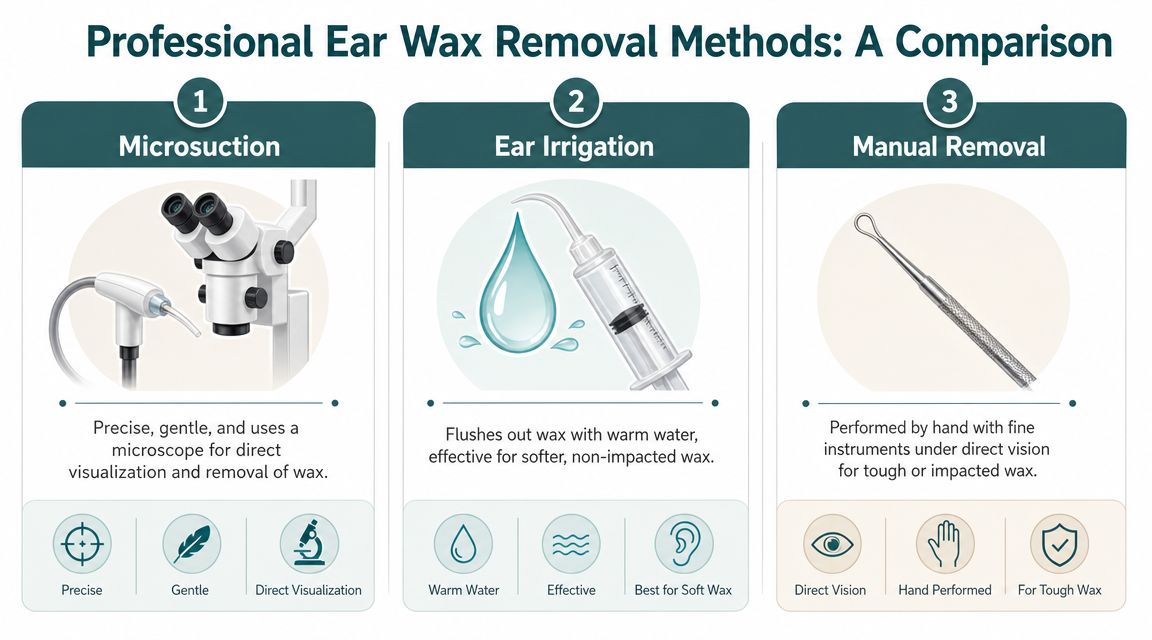
Professional ear wax removal isn’t one procedure. It’s a small group of techniques, and the best clinics choose between them based on what they see on examination. That matters because soft wax, hard impacted wax, narrow canals, sensitive skin, and a history of ear problems don’t all respond the same way.
The three main methods
Think of microsuction as a tiny, controlled hoover. The clinician looks directly into the ear using magnification and lighting, then uses a fine suction device to remove wax piece by piece. It’s often the method patients ask for because it avoids flushing the ear with water. A study of 159 patients found microsuction cleared wax in 91% of cases, which helps explain why many private clinics favour it for effectiveness, as reported in this peer-reviewed review on earwax management.
Ear irrigation is closer to a gentle warm shower for the ear canal. Water is used to wash softened wax out. It can work well when the wax is softer and the ear is suitable, but it depends heavily on safety screening before treatment.
Manual removal uses fine instruments such as a curette, hook, or forceps under direct vision. This is the delicate toolkit approach. It can be very effective for wax sitting near the outer canal, awkward fragments, or cases where suction alone isn’t ideal.
Ear wax removal methods at a glance
| Method | How It Works | Best For | Key Benefit |
|---|---|---|---|
| Microsuction | Uses fine suction under direct vision to lift or draw wax out | Impacted wax, patients who want a water-free method, ears needing precision | Precise removal with good visibility |
| Ear irrigation | Flushes softened wax out using warmed water | Softer wax in an ear that has passed safety screening | Can clear loose or softened wax efficiently |
| Manual removal | Uses small instruments under direct vision to tease wax out | Localised pieces of wax, awkward fragments, some narrow canals | Excellent control in skilled hands |
What each method feels like
Patients often ask whether one method is more comfortable than another. The honest answer is that comfort depends on the ear, the wax, and the operator.
- Microsuction: You may hear a louder sucking noise inside your head. Some people describe it as odd rather than painful.
- Irrigation: This can feel like warmth and pressure. If the water temperature isn't right or the ear isn't suitable, it can be unpleasant.
- Manual removal: This often feels like light movement or pressure in the canal. It requires steady technique and good visibility.
A single-method service can only offer the method it has. A clinician with several options can offer the method your ear actually needs.
Why choice matters more than branding
A lot of marketing focuses on one technique as though it's automatically best. In practice, the better question is whether the clinic can assess the ear properly and switch methods if needed. A consultant-led or medically supervised clinic is often stronger here because the decision starts with anatomy and safety, not with a fixed menu.
That's a significant advantage of private ear wax removal. You're not booking a machine. You're booking a clinical judgement.
Is Private Removal Right for You
Not every blocked ear needs a procedure. Some need drops, some need time, and some need a proper ear examination because the problem may not be wax at all.
Signs that make assessment worthwhile
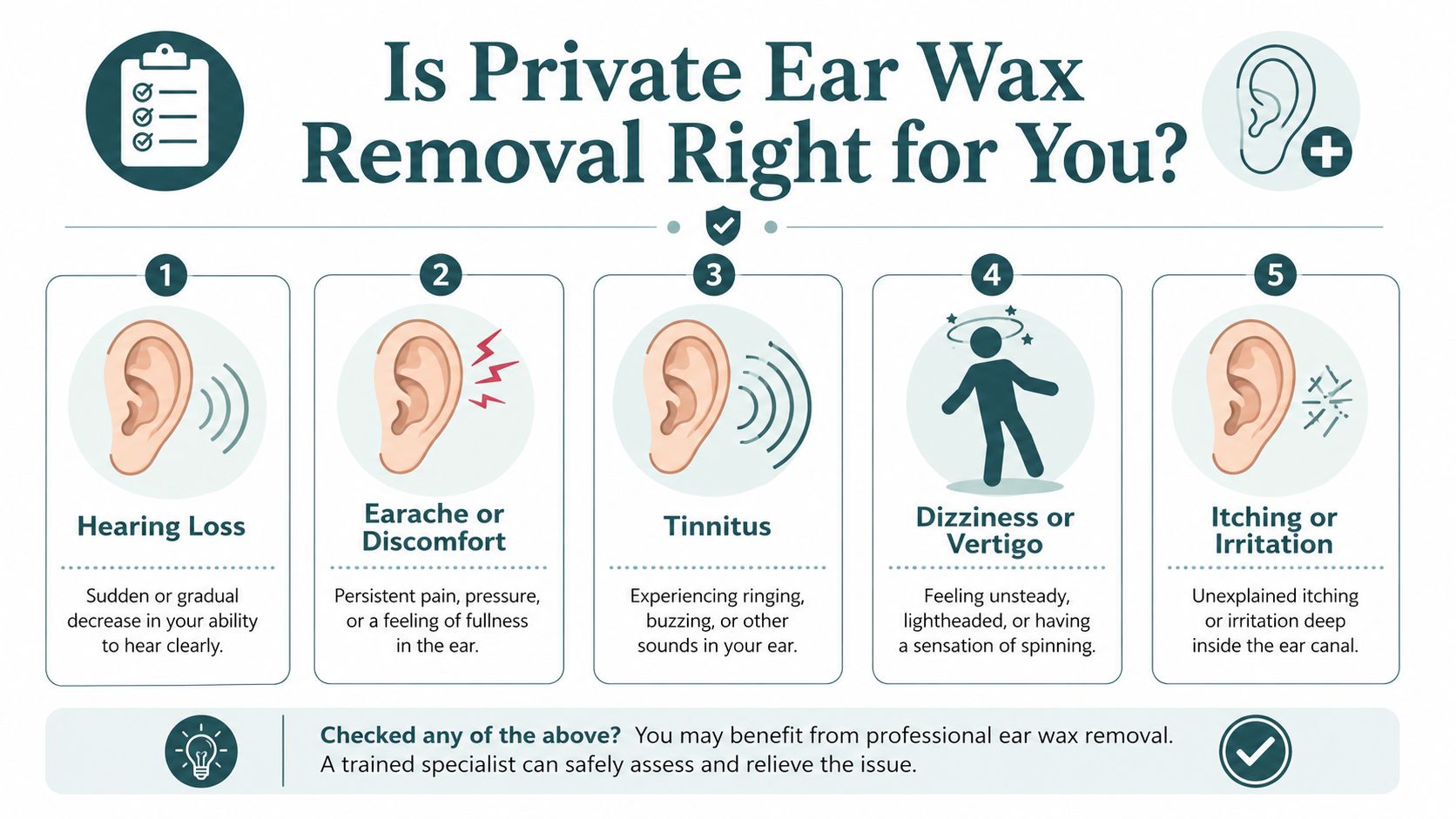
Private ear wax removal is often worth considering if you've developed symptoms such as:
- Muffled hearing: Sounds seem dulled, uneven, or distant.
- Fullness or pressure: The ear feels blocked and won't clear.
- Tinnitus: Ringing or buzzing seems worse when the ear feels obstructed.
- Itching or irritation: The canal feels uncomfortable or sensitive.
- Balance disturbance: Some people notice light-headedness or a vague off-balance feeling.
UK guidance also says wax usually only needs removal if it's causing symptoms or blocking a necessary examination, which is why a proper assessment is often more useful than assuming every ear needs cleaning. That point is explained well in this guide on when earwax removal is actually needed.
When drops may be enough
If the ear feels blocked but there's no pain, discharge, or sudden change in hearing, softening drops may be the right first step. In many routine cases, a clinician will advise using olive oil or another suitable softener before removal is attempted.
That's especially useful when wax is dry and tightly packed. Softening it first can make treatment easier and more comfortable.
When safety checks matter most
This is the part patients often underestimate. Irrigation is only safe if the eardrum is intact. UK procedural guidance stresses that water entering an ear with a perforation risk can cause infection, pain, vertigo, or contamination of the middle ear. It also notes that irrigation water should be warmed to body temperature and directed away from the eardrum, which is why pre-procedure otoscopy isn't optional. Those safety points are set out in this UK-aligned earwax removal technique guidance.
A clinician needs to look for more than wax. They're checking the condition of the ear canal, the appearance of the eardrum, whether there are signs of inflammation, and whether the method you expected is the method that should be used.
If the ear hasn't been examined first, no one can say confidently which removal method is safest.
Situations that need more caution
Book an assessment rather than trying to force home treatment if you have any of these:
- Previous ear surgery: The anatomy may be altered.
- A known perforation or past perforation: Water-based methods may be unsuitable.
- Ear discharge or active infection symptoms: Wax may not be the main issue.
- Significant pain: Impacted wax can be uncomfortable, but pain also raises other possibilities.
- Only hearing ear: Extra caution is sensible when one ear matters even more.
The safest private ear wax removal service is not the one that promises to remove wax fastest. It's the one that's willing to say, “This method isn't right for your ear.”
Your Appointment Step-by-Step
Most patients feel more relaxed once they know what the visit involves. A private ear wax removal appointment is usually straightforward, calm, and shorter than people expect, but it should never feel rushed.
Before you arrive
Many clinics ask you to use olive oil drops beforehand if that's appropriate for your symptoms and history. The purpose is simple. Soft wax comes away more easily than hard, dry plugs pressed against the canal wall.
If you haven't used drops, don't panic. The clinician will still examine the ear and advise what's possible on the day.
What happens in the room
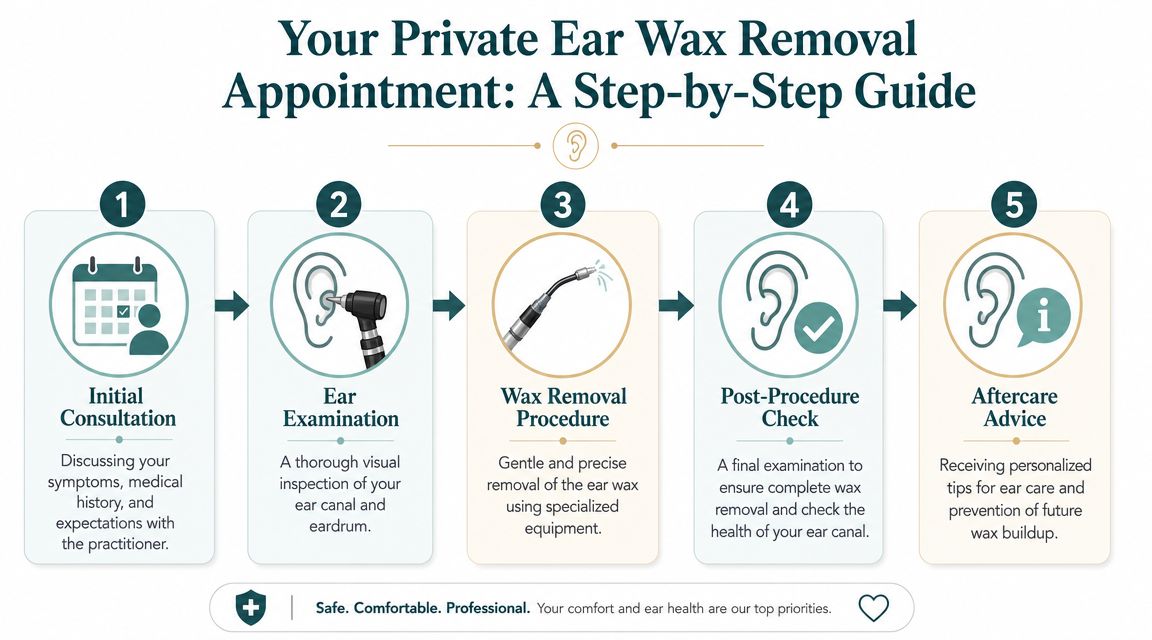
Appointments usually begin with a short conversation. Expect questions about blocked hearing, tinnitus, discomfort, previous infections, perforations, surgery, hearing aids, and any recent attempts to clear the wax yourself.
Then comes the ear examination. The clinician uses an otoscope or a magnified viewing system to inspect the canal and eardrum. The plan is made at this stage. Not before.
A typical sequence looks like this:
- History taking: Symptoms, duration, medical background, and any red flags.
- Otoscopy: A direct look inside the ear to confirm whether wax is present and how much.
- Method selection: Microsuction, irrigation, manual removal, or a decision to defer.
- Removal: The chosen technique is carried out carefully, with pauses if needed.
- Final re-check: The ear is inspected again after treatment.
What the procedure feels like
Microsuction often surprises people because of the sound. It can be noisy inside your own head, a bit like holding a small vacuum cleaner close to your ear. That doesn't mean anything is wrong. It's just the nature of suction in a narrow space.
Irrigation feels different. You may notice warmth and movement as the water circulates. Manual removal tends to feel more like fine pressure or gentle contact.
Most patients cope very well once they know what they're feeling. Unfamiliar doesn't always mean uncomfortable.
After the wax comes out
The immediate change can be dramatic. Some people notice clearer hearing straight away. Others notice that the ear suddenly feels open, lighter, or less pressured.
It's also normal for hearing to seem almost too sharp for a short while, especially if one ear has been blocked for days or weeks. That usually settles quickly as the brain readjusts to normal sound input.
A good appointment ends with explanation, not just extraction. You should be told what was found, whether the canal and eardrum looked healthy, and what to do if symptoms persist.
Costs Booking and Aftercare
Cost matters, but it helps to frame private ear wax removal correctly. You're not paying only for wax extraction. You're paying for clinical time, ear examination, safe equipment, method selection, and aftercare advice.
What you're really paying for
The strongest private services include more than one step:
- Assessment: Someone examines the ear and checks whether wax is the cause.
- Clinical judgement: The practitioner decides which method is suitable, or whether treatment should wait.
- Treatment: Removal is carried out with the right tools for that ear.
- Advice afterwards: You leave with guidance rather than guesswork.
That's why the cheapest option isn't always the best value. A low headline price means little if the service offers only one method or skips proper screening.
How to book without overthinking it
Booking should be easy. If your hearing is blocked, the last thing you need is a complicated process.
A sensible approach is:
- Check symptoms first: If you have severe pain, discharge, or sudden hearing loss, ask whether you need medical review rather than routine wax removal.
- Ask what the appointment includes: Ear examination should be part of it.
- Confirm methods offered: A clinic that can provide microsuction, irrigation, and manual removal has more flexibility.
- Choose a convenient slot: Delaying often means more frustration, not less.
You can call to book if you want to speak to someone first. If you prefer to arrange it online, click to book through the clinic's appointment system or visit website pages that show availability and service details.
Aftercare that actually helps
After treatment, individuals can typically return to normal activity straight away. You may be advised to keep the ear dry for a short period, avoid poking the canal, and use drops only if specifically recommended.
Watch for a few simple points:
- Mild sensitivity: The ear canal can feel slightly tender after removal, especially if the wax was hard or deep.
- Temporary light-headedness: Some people feel briefly odd after treatment, particularly if the ear has been blocked for some time.
- Sharper hearing: This can feel strange at first but usually settles.
Don't put cotton buds, grips, keys, or home tools into the ear afterwards. If symptoms continue despite wax removal, the issue may not have been wax alone, and you may need a wider ear assessment.
FAQs and When to See a Specialist
Some questions come up in almost every clinic room. The answers are usually reassuring, but they're worth stating plainly.
Common questions patients ask
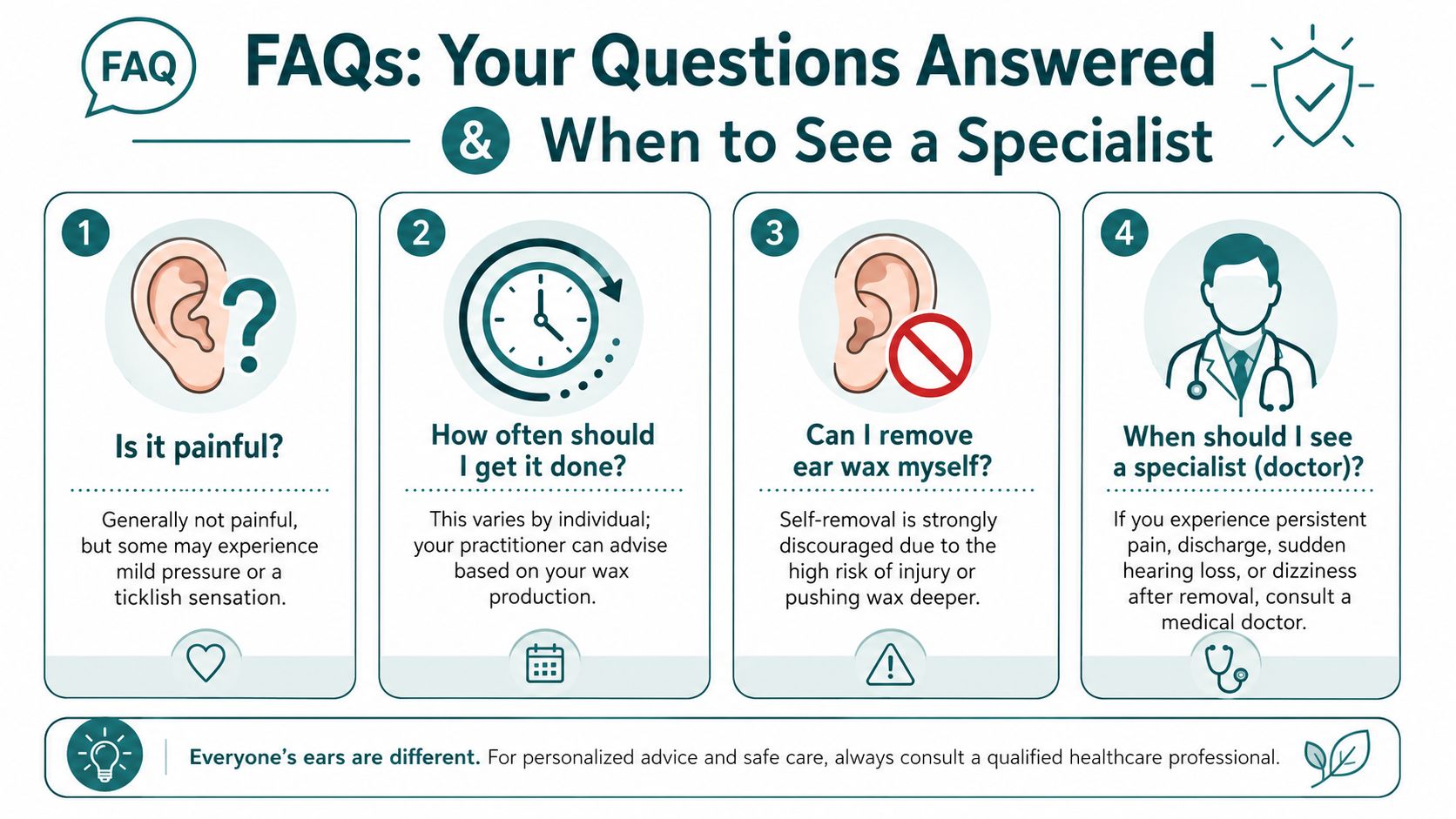
Is ear wax removal painful?
Usually not. It can feel noisy, odd, tickly, or pressurised depending on the method, but a properly performed procedure should be tolerable. If it hurts, the clinician should stop and reassess.
How often should I have it done?
There isn't one schedule that suits everyone. Some people rarely need help. Others, especially hearing aid users or people who naturally produce more wax, may need periodic review.
Can I remove ear wax myself?
Trying to dig it out usually makes things worse. Cotton buds often push wax further in and can irritate the canal. Home cameras and improvised tools add risk without giving you clinical judgement.
Do all blocked ears contain wax?
No. A blocked sensation can also come from congestion, infection, skin problems in the canal, or pressure changes. That's one reason examination matters.
When you should see a specialist
Professional wax removal is one thing. Specialist ENT assessment is another. You should ask for medical review if symptoms suggest something more than routine wax build-up.
Seek specialist input if you have:
- Persistent pain: Especially if removal hasn't helped.
- Discharge from the ear: This can point to infection or another ear condition.
- Sudden hearing loss: Don't assume this is wax without urgent assessment.
- Ongoing dizziness or vertigo: Particularly if it continues after treatment.
- Repeated failed removals: The issue may be anatomy, skin disease, or deeper impaction.
A blocked ear is common. A blocked ear with sudden hearing loss, discharge, or persistent vertigo needs a higher level of attention.
The final decision
Private ear wax removal makes sense when symptoms are affecting you, self-care hasn't solved the problem, and you want prompt assessment by a clinician who can look properly and choose the right method. The biggest advantage isn't merely getting wax out. It's getting the right answer about what's in the ear and what should be done about it.
If you want a consultant-led setting with broader medical support available when a simple wax problem turns out to be something more complex, call to book, click to book, or visit website at Haven Medical.