

Feeling anxious before an exam, a presentation, or a difficult conversation is part of being human. An anxiety disorder is different. It doesn’t merely make life feel stressful. It can narrow a person’s world, affect sleep, concentration, relationships, attendance, and confidence, and make ordinary tasks feel unsafe.
In the UK, this is far from rare. 6.5% of people aged 16 and over show symptoms of generalised anxiety disorder in any given week, which is around 3.5 million adults, according to the Adult Psychiatric Morbidity Survey findings discussed here. That single figure changes the conversation. Anxiety disorders are not a niche issue. They affect families, classrooms, workplaces, and whole communities.
If you’re worried about yourself, your child, a student, or an employee, the most useful starting point is this. Anxiety disorders are real, common, and treatable. The challenge is often recognising what you’re seeing, understanding what type of problem may be present, and knowing what to do next.
The True Scale of Anxiety Disorders in the UK
Why this matters to so many people
In a country the size of the UK, even a condition that affects a minority of adults will touch millions of daily decisions. It shows up in sickness absence, falling attendance, strained family routines, school refusal, and talented people stepping back from work or study because life no longer feels manageable.
That wider impact is the part people often miss.
As noted earlier, anxiety disorders are common in the UK. The point is not only how many people meet symptom thresholds. It is how often anxiety changes behaviour before anyone names it. A parent may stop driving on motorways. A pupil may begin missing lessons because of stomach aches and dread before school. An employee may avoid presentations, phone calls, travel, or busy offices, then look unreliable rather than unwell.
Anxiety works a little like a smoke alarm that has become too sensitive. It is designed to protect you, but it starts reacting to situations that are uncomfortable rather than dangerous. Over time, the person may organise more and more of life around avoiding that alarm. The result can look like poor coping from the outside, when in fact it is a health problem affecting body, mind, and behaviour together.
Anxiety isn’t always visible
A severe anxiety disorder does not always look dramatic. Some people continue achieving highly while paying a private cost in poor sleep, muscle tension, nausea, dread, irritability, and constant mental rehearsal. Others become quieter, more perfectionistic, or more avoidant. In children and teenagers, it may present as refusal, tears, anger, repeated reassurance-seeking, or physical complaints before school.
This is why anxiety is often first noticed by the people around the person, not by the person themselves. Family members may notice short tempers or withdrawal. Teachers may see lateness, non-attendance, unfinished work, or distress around tests and transitions. Employers may notice increased sick days, reduced confidence, missed meetings, or a sudden drop in performance in tasks that involve scrutiny or uncertainty.
Those observations matter. They are often the first practical clues that someone needs assessment and support.
Why early recognition changes outcomes
Untreated anxiety tends to shrink a person’s world gradually. They avoid what triggers fear, feel brief relief, then become less confident the next time. That cycle is one reason early recognition matters so much in homes, schools, and workplaces.
Good support is not about telling someone to “calm down” or push through. It is about spotting patterns early, reducing avoidable stress where possible, and guiding the person towards proper treatment. For schools and employers, that may mean noticing repeated avoidance, opening a calm conversation, making sensible short-term adjustments, and encouraging assessment rather than discipline alone.
For families, it means taking persistent anxiety seriously without reinforcing every avoidance pattern. For organisations, it means understanding that early help can protect attendance, learning, retention, and wellbeing.
And for people who want a clear route into care, it helps to know there is another option besides waiting and wondering. Consultant-led private assessment through Haven Medical can offer a direct path from concern to diagnosis, treatment planning, and practical advice for school or work, which is often the step missing from NHS-focused guidance.
Defining the Different Types of Anxiety Disorder
Anxiety disorders share a common ingredient: fear or worry that becomes excessive, persistent, or disruptive. But they don’t all feel the same. It’s helpful to think of them as different patterns rather than one single condition.
Some people worry about many areas of life at once. Some have sudden surges of intense fear. Some fear being judged. Others become extremely frightened of a specific situation or object. Knowing the pattern helps clinicians choose the right treatment.
Everyday anxiety compared with an anxiety disorder
Everyday anxiety usually has a clear trigger and settles when the situation passes. You might feel tense before a deadline, then recover afterwards.
An anxiety disorder tends to do more than that. It may:
- Last longer: The worry or fear keeps returning, even when there’s no immediate threat.
- Spread further: It starts affecting sleep, concentration, appetite, attendance, or relationships.
- Change behaviour: The person avoids situations, seeks repeated reassurance, or structures life around feeling safe.
Comparison of common anxiety disorders
| Disorder Type | Core Feature | Primary Focus of Worry | Example Physical Symptoms |
|---|---|---|---|
| Generalised anxiety disorder | Persistent, hard-to-control worry across multiple areas of life | Health, family, work, school, finances, everyday responsibilities | Muscle tension, poor sleep, restlessness, fatigue |
| Panic disorder | Recurrent panic attacks and fear of having more | Sudden physical sensations or the possibility of losing control | Racing heart, dizziness, breathlessness, trembling |
| Social anxiety disorder | Intense fear of scrutiny, embarrassment, or negative judgement | Speaking, eating, performing, meeting people, being observed | Blushing, shaking, nausea, pounding heart |
| Specific phobia | Strong fear linked to a particular object or situation | Flying, needles, animals, heights, confined spaces, and similar triggers | Sweating, rapid heartbeat, feeling faint, urgent need to escape |
A closer look at social anxiety disorder
Social anxiety disorder is often misunderstood as shyness. Shyness may feel uncomfortable, but social anxiety can be significantly impairing. A person may dread speaking in class, eating in front of others, using public toilets, attending meetings, or even making eye contact because they fear humiliation, criticism, or visible signs of anxiety.
In UK adults, social anxiety disorder affects 2.3% in any given week, with onset typically by age 13. It’s also linked to a 3-fold increased risk of comorbid depression and substance misuse if left untreated, according to the review article available here.
That early onset matters. A teenager who looks disengaged may be frightened. An employee who avoids presentations may not lack ambition. A parent who declines school events may not be unfriendly. The behaviour can make more sense once you recognise the fear driving it.
Social anxiety often hides behind labels like “quiet”, “difficult”, “awkward”, or “not a team player”.
Where people often get confused
People frequently ask whether they need to identify the exact label before seeking help. Usually, they don’t. A clinician’s job is to sort through the pattern.
What matters most at first is noticing:
- How broad the worry is
- Whether there are panic episodes
- Whether social judgement is the main fear
- Whether avoidance centres on a specific trigger
A clear diagnosis can come later. If the symptoms are interfering with life, that’s already enough reason to ask for an assessment.
Recognising the Common Symptoms of Anxiety
Anxiety symptoms usually show up in three overlapping ways. The body reacts. The mind reacts. Behaviour changes. People often recognise only one part of that picture, which is why anxiety can be mistaken for a heart problem, poor motivation, irritability, or “just stress”.
Physical symptoms
A common example is the person who says, “I know it’s probably anxiety, but it feels physical.” That makes sense because anxiety often is physical.
Someone might sit in a meeting and notice a pounding heart, tight chest, shaky hands, dry mouth, nausea, or a feeling of not getting enough air. Another person may wake in the night with a clenched jaw, stomach discomfort, sweating, and a sense that something is wrong.
Common physical symptoms can include:
- Cardiovascular sensations: Racing heart, palpitations, chest tightness
- Breathing changes: Breathlessness, sighing, a sense of air hunger
- Muscle symptoms: Tension in the shoulders, jaw clenching, trembling
- Digestive upset: Nausea, “butterflies”, urgent bowel movements, reduced appetite
- General stress responses: Dizziness, sweating, tiredness, poor sleep
Psychological symptoms
The mental side of anxiety is often less visible to others. A student may look calm while internally rehearsing every possible mistake. A parent may appear organised while imagining worst-case scenarios all day. An employee may spend hours checking one email because they fear getting something wrong.
Psychological symptoms often include persistent worry, dread, catastrophising, difficulty concentrating, irritability, and a sense of being constantly “on alert”. Some people describe it as a mind that won’t stop scanning for danger.
A useful clue is this: anxiety rarely stays in the present. It pulls attention into “what if?” thinking.
Behavioural symptoms
Behaviour tells us a great deal about anxiety. The person may stop doing things that once felt manageable, not because they don’t care, but because avoidance brings temporary relief.
That can look like:
- Avoidance: Missing school, declining invitations, skipping appointments, avoiding travel
- Reassurance seeking: Repeatedly asking if everything will be okay
- Safety behaviours: Sitting near exits, overpreparing, checking routes, carrying items “just in case”
- Withdrawal: Speaking less, contributing less, becoming harder to reach
These patterns matter because they can keep anxiety going. If someone always escapes the feared situation, they never get the chance to learn that they can cope.
Exploring the Causes and Risk Factors
Anxiety disorders rarely come from one single cause. Most develop through a combination of biology, psychology, and life experience. This is often called a biopsychosocial model. The phrase sounds technical, but the idea is simple. Your body, your mind, and your environment all interact.
That matters because many people blame themselves. They think, “Why can’t I just be stronger?” In reality, anxiety often develops from several converging factors, not from a lack of character.
A visual can help make that clearer.

Biological factors
Some people seem to arrive with a more sensitive alarm system. They notice bodily sensations quickly, react strongly to uncertainty, or stay physiologically keyed up for longer after stress. Family history can also matter, suggesting that inherited vulnerability plays a part for some people.
Brain systems involved in fear and threat detection are also relevant. When those systems become over-responsive, everyday situations can feel more dangerous than they are. That doesn’t mean the person is imagining it. It means their internal threat response is firing too easily or too often.
Psychological factors
Temperament shapes how anxiety is experienced. People who are naturally cautious, highly self-aware, perfectionistic, or prone to overthinking may be more vulnerable when stress builds.
Past learning matters too. If someone has had an embarrassing experience, a sudden panic episode, bullying, loss, or prolonged stress, the brain may start pairing certain places or situations with danger. Over time, that association can become automatic.
Social and environmental factors
Stress at home, school, or work can push an already sensitive system further. Uncertainty, conflict, pressure, poor sleep, and reduced support can all make anxiety worse.
Children and teenagers are especially affected by the environments around them. Adults are too, though they often hide it better. A person can appear high-functioning and still be struggling under sustained pressure.
Here’s the key point. Anxiety disorders are understandable responses shaped by multiple influences. Understanding those influences helps treatment feel less mysterious and less blaming.
Your Pathway to Diagnosis and Effective Treatment
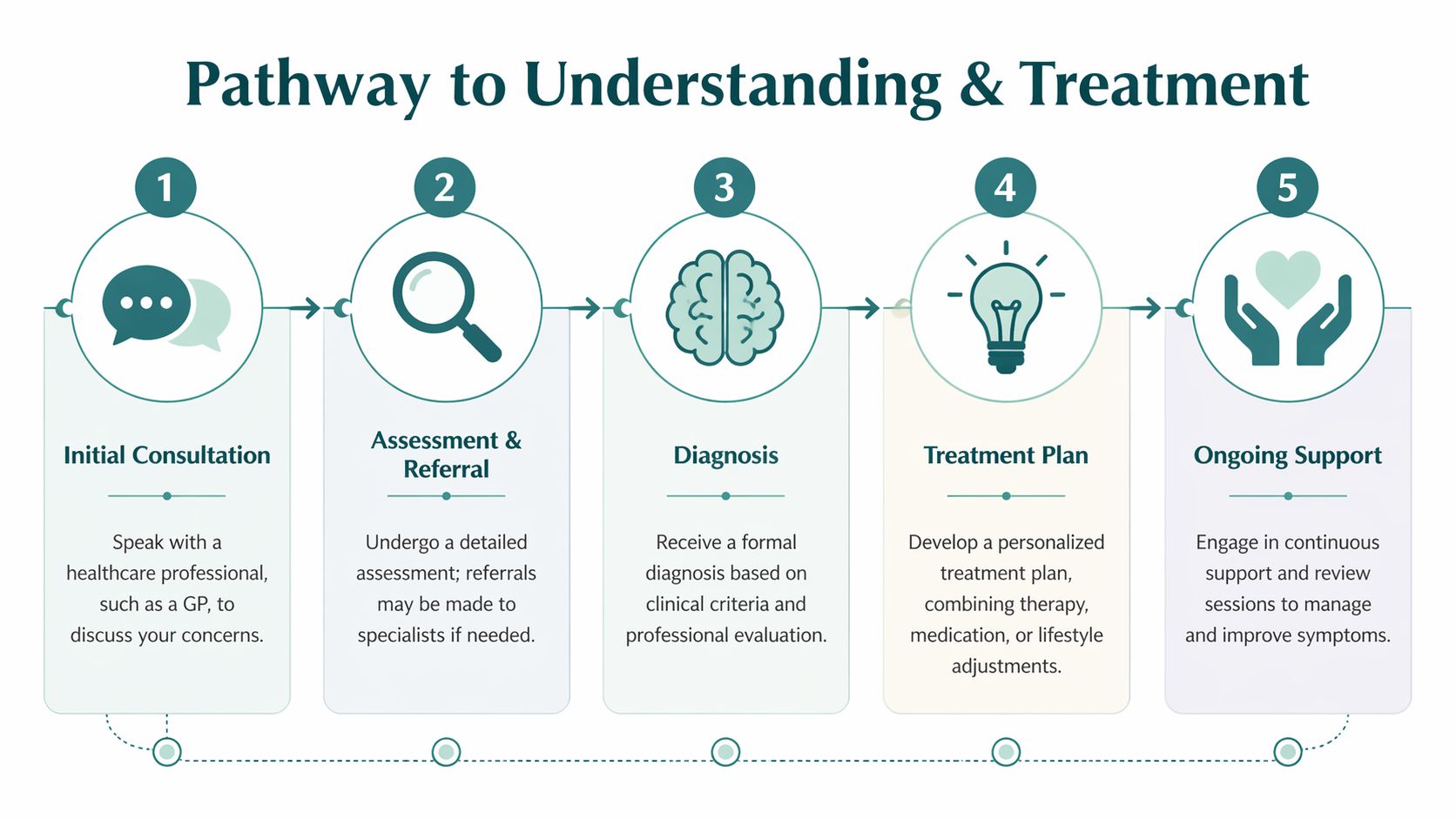
Many people delay getting help because they assume an anxiety assessment will be long, uncomfortable, or hard to access. In practice, the process is usually much more straightforward. A good assessment works like a careful map. It identifies what type of anxiety is present, what may be worsening it, and which treatment is most likely to help.
That clarity matters. Anxiety often creates uncertainty, and uncertainty is one of the very things that keeps anxiety going.
What happens at the first appointment
A proper first appointment is more than a quick checklist. The clinician is trying to answer several practical questions. What kind of anxiety is this? How severe is it? What else could be contributing? How much is it interfering with daily life?
You can expect questions about:
- The pattern of symptoms: Is the anxiety constant, situation-specific, social, panic-based, or tied to health worries?
- The level of interference: Has the person started avoiding school, work, travel, sleepovers, meetings, shopping, or driving?
- The timeline: Did it build gradually, appear after a stressful event, or come on suddenly?
- The wider clinical picture: Are there signs of depression, trauma, burnout, autism, ADHD, sleep problems, or a physical health issue that could overlap?
Questionnaires may be used, but they are only one tool. They support clinical judgement. They do not replace it.
A careful assessment should also consider physical symptoms that can mimic or worsen anxiety, such as palpitations, dizziness, breathlessness, hormonal changes, or medication side effects. That is one reason a medical review can be so helpful. It reduces guesswork.
The treatments most people are offered
Treatment is matched to the person, not just the label. Mild or early anxiety may respond well to guided self-help, targeted changes to routine, and psychological therapy. More entrenched anxiety often needs a fuller treatment plan.
For generalised anxiety disorder, cognitive behavioural therapy is often offered first. CBT helps people spot patterns that keep anxiety active. It teaches them to test fearful predictions, reduce avoidance, and respond differently to uncertainty and physical sensations. The WHO anxiety disorders overview notes that both psychological treatment and medication can reduce symptoms meaningfully.
Medication can also be appropriate, especially when symptoms are persistent, severe, or making therapy hard to engage with. SSRIs are commonly used. They are not a sedative and they do not erase personality. Their role is to turn down the volume of the alarm system so the person can function and recover more consistently. The right choice, dose, and follow-up matter, which is why consultant-led review is valuable.
The best plan often combines approaches. For one person, that may mean CBT and school support. For another, it may mean medication, therapy, sleep work, and workplace adjustments.
What good treatment looks like in real life
Recovery usually happens in steps. A child gets back into class without tears. A teenager manages the bus again. An adult attends a meeting, answers emails without dread, or goes to the supermarket without scanning for the nearest exit.
Those gains may sound small from the outside. For the person living with anxiety, they are often major signs that life is opening up again.
Choosing a route to care
In the UK, many people start with their GP, and that remains an appropriate option. The difficulty is that anxiety care can become fragmented. Waiting times vary, follow-up may be limited, and families, schools, or employers are sometimes left unsure what to do while symptoms continue.
Private care can shorten that gap between concern and treatment. At Haven Medical, the aim is not limited to providing information. It is to move from information to action through timely, consultant-led assessment, a clear diagnosis where appropriate, and treatment planning that also takes account of school demands, family pressures, and workplace realities.
That wider view is often what people need. Anxiety does not exist only in a clinic room. It shows up in attendance records, missed deadlines, poor sleep, family conflict, and loss of confidence.
Questions worth asking when seeking care
If you are arranging an assessment for yourself, your child, or an employee, these questions help bring the process into focus:
- Who will carry out the assessment, and what is their clinical experience with anxiety disorders?
- How will physical health factors be considered if symptoms overlap?
- Which treatments are suitable for this specific type of anxiety?
- How will progress be reviewed, and what happens if the first plan does not help enough?
- Will the recommendations be practical for home, school, or work?
Clear answers make it easier to choose care with confidence. They also help separate generic reassurance from properly structured treatment.
Supporting Anxiety in Schools and Workplaces
In practice, schools and employers often notice anxiety before a clinician does. They see the pattern rather than the label. A pupil starts missing registration and complains of stomach aches on Monday mornings. An employee who was once steady begins avoiding meetings, arriving late, or going silent under pressure. If those changes are treated only as poor motivation or poor performance, anxiety often becomes harder to reverse.
In UK reporting, 526,000 workers were suffering from work-related anxiety or depression in 2024/25, and only half sought help due to stigma, according to Pharmacy Times reporting on underdiagnosed and undertreated anxiety disorders. For schools and employers, the message is simple. Waiting for a person to declare that they are struggling is not a reliable system when fear, embarrassment, and self-blame are part of the problem.

What support looks like at work
Good workplace support works like a handrail on a staircase. It does not remove the stairs. It makes it easier and safer to keep going.
That usually means reducing avoidable uncertainty. Anxiety often feeds on unpredictability, mixed messages, and fear of being caught out. Clear expectations, calm communication, and reasonable adjustments can lower that background threat level enough for someone to function well again.
Helpful workplace steps include:
- Predictable communication: Give notice for presentations, major meetings, deadline changes, and travel where possible
- Reasonable adjustments: Consider quieter workspaces, flexible start times, remote attendance for some meetings, or a phased return after sick leave
- Manager training: Help line managers recognise distress, respond without judgement, and know when to suggest clinical help
- Defined referral routes: Make access to assessment, therapy, occupational health, or nurse-led follow-up easy to understand
This matters for productivity, retention, and safety. It also matters for trust. Staff are more likely to ask for help early when they believe the response will be practical rather than punitive.
What support looks like in schools
In children and teenagers, anxiety often appears indirectly. A young person may not have the words to say, “I am anxious about school.” They may say they feel sick, ask to stay home, freeze in lessons, become unusually angry, or spend hours chasing perfect work because making a mistake feels unbearable.
Schools can help by making the day feel more manageable rather than more threatening. Small changes are often more useful than dramatic ones, especially when they are consistent.
Helpful school responses include:
- A calm first conversation: Start with curiosity and specific observations, not sanctions
- Small, practical adjustments: Use quiet check-ins, supported arrivals, a temporary reduced exposure plan, or structured transitions between lessons
- Consistent adults: Give the pupil one or two reliable points of contact so support feels predictable
- Family coordination: Agree the plan with parents or carers so home and school are not sending mixed messages
Exam periods often increase anxiety, even in pupils who usually cope well. Uncertainty is a common trigger, which is why clear information helps. For families who want to reduce guesswork around assessment periods, this guide to GCSE mock exams explains what students can expect and how to prepare without adding unnecessary pressure.
One question often changes the tone of a school or workplace conversation: What is making participation harder right now, and what is the smallest helpful adjustment?
Practical support should lead somewhere
Support inside a school or workplace has limits. A teacher cannot diagnose an anxiety disorder. A manager should not become a therapist. Their role is to notice patterns, respond sensibly, reduce avoidable pressure, and help the person reach proper care when needed.
That link between support and treatment is where many people get stuck. Services may be hard to access, advice can be vague, and schools or employers are often left trying to contain a problem that needs formal assessment. A private, consultant-led route can be helpful here, particularly when symptoms are affecting attendance, performance, exams, family life, or fitness for work and a clear plan is needed quickly.
Culture still matters. Policies, posters, and awareness campaigns help only if the everyday response is calm, consistent, and credible. Standards can remain high while unnecessary barriers are removed. That is how schools and employers support recovery without pretending anxiety is only a matter of trying harder.
How Haven Medical Provides Expert Anxiety Care
Effective anxiety care needs more than reassurance or general tips. It needs a careful assessment, a clinician who can sort anxiety from other possible causes, and a plan that matches the person’s symptoms, circumstances, and responsibilities at home, in school, or at work.
Haven Medical offers that kind of consultant-led private care in a way that is practical for real life. For some people, the right starting point is a private GP appointment. That can help clarify what is happening, check for physical factors that may be adding to symptoms, and decide whether psychiatry, psychology, or another form of follow-up is needed. For others, especially where symptoms are severe, complicated, or already clearly affecting function, a more focused psychiatric or psychological assessment may be the better first step.
Care that matches the problem
Anxiety is not one single problem, so it rarely responds well to a one-size-fits-all approach. A useful way to picture good care is as triage followed by targeted treatment. First, someone works out what is driving the symptoms. Then the right type of help is put in place.
At Haven Medical, that may involve:
- Private GP care for an initial assessment, review of symptoms, and coordination of onward referrals
- Psychiatry when diagnosis is unclear, medication is being considered, risk needs closer oversight, or symptoms are more severe
- Psychology when structured therapy such as CBT is likely to help
- Nurse-led support for follow-up, monitoring, and practical continuity between appointments
This can be especially helpful when anxiety is affecting attendance, exam performance, work capacity, sleep, or family life, and a school, parent, or employer needs a clear clinical plan rather than repeated guesswork.
When an assessment is sensible
A formal appointment is worth considering when anxiety is persistent, disruptive, or starting to narrow daily life. In practice, that may mean someone is avoiding lessons, meetings, travel, social contact, presentations, or ordinary routines because fear is beginning to set the agenda.
Assessment also becomes more useful when the picture is mixed. Panic symptoms, low mood, burnout, neurodevelopmental questions, physical health concerns, and medication decisions can overlap. Anxiety can look simple from the outside while being more layered underneath, much like a warning light on a dashboard. The light matters, but you still need to find the actual fault.
Earlier input often makes the next steps clearer.
A clearer route into care
One of the gaps in many anxiety resources is that they explain the condition well but stop short of showing people how to act on that information. Haven Medical is designed to bridge that gap. Individuals can seek assessment for themselves. Parents can get a clearer understanding of what support a child may need. Schools and employers can point someone towards a proper clinical route while keeping their own role appropriate and bounded.
If you want to explore those options, you can read more about the clinic and available services at Haven Medical, or contact the team to discuss an assessment. For many people, the turning point is not a dramatic event. It is having the right clinician, asking the right questions, at the right time.