




Late at night, the search often starts the same way. A parent sits with school emails open, half-finished notes on the kitchen table, and a browser tab that reads “autism specialist near me”. Or an adult finally decides that years of feeling different, exhausted by social effort, and misunderstood at work or in relationships deserve a proper answer.
That search carries a lot. Hope, worry, relief, scepticism, and sometimes guilt for not doing it sooner. Individuals aren’t just looking for a name on a map. They’re trying to find someone trustworthy, qualified, and calm enough to guide them through a process that can feel opaque.
A good assessment should bring clarity, not confusion. It should tell you who is involved, what will happen, how conclusions are reached, and what support follows next.
Your Search for an Autism Specialist Starts Here
People usually start with geography. They type “autism specialist near me” because local care feels easier, more practical, and less disruptive. That makes sense. But “near me” shouldn’t be the only filter. The right clinician may be local, or they may be the nearest specialist with the right experience for your age group, presentation, or communication profile.
The most common mistake I see is choosing the first clinic that mentions autism on its website. That’s not enough. Autism assessment is a specialist task. It needs proper clinical training, a structured pathway, and a team that knows what can be missed, especially in girls, women, high-masking adults, and people whose difficulties have been written off as anxiety, shyness, or personality.
Practical rule: Don’t choose a clinic because it appears first in search results. Choose it because you can clearly identify who assesses, how they assess, and what standard they follow.
There’s also an emotional trade-off to recognise. Some families wait because they want absolute certainty before booking. Others rush because the uncertainty feels unbearable. Neither extreme helps much. What works better is a steady approach. Confirm the specialist’s credentials, understand the pathway, ask direct questions, and make sure the outcome will be usable for school, workplace, or healthcare planning.
Three things matter most at the start:
- Clinical fit: Does the specialist assess children, adolescents, or adults, and do they understand complex presentations?
- Process quality: Is the assessment based on recognised tools and a structured clinical formulation?
- Aftercare: Will you receive a clear report and guidance for next steps, not just a label?
If you’re feeling overwhelmed, that reaction is normal. The process becomes much more manageable once you know who does what, where to look, and what a sound assessment includes.
Understanding the Different Types of Autism Specialists
The term “autism specialist” gets used loosely. In practice, several professionals may contribute to assessment, and their roles are not interchangeable. Knowing the difference helps you avoid paying for the wrong appointment or joining a waiting list that doesn’t meet your needs.
Who usually leads an assessment
In the UK, a Consultant Psychiatrist, Clinical Psychologist, Developmental Paediatrician, or a multi-disciplinary neurodevelopmental team may lead or coordinate diagnosis, depending on age and setting. For children, paediatric and child mental health services are common routes. For adults, psychiatry and clinical psychology are more typical.
A thorough assessment often includes more than one professional because autism affects communication, social interaction, behaviour, sensory experience, and day-to-day functioning. One clinician can contribute valuable expertise, but a team usually provides the richer picture.
Comparing Autism Assessment Specialists in the UK
| Specialist Title | Key Qualification | Primary Role in Assessment | Best For |
|---|---|---|---|
| Consultant Psychiatrist | Medical degree with specialist psychiatric training | Leads diagnostic formulation, reviews mental health overlap, considers differential diagnosis | Adults, adolescents, complex presentations, co-occurring mental health concerns |
| Clinical Psychologist | Doctoral training in clinical psychology | Cognitive and behavioural assessment, developmental formulation, structured interviews | Children, adolescents, adults needing detailed psychological profiling |
| Specialist Speech and Language Therapist | Professional training in speech and language therapy | Examines social communication, pragmatic language, interaction style | Children with communication differences, cases where language profile matters |
| Developmental Paediatrician | Medical degree with paediatric specialist training | Reviews child development, early history, neurodevelopmental concerns | Younger children, developmental delay, broader child health questions |
What each specialist adds
A Consultant Psychiatrist is particularly useful when autism may overlap with anxiety, depression, trauma, OCD, ADHD, or sleep difficulty. They’re trained to distinguish conditions that can look similar on the surface.
A Clinical Psychologist often takes a detailed developmental and behavioural view. They may be especially helpful when the question isn’t only “Is this autism?” but also “How does this person process information, cope socially, and function day to day?”
A Specialist Speech and Language Therapist helps when the communication profile is unclear. Parents sometimes say, “They speak a lot, so language can’t be the issue.” That misses the point. Autism often affects the social use of language, not only speech development.
A Developmental Paediatrician is often central in child assessment, especially where there are early developmental concerns, learning needs, or questions that sit across health and education.
A specialist title matters less than the quality of the assessment model behind it. The strongest services explain who is involved, why they are involved, and how they reach a conclusion together.
If a clinic offers an autism diagnosis but can’t tell you who conducts it, who reviews it, and how communication or developmental history are examined, keep looking.
Where to Find a Reputable Autism Specialist in the UK
It often starts the same way. A parent has spent months hearing that their child is anxious, oppositional, shy, or “probably fine,” or an adult has recognised their own traits and wants a proper answer without another vague conversation. At that point, typing “autism specialist near me” into a search engine rarely gives enough to make a safe decision. A better approach is to use a few reliable routes and compare services with a clear head.
The NHS route
For children and adults alike, the GP is often the first practical step. They can refer into the local autism pathway, which may sit in CAMHS, paediatrics, adult mental health, or a dedicated neurodevelopmental team.
The main advantage of the NHS route is cost. The main trade-off is time. In some areas, referrals are processed reasonably quickly and the pathway is clearly explained. In others, families wait a long time for triage, then longer for assessment. If school support, workplace adjustments, or a clearer explanation for day-to-day difficulties is urgently needed, that delay matters.
It also helps to ask one direct question early: which team carries out autism assessments in your area? Families are sometimes passed between services because the local setup is not obvious from the start.
The private route
Private assessment is often chosen for speed, but speed should not be the only reason. The stronger reason is fit. Some clinics have more experience with adult diagnosis, female presentation, co-occurring ADHD, or people who mask well in brief appointments.
Search terms can help narrow the field:
- “Consultant psychiatrist autism assessment adults [your town]”
- “Clinical psychologist autism assessment children [your county]”
- “Private autism assessment near me NICE guideline”
- “Autism specialist telehealth UK”
Then stop reading the marketing language and start reading the service details. A reputable clinic usually tells you who assesses, which age groups they see, what information they collect, how long the process takes, and what you receive at the end. If those basics are missing, I would treat that as a warning sign.
Directories and practical filters
Professional registers are useful because they let you check whether a clinician is real, regulated, and working within the right scope. Doctors should be traceable through the GMC. Psychologists and speech and language therapists should be traceable through the HCPC.
Professional bodies and charities can also help you find names worth shortlisting. The British Psychological Society, the Royal College of Psychiatrists, and the National Autistic Society are sensible places to start when you want to compare options beyond whatever appears first on Google.
One practical point is often overlooked. Nearer is convenient, but convenience is not the same as quality. A clinic 20 minutes away that cannot explain its method is a poorer choice than a clinic farther out, or online, that gives a clear assessment pathway, named clinicians, and a report that schools, employers, and GPs can use.
If a clinic advertises autism assessments but gives no clinician names, no registration details, and no explanation of how conclusions are reached, move on.
That decision saves time, money, and stress later.
How to Evaluate and Choose the Right Specialist for You
A family often reaches this stage tired, pressed for time, and worried about getting it wrong. The clinic website looks polished, the receptionist sounds reassuring, and the price is clear. None of that tells you whether the assessment itself will stand up to scrutiny from a GP, school, university, employer, or another clinician.
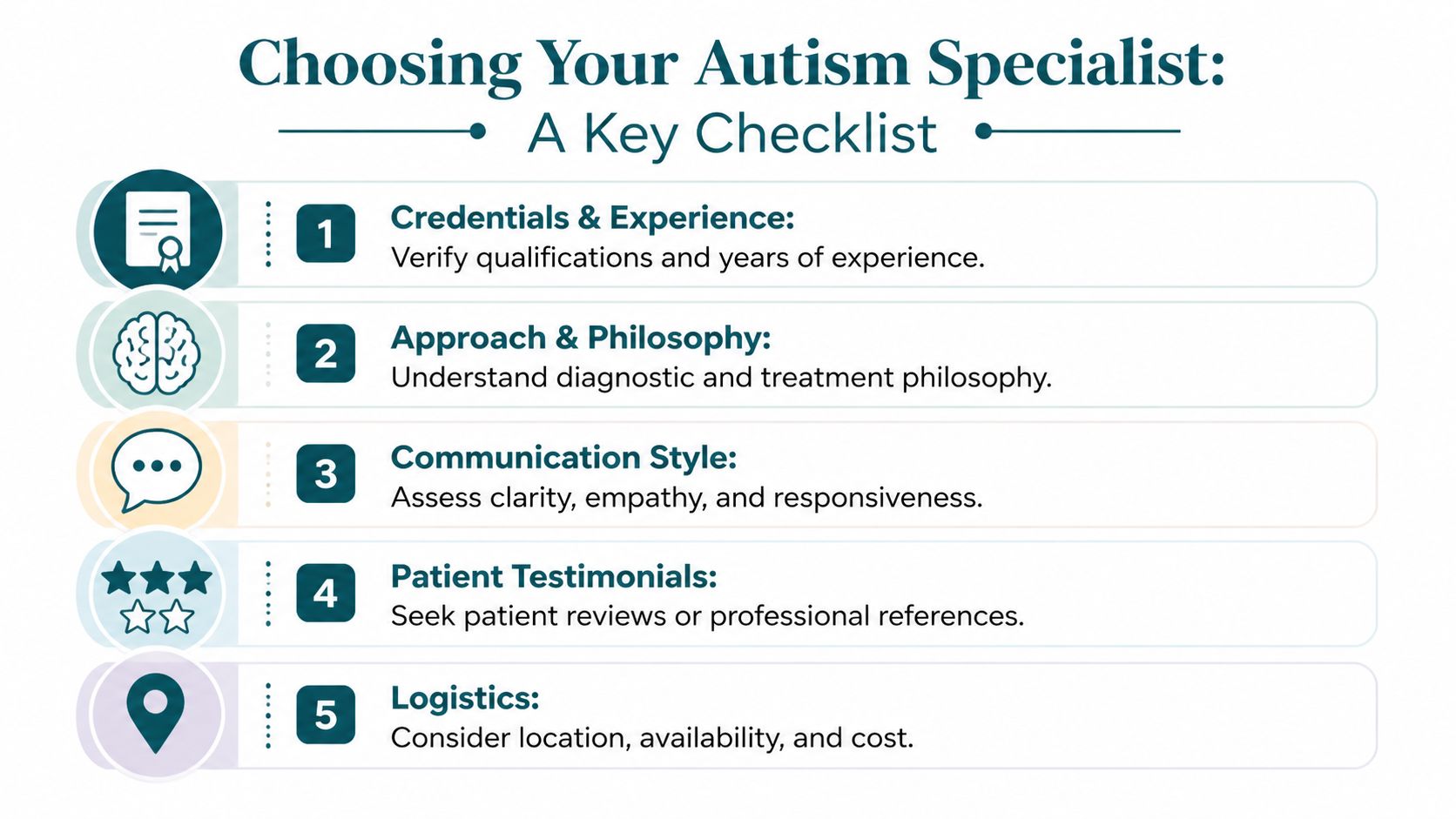
A good choice comes down to method, clinical judgement, and fit. In practice, families are not only choosing a professional. They are also choosing how much clarity, support, and credibility they are likely to get at the end of a stressful process.
Starting with the basics
Check who is assessing you or your child. The clinician should be named, and their registration should be easy to verify through the GMC or HCPC, depending on profession. After that, look at their day-to-day work. Autism assessment should be a regular part of their clinical practice, especially for the age group and presentation you are asking them to assess.
Then ask how the assessment is carried out. A clinic should be able to explain its pathway in plain English, including history-taking, observation, collateral information, and how conclusions are reached. The verified summary linked to the private autism pathway evidence review describes structured private pathways that use staged assessment rather than a single quick appointment.
That matters for a simple reason. A clear process usually reflects careful thinking.
Questions worth asking before you book
The quality of the reply matters almost as much as the content. Clear, specific answers usually come from services that know exactly how they work.
- Who carries out the assessment: one clinician, or more than one professional where needed?
- What information is included: developmental history, direct observation, structured interviews, school or workplace information, and input from family or someone who knows the person well?
- Who is the service designed for: children, teenagers, adults, or a specific subgroup such as high-masking adults?
- How do you approach complex presentations: for example, co-occurring anxiety, ADHD, trauma, learning disability, or long-term masking?
- What will the written report contain: diagnosis, reasoning, strengths and difficulties, and practical recommendations?
- What support comes after the appointment: feedback, signposting, or advice on next steps?
For adults who are still working out whether to pursue a formal assessment, it can help to review independent autism diagnosis resources for adults before booking. That can make your questions sharper and the first call less overwhelming.
How to spot weak practice
Be cautious with any service that relies heavily on one questionnaire, avoids speaking to someone who knew the person in childhood when that history is available, or blurs the line between screening and diagnosis. Those shortcuts can miss the very patterns the assessment is supposed to examine.
I also advise families to listen for overconfidence. Careful clinicians explain uncertainty where it exists, especially in people with overlapping mental health needs or a long history of masking. They do not promise a diagnosis in advance, and they do not treat autism assessment as a sales process.
Ask, “How do you reach your conclusion, and how will that be explained in the report?”
That question usually brings the actual quality of the service into view.
Weighing fit, convenience, and route of care
The right specialist is not always the nearest clinic or the cheapest one. Some families need evening appointments, online options, or a service experienced in adult diagnosis. Others need a team comfortable with school evidence, safeguarding issues, or complicated developmental histories. Those are real trade-offs, and naming them early prevents disappointment later.
A clinic such as Haven Medical may suit people who want a consultant-led private assessment within a broader medical service, particularly when autism concerns overlap with mental health or developmental questions. That does not make it the right choice for everyone. It means the service model may fit some patients better than others, and it should be judged by the same standards as any other provider.
Preparing for Your Autism Assessment Appointment
You finally have an appointment date, and the worry often shifts. Families stop asking, “How do we find the right specialist?” and start asking, “What do we need to bring, and what if we forget something important?” That reaction is normal. Good preparation does not mean building a perfect life history. It means giving the clinician enough real-world detail to see patterns across childhood, school, work, home, and relationships.

What a thorough assessment usually involves
A proper autism assessment in the UK is usually built from several parts. The clinician or team will look at developmental history, speak with the person being assessed, and often gather collateral information from someone who knows them well. Some services also use structured tools such as the ADI-R and ADOS-2 alongside clinical interviews and review of records under NICE guideline NG128.
In practice, these tools answer different questions. ADI-R is a detailed developmental interview, often done with a parent or another adult who knew the person well in childhood. ADOS-2 is a structured observational assessment adapted to age and communication level. Neither tool should be treated as a shortcut to diagnosis. Good clinicians interpret them in context, especially when masking, anxiety, trauma history, ADHD, or long-standing mental health difficulties may blur the picture.
That matters for adults in particular. By the time someone reaches assessment in their twenties, thirties, or later, they may have spent years compensating socially, copying others, or being treated for something related but different.
What to gather before the appointment
Bring what you have. Missing documents do not make an assessment impossible.
Useful material often includes:
- Developmental history: early milestones, pretend play, friendships, routines, sensory reactions, and communication style
- School information: reports, SEN paperwork, teacher comments, exclusions, attendance concerns, or pastoral notes
- Current examples: brief notes about sensory overload, shutdowns, repetitive behaviours, social misunderstandings, fatigue after social contact, or difficulty with change
- Health history: previous diagnoses, therapy, medication, sleep issues, ADHD concerns, and mental health treatment
- Collateral input: a parent, partner, sibling, or trusted adult who can describe patterns over time
I usually advise families to focus on examples, not labels. “He covered his ears in assembly and refused birthday parties” is more useful than “sensory issues since childhood.” “I script conversations before work meetings and crash afterwards” is more useful than “social difficulty.” Specific examples help the assessor judge frequency, severity, and how long the pattern has been present.
For adults putting the story together later in life, it can help to review autism diagnosis resources for adults before the appointment. Used carefully, that kind of material can help organise memories and questions. It should not be used to rehearse answers.
How to prepare without over-preparing
The strongest assessments are usually the most honest ones. There is no prize for sounding more impaired, more articulate, or more certain than you really feel.
A short note on your phone or one page of bullet points is usually enough. Include examples from different settings, note anything that has changed over time, and mark the areas that cost the most energy. If your experience is inconsistent, say that. Many autistic people do better in structured settings and struggle badly in less predictable ones. That difference is useful clinical information.
If childhood history is patchy, say so directly. Many adults do not have access to a parent, old school reports, or anyone who can fill in those early years. A skilled clinician will work with the evidence available and be clear about any limits that creates.
On the day of the assessment
Answer plainly. If the honest answer is “I don’t know,” “sometimes,” or “only when I’m overwhelmed,” say that.
If the appointment is remote, ask beforehand what will happen by video and whether any part may need to be completed in person. Some clinics use telehealth well for history-taking and interview work. Observation-based elements may depend on the person’s age, presentation, and the service model.
A few practical steps help:
- Keep notes brief. Bullet points are easier to use than a long written statement.
- Bring another person if the clinic allows it. They may notice patterns you miss or minimise.
- Leave recovery time afterwards. Even a well-run assessment can be draining.
You do not need to perform autism. You need to describe your day-to-day reality as accurately as you can.
How Haven Medical Delivers Expert Autism Assessments
A private assessment can be the right choice when the main problem is delay, or when the diagnostic picture is complicated by anxiety, low mood, trauma history, ADHD traits, or physical health concerns that need careful separation.
Haven Medical uses an expert-led model within a private service that includes multiple clinicians with specific expertise in diagnosing autism. That setup can help when someone’s presentation does not fit neatly into one box, because the assessment sits in a broader clinical context rather than as a stand-alone screening exercise.
What matters here is not the clinic name. It is the service model. In a robust pathway, there is a clearly identified senior clinician responsible for the diagnostic reasoning, the standard of the report, and the explanation given to the patient or family afterwards. For many people, that reduces one of the biggest stresses in this process. Uncertainty about who is making the decision and how that decision will be justified.
This kind of service is often a better fit for people who want clarity about three practical points. Who will assess them. Which diagnostic tools and interviews are used. What the final report will contain, including whether it explains strengths, difficulties, differential diagnoses, and recommended supports in plain language.
There are trade-offs. Private care is faster for many families, but it comes with cost, and speed alone does not make an assessment good. The standard still depends on clinician experience, careful history-taking, and a report that stands up to scrutiny from schools, employers, GPs, or other services.
If you are comparing providers, Haven Medical is one example where quality and experience is uppermost. The useful question is whether the clinic can explain its process clearly, answer direct questions without sales language, and show who carries clinical responsibility from first appointment to final report.
Your Next Steps and Frequently Asked Questions
A search for an autism specialist near me usually begins in uncertainty. It gets easier once you separate location from quality, check credentials carefully, and choose a service that uses a structured diagnostic pathway rather than a shortcut.
If you’re stuck, keep the next step small. Pick three providers. Verify registrations. Ask the same short list of questions. Compare the answers. Good services make this easier, not harder.
Frequently asked questions
What is the difference between an educational view and a clinical diagnosis
A school may recognise autistic traits and put support in place based on observed needs. A clinical diagnosis is made by qualified healthcare professionals through a formal assessment process. Schools can be very helpful, but they don’t replace a medical or psychological diagnostic opinion.
What can I do while waiting for an assessment
Start gathering background information. Keep brief notes about sensory issues, routines, communication patterns, and situations that trigger distress or exhaustion. Ask school or work for practical adjustments based on need, even before diagnosis, if those adjustments are reasonable and clearly explained.
What should happen after a diagnosis
You should receive a feedback discussion, a written report, and guidance about support. That may include school planning, workplace adjustments, psychoeducation, family guidance, and referrals where needed. Diagnosis should be the start of clearer support, not the end of the conversation.
What if the assessment says it isn’t autism
That outcome can still be useful if the clinician explains what they found instead. A good assessment should clarify whether another neurodevelopmental, mental health, communication, or behavioural picture better accounts for the difficulties.
If you’re ready to move from searching to action, visit website, click to book, or call to book and speak with a clinician-led team about the next step.