




You might be reading this after another missed deadline, another forgotten school email, or another evening spent thinking, “Why does everything feel harder for me than it seems to for other people?” For some families, the worry looks different. A child can’t sit through homework without tears, arguments, or constant redirection, and everyone ends the day exhausted.
That doesn’t automatically mean ADHD. But it does mean your difficulties deserve a careful, respectful look.
Across the UK, more people are recognising patterns that may fit ADHD, yet getting clear answers isn’t always straightforward. NHS England reported in 2024 that more than 200,000 people were waiting for an ADHD assessment in England, and many waits were measured in years rather than months according to CHADD’s overview of ADHD prevalence and UK access pressures. When people feel stuck between concern and delay, frustration is understandable.
A clear map helps at this stage. Good adhd diagnosis and treatment isn’t about collecting labels. It’s about understanding what’s been happening, working out whether ADHD is the right explanation, and building support that fits real life at home, in school, and at work.
Understanding the Journey to an ADHD Diagnosis
A diagnosis usually begins with a pattern that keeps repeating. An adult may notice they can handle urgent, high-pressure tasks yet still miss routine emails, lose track of appointments, or freeze when paperwork piles up. A parent may realise their child is energetic, yet also consistently struggling to follow instructions, organise schoolwork, or recover from frustration.
These patterns can feel messy and hard to name. ADHD often works like a faulty filter. The person may be intelligent, motivated, and trying hard, but everyday information does not stay organised in the way it should.
Why people often wait too long
Many people delay seeking an assessment because ADHD is still misunderstood. Some expect it to look only like obvious hyperactivity. In real life, it can also show up as chronic lateness, unfinished tasks, emotional overload, impulsive decisions, or a mind that stays busy long after the day has ended.
Confusion often leads to self-blame.
Adults may decide they are lazy, careless, or “just bad at life.” Parents may be told their child needs firmer boundaries, more discipline, or time to mature. Those explanations can sound plausible for a while, which is why the path to diagnosis is often longer than it should be.
Practical rule: If problems with attention, organisation, impulsivity, or restlessness consistently appear across daily life, seek a proper assessment rather than trying to “push through” indefinitely.
What the UK picture means for you
Long NHS waiting lists have changed the experience of getting assessed in the UK. For many people, the problem is no longer deciding whether to ask for help. The problem is how to get clear answers within a reasonable timeframe.
That is why it helps to understand both routes early. The NHS pathway remains the right option for many families and adults, but private assessment is often considered when delays are severe, work or school is suffering, or daily life is becoming harder to hold together. A good guide should prepare you for both, rather than pretending there is only one realistic path.
If you’re preparing to raise the issue with a GP or specialist, a practical starting point is this guide on preparing for an ADHD assessment. It can help you organise what you want to say, especially if your mind goes blank in appointments.
What a helpful journey looks like
A careful diagnostic process should reduce uncertainty. By the end, you should have a clearer picture of what is happening, whether ADHD fits, and what support makes sense next.
That usually includes four things:
- A clear explanation of the symptoms being assessed
- Consideration of other possible explanations, not just ADHD
- A reasoned clinical judgement based on history and current difficulties
- Practical next steps for treatment, coaching, school support, or workplace adjustments
Diagnosis is more than a label. It is like getting the right map after taking wrong turns for years. Whether you are seen through the NHS or privately, you deserve an assessment that is careful, respectful, and useful in real life.
Recognising the Signs of ADHD in Adults and Children
ADHD isn’t one single presentation. Some people mainly struggle with attention and organisation. Others show more restlessness and impulsivity. Many have a mixture of both.
The pattern can also change with age. A child may climb, interrupt, and bolt ahead without thinking. An adult may look outwardly calm but feel intensely restless inside, jumping between tabs, tasks, and thoughts all day.

The three main presentations
Predominantly inattentive presentation
This is often missed because it doesn’t always look disruptive. The person may seem bright, thoughtful, and well intentioned, yet daily life keeps slipping out of their hands.
Common real-world examples include:
- Starting strongly but not finishing projects, coursework, admin, or chores
- Losing track of instructions halfway through, even when trying hard to listen
- Misplacing essentials such as keys, chargers, school letters, or work documents
- Avoiding tasks that need sustained effort like reports, forms, revision, or budgeting
- Making careless mistakes not because of lack of ability, but because attention drifts
In children, this may show up as incomplete homework, forgotten kit, and frequent daydreaming in class. In adults, it often appears as chronic disorganisation, poor follow-through, and a sense of always being behind.
Predominantly hyperactive-impulsive presentation
This is the version many people recognise first. In children, it may look like constant motion, blurting out answers, grabbing before thinking, or difficulty waiting their turn.
Adults can present differently. They may not run around the room, but they often describe:
- Inner restlessness that makes relaxing difficult
- Talking over people or finishing others’ sentences
- Acting quickly without enough pause
- Feeling driven to keep moving or doing
- Impatience in queues, meetings, or slow conversations
A child may bounce from activity to activity. An adult may look productive on the surface while feeling mentally over-revved and impulsive underneath.
Combined presentation
Many people have both sets of difficulties. They struggle to focus, organise, and complete tasks, while also dealing with impulsivity, fidgeting, or emotional reactivity.
That combination can be especially exhausting. Someone may have plenty of ideas and energy, but little consistency in turning plans into finished work.
ADHD isn’t defined by being busy or distracted occasionally. The pattern has to be persistent, broad, and impairing.
What clinicians look for formally
For a formal diagnosis, DSM-5-TR criteria require clinicians to identify at least 6 symptoms for children up to age 16, or 5 symptoms for those 17 and older. Those symptoms must be present for at least 6 months, have appeared before age 12, and cause impairment in two or more settings, according to this DSM-5-TR and ICD-11 comparison summary from Qbtech.
That “two or more settings” rule is one of the biggest points of confusion. A child can’t meet criteria based only on difficulties in one classroom. An adult can’t usually be diagnosed because work feels chaotic if there’s no sign of similar issues elsewhere. Clinicians need a wider picture.
Why symptom lists can be misleading
Many people read an ADHD checklist and recognise themselves immediately. That can be useful. It can also be incomplete.
Several other difficulties can overlap with ADHD-style symptoms, including stress, poor sleep, anxiety, depression, or autism-related traits. That’s why proper assessment matters. The question isn’t only “Do you relate to these symptoms?” It’s “Does ADHD best explain the pattern over time?”
A helpful way to think about it is this:
| Everyday experience | Possible ADHD meaning |
|---|---|
| Forgetting one appointment during a stressful week | Normal human lapse |
| Repeatedly missing appointments, deadlines, and key steps despite strong effort | Could suggest an executive function difficulty |
| Feeling restless during one long meeting | Common |
| Feeling unable to settle, wait, or pace yourself across many situations | Worth exploring clinically |
Recognition is the first step. Diagnosis needs a fuller story.
Your Diagnostic Pathway A Step-by-Step Journey
Uncertainty makes people anxious. Most patients feel calmer once they know what the assessment process involves. A thorough pathway should feel structured, not mysterious.
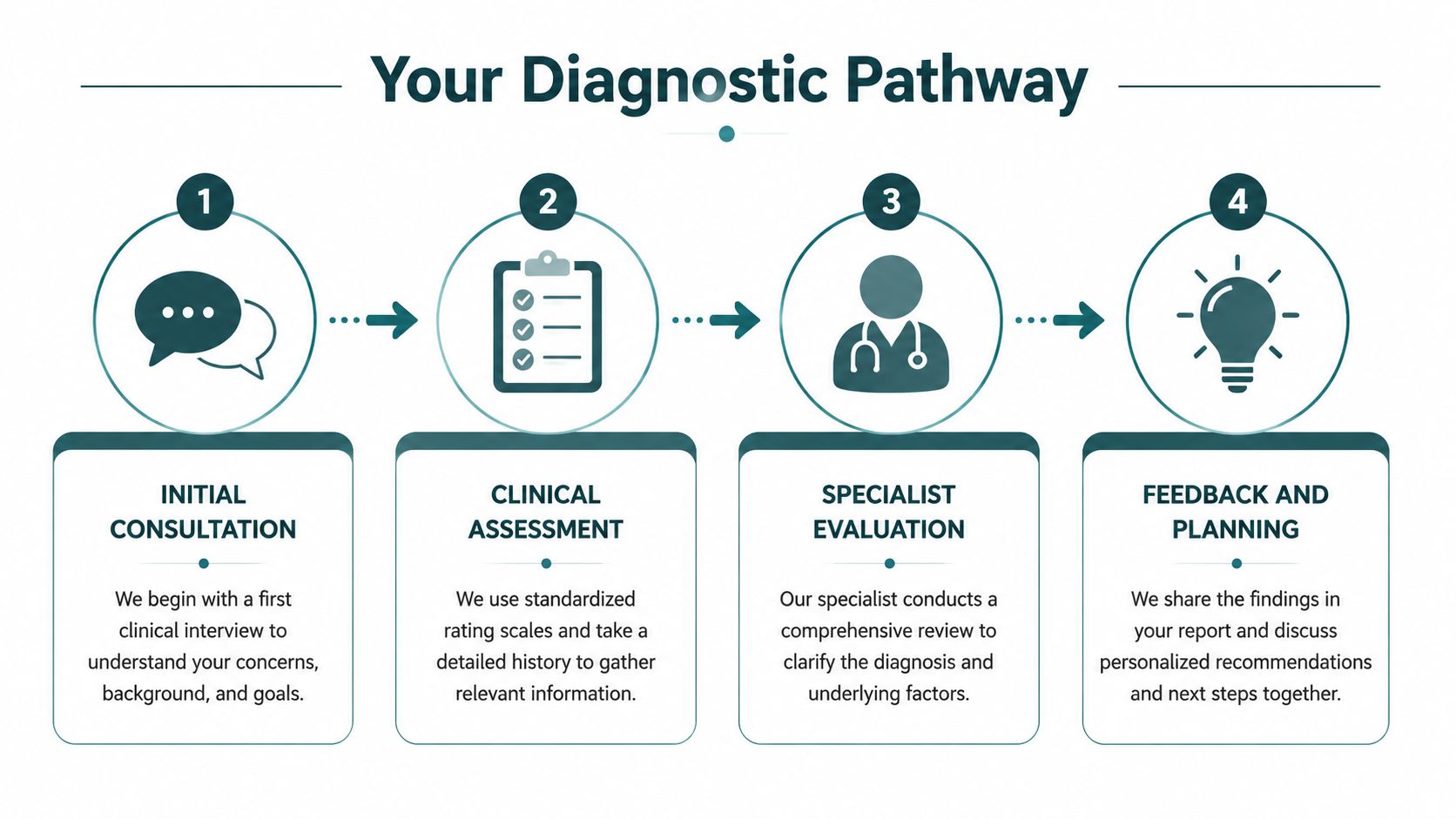
Step one starts before the appointment
Before you see a GP or specialist, write down examples rather than broad labels. “I struggle to focus” is less useful than “I reread the same paragraph three times and still can’t absorb it” or “I miss important work steps unless someone breaks them down for me.”
Gather practical details such as:
- Current problems at work, school, university, or home
- Childhood patterns you remember, or that relatives recall
- Reports from others such as a partner, parent, or teacher where relevant
- Previous mental health history and any existing diagnoses
- Questions you want answered so you don’t leave the appointment unsure
A GP usually needs enough detail to understand why a referral is appropriate. Specific examples make that easier.
What happens during a specialist assessment
A proper ADHD assessment is not a quick yes-or-no chat. It usually includes a detailed clinical interview and a review of how symptoms affect functioning across settings.
Clinicians often explore areas such as:
Developmental history They’ll ask what you were like as a child. ADHD is a neurodevelopmental condition, so the pattern should trace back to earlier life even if it wasn’t recognised at the time.
Current symptoms
They’ll ask about attention, impulsivity, restlessness, organisation, memory, time management, and emotional regulation.Functional impact
This is a major part of diagnosis. The clinician wants to know how the pattern affects school performance, work reliability, relationships, home life, or day-to-day independence.Observer information
Depending on age and circumstances, rating scales or collateral information may be requested from a parent, partner, or teacher.
Why developmental history matters so much
Adults are often surprised by the childhood questions. They may think, “I’m here because work is unmanageable now. Why are we discussing primary school?”
The reason is simple. ADHD doesn’t suddenly appear in adulthood. Adult life may expose the difficulties more sharply because the demands become heavier, but the roots need to be there.
Bring examples from different life stages if you can. School reports, old comments like “bright but disorganised,” or family observations can help build a clearer picture.
What a careful clinician is trying to rule in or rule out
Assessment isn’t just about matching symptoms to a checklist. The clinician also considers whether another explanation fits better, or whether more than one condition may be present.
That review may include discussion of:
- Sleep problems
- Anxiety or low mood
- Autism traits
- Learning difficulties
- Substance use
- Physical health factors
- Medication history
This is part of good practice, not a sign that your concerns aren’t being taken seriously.
What happens after the assessment
You should receive clear feedback. If ADHD is diagnosed, the next steps usually include discussion of treatment options, practical supports, and any follow-up needed. If ADHD is not diagnosed, a good assessment should still give you a coherent explanation and direction for what to do next.
The most reassuring point for many patients is that assessment doesn’t force a single outcome. It creates clarity. Sometimes that clarity is a diagnosis. Sometimes it’s a different answer. Both can be useful if the process is done properly.
Navigating NHS and Private Assessment Pathways
For many individuals in the UK, the core question isn’t only “Do I have ADHD?” It’s “How do I get assessed without getting lost in the system?”
The answer depends on local services, your urgency, your budget, and how much choice you want over who assesses you.
Why the NHS experience varies so much
Many adults feel confused when they hear that someone in one area moved through the system relatively smoothly while someone elsewhere waited far longer. That inconsistency is real. Evidence shows large regional differences in ADHD prescribing and diagnosis, suggesting access is often shaped by local service capacity and commissioning bottlenecks rather than just clinical need, as summarised in this CDC discussion of regional variation in ADHD service activity.
In plain language, your pathway may depend heavily on where you live and what local services are available.
That’s why one person’s experience on the NHS may not predict your own.
How the two routes differ in practice
The NHS route is often the first choice because it can lead into ongoing public care, but delays can be substantial. A private route may offer a faster timeline and more control over scheduling, though it involves direct cost and requires careful planning around follow-up and prescribing arrangements.
Here’s a practical side-by-side view.
| Factor | NHS Pathway | Private Pathway (e.g., Haven Medical) |
|---|---|---|
| Access point | Usually starts with a GP referral and local referral rules | Usually self-funded direct booking or referral depending on provider |
| Waiting time | Can be long and vary by area | Often quicker to arrange |
| Choice of clinician | Usually limited by local service structure | More ability to choose provider or consultant |
| Cost to patient | Usually lower at point of care | Upfront assessment and follow-up costs apply |
| Continuity after diagnosis | Can connect into NHS systems, though local variation still matters | May require discussion with your GP about shared care and ongoing prescriptions |
| Best suited to | People who can wait or need a fully NHS-led route | People who want faster answers or more control over timing |
When private assessment may make sense
A private route can be reasonable if delays are affecting your education, work, safety, or family life. It can also help if you've already spent a long time trying to use referral systems and need a clearer timeframe.
Haven Medical is one example of a private provider offering consultant-led ADHD assessment and follow-up. The key issue is not branding. It's whether the service gives you a thorough evaluation, a clear report, and a realistic treatment plan.
Choose a service that explains its process plainly. You should know who will assess you, what information they'll gather, and what happens after the diagnosis.
Questions worth asking before you book
Ask these before committing to any route:
- Who completes the assessment
- How developmental history is gathered
- Whether collateral information is requested
- What written report you'll receive
- How medication follow-up works if needed
- Whether your GP may be asked to enter a shared care arrangement
Those questions often matter more than glossy marketing or broad promises.
Exploring Evidence-Based ADHD Treatments
A diagnosis can bring relief, but it also raises a new question. What helps?
The best adhd diagnosis and treatment plans are usually multimodal, meaning they combine more than one type of support. Medication may help the brain regulate attention and impulse control. Therapy or coaching can help you build systems that medication alone won't teach. Psychoeducation helps you understand your own pattern without shame.

Medication and what it can and cannot do
Medication is often the first treatment people ask about, and sometimes the one they fear most. It helps to think of it less as a personality change and more like tuning a radio signal. The station is already there, but the signal may be fuzzy, inconsistent, or full of interference. Medication can help the brain lock onto the signal more reliably.
Broadly, treatment discussions may include:
Stimulant medication
These are commonly used in ADHD care and may help with attention, impulsivity, and restlessness.Non-stimulant medication
These may be considered when stimulants aren't suitable, aren't tolerated, or don't provide the right balance of effect.
Medication doesn't create organisation skills by itself. It doesn't automatically fix a filing system, a revision routine, or a difficult work pattern. What it often does is create enough mental steadiness for those tools to start working.
Therapy and coaching build the missing skills
A lot of distress in ADHD comes from repeated breakdowns in everyday systems. You know what you need to do, but you can't sequence it, start it, prioritise it, or stay with it.
That's where psychological support can help. Depending on the person, this may include ADHD-informed CBT, practical coaching, or supportive therapy focused on routine, planning, emotional regulation, and self-criticism.
Examples of useful targets include:
- Breaking large tasks into smaller actions
- Building visual reminders and external prompts
- Creating routines for mornings, study, or handovers
- Reducing avoidance and panic around difficult tasks
- Learning how to pause before impulsive decisions
For many adults, the first big shift isn't productivity. It's understanding that years of struggle were not laziness or lack of intelligence.
Treatment works best when the plan fits the person. Some patients need medication first. Others need structure, education, and coping tools alongside or before that discussion.
Psychoeducation changes the whole picture
Psychoeducation sounds technical, but it means learning how ADHD affects you. That knowledge can transform daily life because it replaces vague self-blame with a more accurate map.
A parent who understands ADHD may stop seeing a child as “not trying.” An employer may realise that verbal instructions alone aren't enough. An adult may finally understand why motivation appears and disappears so unpredictably.
Psychoeducation often covers:
| Area | Why it matters |
|---|---|
| Attention patterns | Helps explain inconsistency rather than assuming lack of effort |
| Executive function | Clarifies why planning and sequencing can be so hard |
| Emotional regulation | Helps people link overwhelm and reactivity to the condition |
| Environmental support | Shows why structure changes outcomes |
| Self-advocacy | Makes it easier to ask for practical adjustments |
Daily strategies still matter
Even with good clinical treatment, daily scaffolding makes a difference. Many people benefit from visible calendars, timers, body-doubling, written checklists, and simplified routines. If you struggle to estimate time or transition between tasks, practical scheduling methods can help. This guide on transform your focus with time blocking gives a useful example of how to turn a vague day into a more manageable one.
What “successful treatment” really means
Treatment is not about becoming a different person. It's about reducing friction so your ability can show up more consistently.
For one person, success means getting through work without panic. For another, it means fewer arguments at home, better school engagement, or finally being able to finish what they start. The plan should be reviewed over time, because needs change with age, environment, and responsibilities.
Implementing Support at School and Work
Treatment doesn't stop in the clinic room. People with ADHD often do better when the environment is adjusted to reduce unnecessary friction.
That's where schools, colleges, universities, and employers can make a real difference. Support is often most effective when it is practical, specific, and agreed collaboratively rather than vaguely “being understanding”.
Helpful support in education
Children and students with ADHD often know more than their output suggests. The gap usually appears in consistency, organisation, and sustained effort.
Useful school or study adjustments may include:
- Preferential seating close to the teacher and away from high distraction areas
- Written instructions alongside spoken instructions
- Chunked assignments broken into smaller deadlines
- Extra processing time for tasks and tests where appropriate
- Check-ins with a named adult to review homework, deadlines, or organisation
- Movement breaks where feasible and appropriate
- Reduced clutter in task presentation so the student can see where to start
A child who forgets every multi-step instruction may not need more telling off. They may need the task written down in three simple steps.
Useful adjustments at work
Adults often compensate for years before seeking help. They may be capable and creative, but the hidden effort is immense. Workplace adjustments can reduce that burden without lowering standards.
Practical examples include:
Clear written follow-up after meetings
This reduces reliance on memory and helps with prioritisation.Protected focus time
Blocking out periods without interruptions can help staff complete complex work.Noise management
A quieter desk location or noise-cancelling headphones may help concentration.Flexible structuring of the day
Some people work better when they can arrange demanding tasks for their most focused periods.Project tools
Shared task boards, reminders, and deadline trackers can make responsibilities visible.
How to start the conversation
People often delay asking for support because they worry they'll sound difficult or incompetent. A simpler approach usually works better. Name the difficulty, explain the impact, and suggest a practical adjustment.
For example:
“I work best when instructions are written down after meetings. That helps me prioritise accurately and reduces avoidable mistakes.”
Managers and teachers don't need to become ADHD specialists to be helpful. They need to respond to patterns, stay open, and work with the person to test what improves functioning.
The principle to remember
Good support is not about giving someone an easier life. It's about removing avoidable obstacles so they can meet expectations more effectively.
When schools and employers take that approach, they often see better follow-through, less conflict, and more consistent performance.
Answering Your Questions on ADHD Diagnosis
Some questions tend to come up at the end of every clinic conversation. Here are the ones people usually need answered most plainly.
How much does a private ADHD assessment cost
Private fees vary by provider, location, and what is included. Because charges differ widely, it's better to ask for a written breakdown before booking. Check the assessment fee, follow-up fees, prescription review costs, and whether a written report is included.
What is shared care
Shared care usually refers to an arrangement where a specialist initiates and stabilises treatment, then a GP may agree to continue prescribing under an agreed plan. This is a common area of uncertainty.
The important point is that shared care is not automatic. A GP may agree, decline, or ask for more information depending on local policy, the quality of the specialist report, and prescribing responsibilities. Ask about this before starting a private route so you understand the likely pathway.
What if I'm told I don't have ADHD
That can feel disappointing, especially if you strongly identified with the possibility. Still, a careful assessment can be valuable even when the answer is no. Ask the clinician:
- What explanation fits better
- What evidence counted against ADHD
- Whether any other support is recommended
- Whether further evaluation would help
A good assessment should not leave you abandoned with a negative result.
Is ADHD overdiagnosed
People often hear this question in the media. In clinical practice, the more useful question is whether the individual assessment is thorough. A rushed process can miss ADHD, and it can also misidentify it. What matters is careful history-taking, evidence from more than one setting, and proper attention to alternative explanations.
Can adults really be diagnosed if no one noticed in childhood
Yes, adults can be diagnosed later in life. The key issue is whether the pattern was present earlier, even if it was misunderstood, masked, or never formally assessed at the time.
If you've recognised yourself or your child in this guide, the next step is to seek a proper assessment rather than staying stuck in uncertainty. If you want to explore a private route, call to book, click to book, or visit website options offered by your chosen provider and ask clear questions about the assessment process, reporting, and follow-up care.