



You may be here because you missed the HPV vaccine at school, you’re booking healthcare privately, or you’re trying to make sense of whether it still matters as an adult. Schools and employers often face a different version of the same problem. They want a clear route for vaccination support, but most public information is built around the standard NHS school programme rather than private access.
That gap leaves people with practical questions. Can you get the vaccine privately in the UK? Who is it for? How does private booking differ from the NHS route? And if you’re an adult, is it still worth discussing?
The short answer is yes. A hpv vaccine private pathway can offer flexibility, clinician-led advice, and easier booking for people who sit outside routine public provision or want a more convenient route. The important part is understanding what the vaccine does, who may benefit, and how to choose the right next step with confidence.
Understanding HPV and the Power of Vaccination
HPV stands for human papillomavirus. It isn’t one single virus. It’s a group of related viruses, and many people will come into contact with HPV at some point in life without ever realising it.
In many cases, HPV causes no symptoms and doesn’t lead to lasting problems. But some types are linked with cancers, including cervical, anal, genital, and head and neck cancers. That’s why HPV vaccination is discussed as a cancer prevention tool rather than just another routine jab.
What the vaccine actually does
A simple way to think about the HPV vaccine is as a security update for your immune system. It trains your body to recognise certain HPV types before they can cause trouble later.
That point matters because the vaccine is preventative. It helps stop future infection from targeted HPV types. It doesn’t remove an infection that’s already there, and it doesn’t replace screening or follow-up care.
Practical rule: Vaccination protects best before exposure, but that doesn’t mean later discussion is pointless. It means the decision becomes more individual.
People often get confused here. They hear that the vaccine works best before sexual contact begins and assume there’s no value after that. In real clinical practice, the conversation is more nuanced. Someone may still gain protection against HPV types they haven’t yet encountered.
Why prevention still matters after adolescence
HPV can be silent for a long time. That can make prevention feel abstract. But a vaccine that reduces the chance of future infection from high-risk HPV types is part of a broader prevention strategy.
That strategy also includes screening.
A useful way to separate the two is this:
- The HPV vaccine helps prevent some HPV infections before they take hold.
- Cervical screening looks for changes that may need attention.
- Both matter because prevention and early detection do different jobs.
When patients understand that distinction, the decision feels less confusing. The vaccine is not about treating a current problem. It’s about reducing future risk. For many people, especially those exploring private care, that makes the conversation much easier to approach.
An Overview of the Gardasil 9 Vaccine and Schedule
If you’re looking into the hpv vaccine private route in the UK, the name you’ll most often see is Gardasil 9. This is the HPV vaccine commonly offered in private practice and it’s designed to protect against nine HPV types.
That broad coverage is why many patients ask for it specifically. In a private setting, people usually want clarity on two things straight away. What does it cover, and how many appointments will I need?
What Gardasil 9 is for
Gardasil 9 is used to help protect against HPV types associated with cancers and genital warts. In practical terms, patients usually don’t need to memorise the individual type numbers. What matters is understanding the purpose of the vaccine. It helps the immune system recognise a wider range of HPV types than older formulations.
That said, no vaccine should be treated as a substitute for routine health checks. If a person is eligible for screening, screening still matters. If they have symptoms, they still need assessment.
The schedule by age
The dose schedule usually depends on the age at which vaccination starts.
| Age at first dose | Typical schedule |
|---|---|
| Under 15 | 2 doses |
| 15 and over | 3 doses |
| Adults having shared decision-making review | Personalised timing confirmed by clinician |
For many older teenagers and adults, the schedule commonly used is:
- First dose at the starting appointment
- Second dose around 2 months later
- Third dose around 6 months after the first dose
For younger children starting early, a 2-dose schedule is often used. In private practice, the exact dates are usually planned at the first appointment so families can book around school terms, exams, work travel, or childcare.
The easiest way to stay on schedule is to book the follow-up appointments as soon as the first dose is given.
What patients usually want to know
Most questions in clinic are practical rather than technical. People ask whether they need all doses, whether spacing matters, and whether the vaccine can still be useful in adulthood.
A clear answer helps. If your clinician recommends a course, the aim is to complete it as advised so your immune response is properly built over time. Private clinics usually document the vaccine name, batch details, and future dose timing so you don't have to keep track alone.
Common concerns include:
"Will one dose be enough?"
Your clinician will advise based on age and the schedule being used. In many private adult bookings, the intended plan is a full course."What if I started elsewhere?"
Bring any vaccination record you have. Clinics can often advise on continuity if the vaccine type and dates are known."Can I book all appointments in advance?"
Yes, that's often the simplest option when using private care.
Why the private consultation matters
Private vaccination isn't just a transaction. A proper consultation helps confirm suitability, discuss timing, and answer the adult questions people often can't resolve from generic online advice.
This is especially important when a patient is older, has missed earlier vaccination, has a complex medical history, or wants a family booking arranged efficiently. The vaccine itself is straightforward. The decision around it sometimes isn't. That's where a careful private consultation adds real value.
NHS vs Private HPV Vaccination An Essential Comparison
A common clinic scenario goes like this. A parent understands the school programme, but wants the vaccine arranged privately for an older child who missed it. An adult in their 30s asks a different question. They want to know whether private vaccination is still possible, how it compares with the NHS route, and who can guide them through the decision.
That is the practical gap this guide is designed to fill for the UK public, schools, and businesses. The NHS and private systems are both legitimate routes, but they are built for different purposes. The NHS focuses on population delivery through defined eligibility rules. Private care focuses on access, timing, and individual decision-making.
The simplest way to compare them is to think about the difference between a public transport timetable and a booked clinic appointment. Both can get you where you need to go. The difference is how fixed the route is, how much flexibility you have, and how closely the service is shaped around your circumstances.
HPV Vaccine Provision NHS vs Private
| Feature | NHS Programme | Private Clinic (e.g., Haven Medical) |
|---|---|---|
| Main route | School-based or other NHS eligibility pathways | Direct self-booking through a private provider |
| Eligibility | Limited to specific groups and programme criteria | Broader access for people outside routine NHS provision |
| Cost to patient | Usually free when eligible | Self-funded or potentially supported depending on insurer and policy terms |
| Vaccine choice | Determined by NHS supply and programme decisions | Commonly Gardasil 9 in private practice |
| Appointment timing | Fixed sessions and public pathway processes | More flexible appointment times |
| Consultation style | Programme-led | Individual clinician-led review |
| Access for businesses and schools | Usually through public systems rather than bespoke workplace or school arrangements | Can be arranged as an organised private service depending on provider |
Where confusion usually starts
Public information often explains the school-based NHS offer clearly. Adults who are outside that routine pathway often get a much less direct answer. That is where uncertainty builds.
Many adults are asking a different question: can I still benefit, and how do I arrange this privately?
For schools and employers, the question is slightly different again. They may be less concerned with eligibility rules and more concerned with organising a clear, efficient vaccination option for a defined group. Private providers can sometimes meet that need more directly, especially where timing, consent processes, and on-site delivery matter.
Why some patients choose private care
Private vaccination appeals to people who want a route that is easier to organise around real life.
That may mean:
- Quicker access when someone does not want to wait on a public pathway
- Appointment flexibility around work, childcare, or term dates
- A one-to-one discussion with a GP or nurse about personal circumstances
- Coordinated family booking where several people need advice or appointments
- Group arrangements for schools, colleges, or employers seeking a single point of contact
Private clinics also tend to make the administrative side clearer. Patients usually know the vaccine being offered, the likely schedule, the cost, and the next appointment plan before they commit. For many people, that clarity is as important as speed.
Private vaccination often answers a personal clinical question and a practical booking question at the same time.
The decision in plain terms
The NHS route usually makes sense if you are eligible, comfortable with the timetable, and happy to follow the standard pathway.
Private care often makes sense if you are outside routine NHS access, want more control over timing, want Gardasil 9 specifically, or want individual advice before deciding. For many adults, that final point is the key distinction. They are not only looking for an appointment. They want a clear medical conversation and a straightforward route to action.
Who Should Consider a Private HPV Vaccine
A common private-clinic scenario looks like this. An adult remembers missing the HPV vaccine at school, tries to work out whether it still matters, then finds mixed advice and no clear next step. Parents, schools, and employers often run into a similar problem. They are not only asking, “Is vaccination available?” They are also asking, “Who is it sensible for, and what is the right route in the UK?”
That is where the private pathway can help fill a gap the public system does not always cover neatly. For some people, the question is eligibility. For others, it is timing, continuity, or the chance to discuss personal circumstances properly before booking.
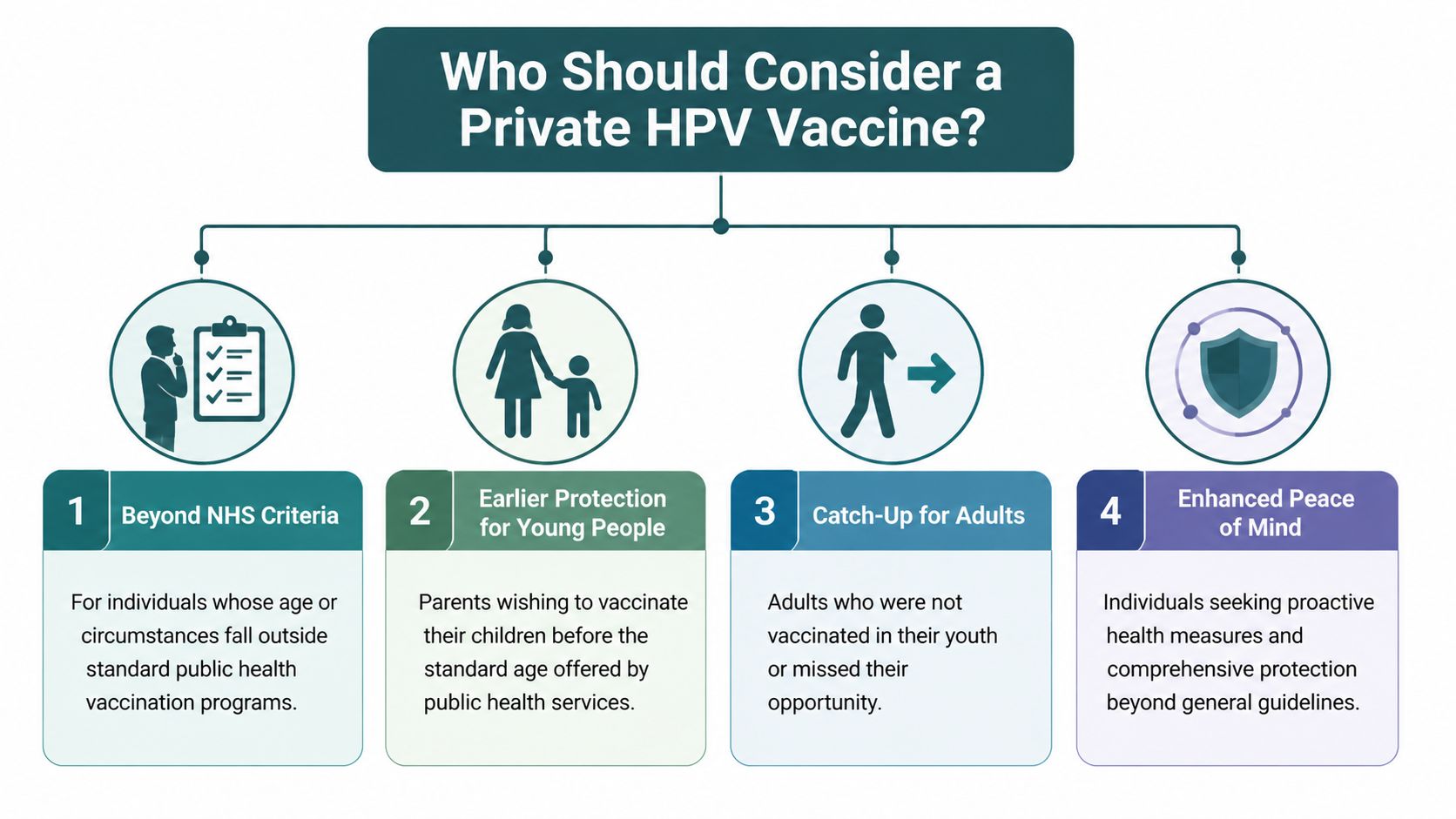
Adults who missed the school programme
This is one of the clearest groups to consider private vaccination.
Some adults were never offered the vaccine in school. Some were offered it but declined, missed appointments, or did not complete the course. Years later, the question often returns. Is there still value in getting protected now?
The answer is not identical for every person, which is exactly why a private consultation can be useful. It gives space to review age, previous doses, likely future exposure, and whether completing a course now is a sensible preventive step. Vaccination is a little like fitting a seatbelt before a journey. It works best before exposure, but that does not mean the conversation becomes pointless just because time has passed.
Adults aged 27 to 45
This group often receives the least clear public guidance and has some of the most reasonable questions.
As noted earlier, since 2019 there has been support for shared clinical decision-making in adults aged 27 to 45. In practice, that means the vaccine is not usually treated as an automatic yes or no. It is a discussion. A clinician looks at likely benefit in the context of the person’s own history and future risk, rather than applying a blanket rule.
That matters because many adults in this age range assume they are “too old” for the conversation. Often, the issue is not age alone. It is whether vaccination could still offer useful protection from HPV types they have not yet encountered.
A private discussion may be particularly reasonable for someone who:
- expects new sexual partners in future
- wants a prevention-focused review after missing earlier vaccination
- prefers an individual risk-benefit discussion rather than a standardised answer
Men and boys who were not covered earlier
Many male patients only hear about HPV vaccination later than they should.
Part of the confusion comes from outdated messaging. HPV has often been framed as a vaccine for girls or women, even though HPV also affects men and is linked to genital warts and several cancers, including some throat, anal, and penile cancers. Once that is explained clearly, the logic becomes much simpler. Protection is not about gender branding. It is about reducing the chance of infection and its consequences.
Private vaccination can therefore make sense for men who missed earlier school eligibility, were outside previous rollout patterns, or now want the same preventive conversation that female patients have had for longer.
Parents who want a clearer plan
Parents are often less worried about the principle of vaccination than about the process.
They may want to avoid uncertainty around school delivery, reduce the chance of a missed session, or arrange appointments in a setting that feels calmer and more predictable for their child. Some families also prefer to organise care for siblings together, especially if they are already using private healthcare for other vaccinations or travel medicine.
For children and teenagers, consent, age, and clinical appropriateness still need proper attention. A good clinic should explain these points plainly, confirm the schedule, and make sure parents know what happens at each stage.
International students, temporary residents, and mobile families
This group is easy to overlook, but it often has very practical needs.
A student may have started a course abroad and need help working out what comes next in the UK. A family may be unsure which vaccine was given previously, whether doses count toward completion, or whether public eligibility applies after a move. In these cases, private care can provide something very useful. Continuity.
Instead of trying to fit a complicated history into a narrow programme box, the clinic can focus on records, timing, and what is medically appropriate now.
Schools, colleges, and employers arranging vaccination support
Private HPV vaccination is not only an individual decision. It can also be relevant for organisations responsible for student or staff wellbeing.
A school may want a clearer route for families who missed routine access. A college may be supporting international students with mixed vaccine records. An employer may be exploring preventive health options and looking for a single clinical contact point. In each case, the value of the private route is structure. People get a defined process, clear eligibility discussions, and booking options that work practically rather than only on paper.
If your circumstances fall outside the standard NHS route, that usually does not close the door. It means the next sensible step is to discuss whether private HPV vaccination fits your situation.
How to Book Your Private HPV Vaccine
Booking a hpv vaccine private appointment should feel straightforward. In reality, people often overcomplicate it because they’re trying to answer every clinical question before they’ve even spoken to a clinician.
A simpler approach works better. Start with a reputable clinic, check that HPV vaccination is offered, and book a consultation or vaccine appointment as directed. Private clinics can play an important role here because research on vaccination infrastructure notes systemic barriers in private provider participation, while also highlighting that private clinics with extended hours, walk-in accessibility, and integrated healthcare can help fill vaccination gaps for private patients.
For individuals
If you’re booking for yourself, keep the process practical.
Choose a clinic that offers HPV vaccination clearly
Look for named vaccine information, consultation support, and proper clinical oversight. If the website is vague, call and ask direct questions.Check whether you need a consultation first
Some clinics book straight into vaccination. Others prefer a short review first, especially for adults, people with medical complexities, or anyone unsure whether vaccination still makes sense for them.Have your basic information ready
Bring any previous vaccine record if you have one. If you don’t, that’s not unusual. Also be ready to mention allergies, immune conditions, pregnancy status if relevant, and current medicines.Book the first appointment, then plan the rest
Once the first dose is arranged, it’s usually easiest to line up future doses before you leave.
If you’re ready, click to book online or call to book if you’d rather speak to a member of the team first.
What happens on the day
Most private vaccine appointments are quick, but they shouldn’t feel rushed. A clinician or nurse should confirm your identity, review suitability, answer questions, obtain consent, and give the injection.
You can expect:
- A short clinical check to confirm the vaccine is appropriate
- An explanation of the schedule so you know when the next dose is due
- Written or digital documentation for your records
- Brief observation afterwards if the clinic’s protocol requires it
Wear clothing that allows easy access to the upper arm. If you’re prone to feeling faint with injections, mention that when you arrive.
For parents booking for a child or teenager
Parents usually need a little more admin, but it still doesn’t have to be difficult.
Bring or prepare:
- Consent details for the child or young person
- Vaccination history if available
- Questions in advance, especially if your child is anxious about injections
- School timetable awareness so follow-up doses don’t land in the middle of exams or trips
A private appointment can work well for young people who would cope better in a quieter setting than a busy school vaccination day.
For schools and businesses
Schools and employers often need something different from a standard patient booking. They need a delivery partner that can organise communication, consent, scheduling, and on-site logistics in a way that doesn’t disrupt the rest of the day.
A sensible process usually looks like this:
| Group | Best first step | What to ask |
|---|---|---|
| School | Contact the clinic's admin or outreach team | Can you support on-site sessions, consent handling, and staged year-group delivery? |
| Business | Ask about occupational or wellness vaccination options | Can you run workplace clinics, provide employee communications, and manage follow-up doses? |
| College or university | Request a planning call | Can you support mixed domestic and international student groups? |
For organisations, the easiest route is usually to visit website and request a planning conversation rather than trying to book multiple individual appointments one by one.
Questions worth asking before you confirm
Not every private provider works in the same way. Before you finalise a booking, ask:
- Which HPV vaccine do you provide?
- Is the consultation included or separate?
- How are follow-up doses scheduled?
- Can records be shared with my GP if I want that?
- What is your process for minors, schools, or staff groups?
Those questions quickly tell you whether the service is organised and whether it fits your needs. Good private care should reduce friction, not add to it.
Aftercare and What to Expect Post-Vaccination
The HPV vaccine is generally well-tolerated. The most common experience is very simple. Your arm may feel sore for a short time, and you may notice mild redness or swelling where the injection went in.
Some people also feel tired, headachy, or slightly under the weather afterwards. These reactions are usually a sign that the immune system is responding to the vaccine. They can be inconvenient, but they're generally manageable.
Simple aftercare at home
A few practical steps usually help:
- Keep the arm moving rather than holding it stiff all day
- Use a cool compress if the area feels hot or tender
- Rest if needed, especially if you feel washed out afterwards
- Take simple pain relief if it's suitable for you and you've been advised it's safe
If you've ever felt faint after an injection, tell the clinician before the vaccine is given. That's common, and clinics are used to helping patients through it calmly.
Most post-vaccine symptoms are mild and short-lived. A sore arm for a day or two is far more common than any serious problem.
When to seek advice
You should contact the clinic or seek medical advice if you feel significantly unwell, if symptoms don't settle as expected, or if you have concerns about an allergic reaction. Patients are often reassured just by knowing what is normal and what is not.
It's also worth remembering that anxiety can mimic side effects. Feeling light-headed, shaky, or flushed straight after a vaccine is often related to the injection experience itself rather than to the vaccine ingredients.
One important reminder
Having the vaccine doesn't mean you can stop routine preventive care. If you're eligible for cervical screening, you should still attend. The vaccine is an important layer of protection, but it isn't a replacement for the rest of good preventive healthcare.
Your Questions Answered and Next Steps
A private HPV vaccine route can give people something the standard system often can't. Choice, timing, and space for a proper conversation. For adults, parents, schools, and employers, that's often what turns uncertainty into action.
If you're ready to move forward, the next step is simple. Call to book your private consultation today, or click to book online via a secure portal. For school or corporate enquiries, visit website and contact the team directly to discuss delivery options.
Common questions
Do I still need cervical screening after the vaccine?
Yes. Vaccination and screening do different jobs. If you're invited for cervical screening, you should still attend.
Is the vaccine still worth discussing if I'm already sexually active?
Yes, it can still be worth discussing. The vaccine doesn't treat existing HPV infection, but it may still help protect against HPV types you haven't been exposed to.
Can I have the vaccine if I've had an abnormal smear test?
Possibly, yes. An abnormal smear doesn't automatically rule vaccination out, but you should discuss your history with a clinician so the decision is made in context.
Can men have the HPV vaccine privately?
Yes. HPV affects men as well as women, and private clinics commonly discuss vaccination with male patients.
Can schools and businesses arrange private vaccination programmes?
Yes, many private providers can support organised vaccination planning for groups, provided the service is set up appropriately and consent processes are clear.
What if I'm not sure whether I had the vaccine at school?
Tell the clinic what you remember and bring any records you can find. If records are incomplete, a clinician can advise on the safest and most sensible next step.
If you'd like personalized advice or want to arrange vaccination through a trusted private clinic, Haven Medical can help. Call to book, click to book, or visit website to enquire about individual, school, or business HPV vaccination options.