



| Activity | Why it may aggravate symptoms |
|---|---|
| Using secateurs or garden tools | Repeated squeezing loads the tendon repeatedly |
| Knitting or crochet | Long periods of small, repetitive finger motion |
| DIY and hand tools | Forceful gripping through the palm |
| Phone use and carrying bags | Sustained finger flexion and gripping |
| Keyboard and mouse work | Repetitive use can make early symptoms more noticeable |
Practical point: You can develop trigger finger without diabetes, arthritis, or a major injury. Repetitive hand use may be enough to irritate the tendon and pulley over time.
Getting a Professional Diagnosis for Your Finger
A proper diagnosis is usually straightforward. Most of the time, it comes from your story and a hands-on examination rather than a long list of tests.
A clinician will usually ask when the symptoms started, whether the finger clicks or locks, what tasks make it worse, and whether you have any related health conditions. Then they'll examine the hand, pressing around the base of the finger and watching how it moves as you open and close it.
What a specialist is looking for
The appointment is often simpler than people expect. A consultant may check for:
- Tenderness over the base of the affected digit
- A palpable lump or thickened area in the palm
- Visible triggering when the finger bends or straightens
- Loss of smooth movement compared with the other hand
- Signs that another condition may be involved
Sometimes patients worry they need a scan before anyone can help. Often, they don't. The diagnosis is commonly clinical.
When to stop waiting and get it checked
Book an assessment if any of these sound familiar:
- The finger locks or you need the other hand to straighten it
- Pain affects daily tasks like writing, dressing, lifting, or driving
- The symptoms keep coming back
- Clicking or stiffness lasts more than a few weeks
- You have diabetes and the problem isn't settling
If arranging appointments is the part life keeps pushing aside, practical systems help. Clinics and patients alike often benefit from simple reminders and booking habits such as those described in these Strategies for patient no-show prevention, especially when follow-up treatment may be needed.
At this stage, a clear diagnosis matters more than guesswork. If you want a consultant assessment, you can call to book and discuss the next step.
Non-Surgical Treatments to Regain Movement
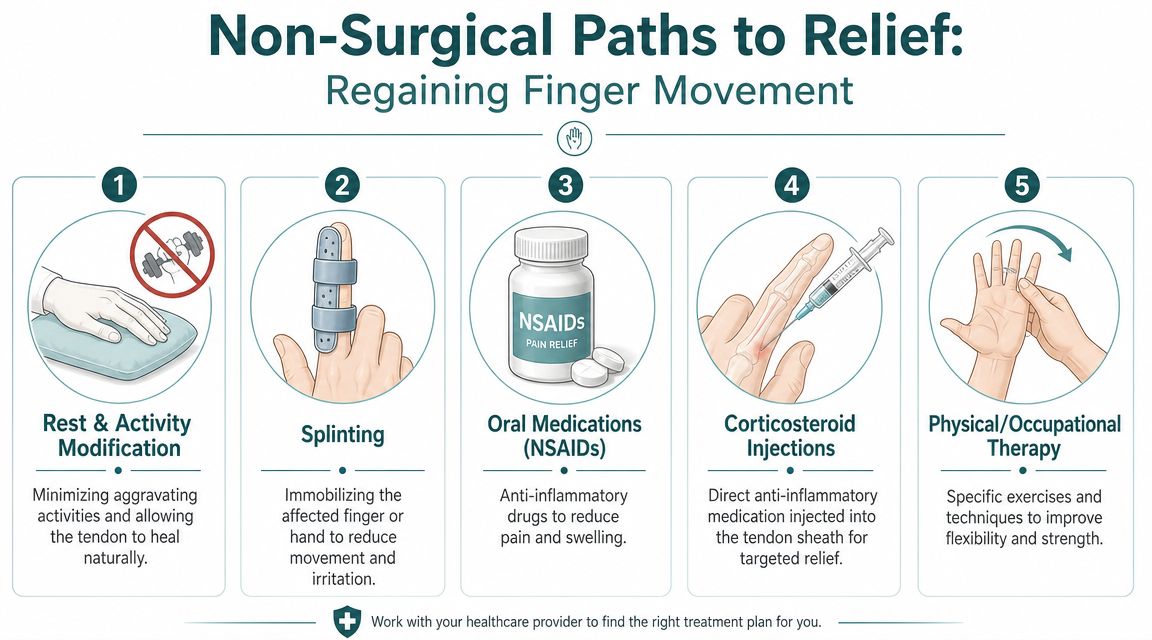
You wake up, make a fist, and one finger feels stiff, sore, or slightly delayed before it straightens. At this stage, treatment is often aimed at calming the irritated tendon and giving it more room to glide before the problem becomes regular locking.
Many patients find it reassuring that some cases do settle with time. Even so, waiting without a plan is not always the best approach, especially if hand use at work or home keeps re-irritating the area. Repetitive gripping, lifting, tool use, typing, or childcare can keep the tendon rubbing through the tight pulley, even in people who do not have diabetes.
The main non-surgical options
Treatment usually depends on how long symptoms have been present, how often the finger catches, and how much daily function is being affected.
| Option | What it aims to do | Best suited to |
|---|---|---|
| Activity modification | Reduce repeated irritation | Early or mild symptoms |
| Splinting | Rest the finger, often overnight | Clicking, morning stiffness |
| NSAIDs | Ease pain and inflammation | Short-term symptom relief |
| Hand therapy | Improve movement habits and exercises | Stiffness, recurrent aggravation |
| Corticosteroid injection | Reduce pulley and tendon-sheath inflammation directly | Persistent symptoms |
How each treatment helps
Activity modification means reducing the movements that keep flaring things up. That does not always mean full rest. It often means changing how you grip, taking shorter bursts of hand-heavy activity, or using larger handled tools for a while.
Splinting is often most helpful when symptoms are worse first thing in the morning. A night splint can keep the finger in a position that reduces irritation, a bit like stopping a frayed rope from repeatedly scraping through a narrow ring.
NSAIDs such as anti-inflammatory tablets or gels may help with pain. They can make the finger more comfortable, but they do not reliably fix the catching itself if the tendon is still struggling to pass through a tight pulley.
Hand therapy can be useful when symptoms are being driven by repeated strain or poor movement patterns. A therapist may advise on tendon gliding exercises, splint use, swelling control, and practical changes to work or home tasks.
Why steroid injection is often the turning point
A corticosteroid injection is often the treatment that changes the situation most clearly short of surgery. The goal is not just to dull pain. The injection is placed around the inflamed tendon sheath to reduce swelling where the tendon is catching, which can allow smoother movement again (UConn Health trigger finger treatment guide).
That point can be confusing for patients. Trigger finger is partly a mechanical problem, but inflammation often makes the narrowing worse. Reducing that inflammation can be enough to stop the clicking and prevent progression.
What usually makes sense in real life
For very early symptoms, especially mild morning clicking without fixed locking, a combination of activity changes, splinting, and observation may be reasonable. If symptoms are persisting, interrupting sleep, or interfering with writing, gripping, dressing, or work, injection treatment is often considered sooner rather than later.
Specialist input helps here because the right plan depends on timing. A finger that only clicks occasionally is different from one that has started to stick halfway through movement. Early treatment can also reduce the chance that stiffness becomes harder to reverse.
At a private clinic, this kind of assessment and injection planning may be offered in one pathway. Haven Medical is one example of a service that provides consultant-led care and day surgery options relevant to hand conditions. If you’d like to explore whether injection, splinting, or watchful waiting makes sense in your case, you can click to book an appointment.
When Surgery Is the Best Path to Lasting Relief
You wake up, curl your fingers around the duvet, and one finger catches hard enough that you have to pause and straighten it carefully. At that stage, the problem is no longer just irritation around the tendon. The pulley has become tight enough that the tendon still cannot glide properly despite simpler treatment.
That is usually the point where surgery enters the conversation. It is considered when locking keeps happening, the finger needs help to straighten, pain or stiffness is affecting work or daily tasks, or symptoms keep returning after splinting or injection. For the right patient, surgery is aimed at a very specific mechanical problem. The tight A1 pulley is released so the tendon has room to move freely again.
Many patients worry that agreeing to surgery means the condition has been neglected or that something major is wrong. In reality, trigger finger release is often a small, targeted procedure used when the finger is still behaving like a rope catching in a narrow ring. If the ring stays too tight, the catching tends to continue.
What surgery usually involves
A hand specialist will usually talk through two main methods:
- Open release, which uses a small cut in the palm to divide the tight pulley directly
- Percutaneous release, which uses a needle technique in selected fingers and selected patients
The choice depends on the finger involved, how clear the diagnosis is, your anatomy, and whether there are reasons to prefer direct visualisation of the pulley.
Surgery is the next mechanical step when swelling control and activity changes have not created enough space for smooth tendon movement.
What recovery tends to be like
Recovery is often more straightforward than patients expect. Many procedures are done under local anaesthetic as a day case, so you go home the same day.
You are usually encouraged to start moving the finger early. That matters because the goal is not only to stop the locking, but also to reduce the stiffness that can build up when a finger has been catching for weeks or months. Some palm soreness and tenderness around the wound are common at first. Grip can feel awkward for a short time, especially with firm twisting or lifting, but normal hand use usually returns as comfort improves.
Timely treatment can make this stage easier. A finger that has only recently started locking often recovers more smoothly than one that has stayed bent or stiff for a long period.
If your symptoms have moved beyond early clicking and into repeated locking, a specialist assessment helps clarify whether surgery is now the most reliable option. You can visit website for more information about consultant-led assessment and day surgery pathways.
Your Questions About Trigger Finger Treatment Answered
Is trigger finger the same as ordinary stiffness
No. Ordinary stiffness usually eases without the distinct catching, clicking, or locking pattern. Trigger finger has a mechanical element. The tendon isn’t gliding smoothly through the pulley.
Can it settle on its own
Sometimes, yes. Some cases do improve without active treatment. But if the symptoms are lasting, worsening, or interfering with daily life, it’s sensible to seek a proper assessment rather than hoping it will disappear.
Do I need an injection straight away
Not always. Mild cases may be managed first with activity changes, splinting, and observation. If symptoms persist or the catching becomes troublesome, injection is often the next option discussed.
Is surgery a major procedure
Usually, no. Trigger finger release is generally a minor procedure aimed at solving a very specific mechanical problem. For the right patient, it can be a straightforward and effective solution.
Will it come back after treatment
It can, depending on the treatment route and individual factors. That’s one reason an accurate diagnosis matters. A specialist can explain the likely course in your specific case and whether a repeat injection, therapy, or surgery makes most sense.
When should I get help
Seek advice if the finger locks, you need your other hand to straighten it, pain is affecting ordinary tasks, or symptoms have continued for more than a few weeks. Early advice often means a simpler path forward.
If you’re dealing with a stiff, painful, or clicking finger and want clarity on the best next step, a specialist review can make the situation much less uncertain.
If your finger is catching, clicking, or locking, don’t ignore it. The earlier you get a clear diagnosis, the easier it is to choose the right treatment. To discuss your symptoms with a consultant, call to book an appointment.