




Pins and needles can be easy to dismiss at first. Your hand falls asleep when you wake up. Your foot tingles after sitting awkwardly. Then it keeps happening, or the numbness starts lasting longer, or you notice you’re dropping things, fumbling buttons, or feeling a strange burning discomfort that doesn’t quite make sense.
That’s often the point when people see their GP and hear a new phrase for the first time: nerve conduction study.
If that’s where you are, it’s understandable to feel uneasy. For many, this test is a new experience. The name sounds technical, and anything involving nerves can feel worrying before you know what it involves. The good news is that this is a well-established, noninvasive test used to investigate exactly these kinds of symptoms. It gives your clinician objective information about how your peripheral nerves are working, which can help move things from uncertainty to a clearer plan.
That Unexplained Tingling and What Comes Next
Sarah had been waking at night with a numb, buzzing feeling in her right hand. At first she blamed stress and long hours at a keyboard. Then opening jars became harder, and she started shaking her hand out in the mornings to “wake it up”. Her GP examined her, listened to the pattern of symptoms, and suggested a specialist referral.
That referral didn’t mean anything dramatic had been found. It meant the next sensible step was to look more closely at how the nerve was functioning.

A story like this is common. Some people notice tingling in the fingers. Others feel numb patches in the feet, weakness in the legs, cramping, burning pain, or a hand that no longer feels as reliable as it used to. The symptoms may come and go, or they may be steadily becoming more noticeable.
Why the uncertainty feels so unsettling
Nerve symptoms are hard to read on your own. Tingling can come from a trapped nerve at the wrist, irritation near the elbow, a problem in the neck, or a more general nerve condition affecting several nerves. Weakness can reflect trouble in the nerve, the muscle, or both.
That uncertainty is often the hardest part. When you can’t tell what’s causing the symptom, your mind fills in the gaps.
A nerve conduction study isn’t a label or a verdict. It’s a way of measuring what the nerve is actually doing.
A more grounded next step
A nerve conduction study gives your clinician information that symptoms alone can’t provide. Instead of relying only on description, the test looks at how electrical signals travel along the nerve. That helps your clinician decide whether there is a nerve problem, where it may be, and how it fits with what you’ve been feeling.
For many patients, that alone is reassuring. Once the test is explained clearly, it stops feeling mysterious and starts feeling useful.
Why Your Doctor Recommended This Test
Your doctor doesn’t request a nerve conduction study at random. It’s usually recommended because your symptoms suggest that a peripheral nerve may not be working normally, and your clinician wants to know where the problem sits and how significant it is.
The symptoms that commonly lead to referral include numbness, tingling, burning discomfort, weakness, altered sensation, or clumsiness in a hand, foot, arm, or leg. Sometimes the symptom is subtle. A hand tires quickly. A foot feels oddly “thick” on the floor. A muscle seems weaker even though there’s no obvious injury.
The test helps answer practical questions
A good neurological assessment starts with localisation. In simple terms, your clinician asks: where is the problem most likely to be?
A nerve conduction study is most useful when paired with clinical localisation because it can objectively rank severity and help separate peripheral nerve disorders from muscle disorders, and abnormal results can support diagnosis and prognosis for conditions such as peripheral neuropathy or compressive mononeuropathy, while normal studies can guide clinicians toward alternative diagnoses, as outlined in this clinical overview of nerve conduction velocities.
That matters in real life. Symptoms in the thumb, index, and middle fingers might suggest carpal tunnel syndrome. Numbness in both feet may fit better with peripheral neuropathy. Pain running from the back into the leg may raise the question of a radicular problem. A nerve conduction study doesn’t replace the examination, but it can sharpen the picture.
What your clinician may be trying to distinguish
Different conditions can feel surprisingly similar to a patient. The test helps sort them out.
- Compressed nerve: This includes problems such as carpal tunnel syndrome, where a nerve is irritated or squeezed along its path.
- Peripheral neuropathy: This means a more widespread nerve problem affecting peripheral nerves, often in a length-dependent pattern such as the feet first.
- Muscle disorder: Sometimes the symptom sounds neurological, but the muscle is the main issue.
- More proximal cause: If the study is normal or near normal, your clinician may think about causes higher up, including the nerve root or another explanation altogether.
What the referral often means: “Your symptoms deserve a more objective look.”
The test is useful because it gives evidence. It can support a diagnosis, suggest severity, and help your clinician decide what happens next, whether that’s splinting, physiotherapy, medication, further imaging, observation, or referral to another specialist.
Understanding the Nerve Conduction Study Procedure
By the time this test is booked, many patients are wondering two things at once. What will they do to me, and what can this test really show?
A nerve conduction study gives a measured look at how well signals travel along a peripheral nerve. Your brain and nerves communicate through small electrical impulses. During this test, the clinician gives a brief stimulation at one point on the skin and records how the nerve responds at another point. From that, they can see whether the signal gets through, how quickly it travels, and how strong the response is.
That may sound technical, but the experience is usually quite straightforward.
What the test is measuring
The goal is not to put electricity into your body in a harmful way. The goal is to check how a nerve responds to a small, controlled stimulus. Surface electrodes are placed on the skin, and the machine records the response. Because the distance between the electrodes is known, the clinician can work out the nerve’s conduction speed.
A useful way to picture it is as a message sent down a line. The message may arrive on time, arrive more slowly than expected, or arrive with a smaller response. Each pattern can point in a different direction.
The study may examine motor nerves, sensory nerves, or both. Motor nerves carry signals to muscles. Sensory nerves carry information such as touch, tingling, or numbness back toward the brain. Looking at these pathways separately helps the clinician narrow down where the problem may be and what kind of nerve change may be present.
What the procedure feels like
For each nerve tested, you will feel a quick electrical pulse. Many patients describe it as a brief tapping, snapping, or buzzing sensation. It can be uncomfortable, but it is very short-lived. The feeling stops as soon as the pulse stops.
The clinician usually repeats the stimulation a few times in different spots. That is not because something is going wrong. It is how the test maps the nerve along its course and checks whether one segment is conducting differently from another.
Some people worry that the test could damage the nerve. It does not. The stimulation is designed to record function, not to injure tissue.
Why the details matter
Symptoms tell us what you feel. This test adds measurements that can support or challenge a suspected diagnosis. A slower signal may suggest the nerve is being compressed or that its insulating layer is affected. A smaller response may suggest fewer nerve fibres are contributing normally.
A normal result is useful too. It can help your clinician reconsider the cause of your symptoms rather than assuming the problem sits in the peripheral nerve being tested.
You do not need to learn the report language before your appointment. What matters most is knowing that the procedure is structured, targeted, and meant to answer a practical question: are your nerves carrying signals in the way we would expect?
How to Prepare and What to Expect on the Day
You wake up on the morning of the test and wonder, “What will happen once I get there?” That question is completely normal. For many patients, the hardest part is not the study itself. It is the uncertainty beforehand.
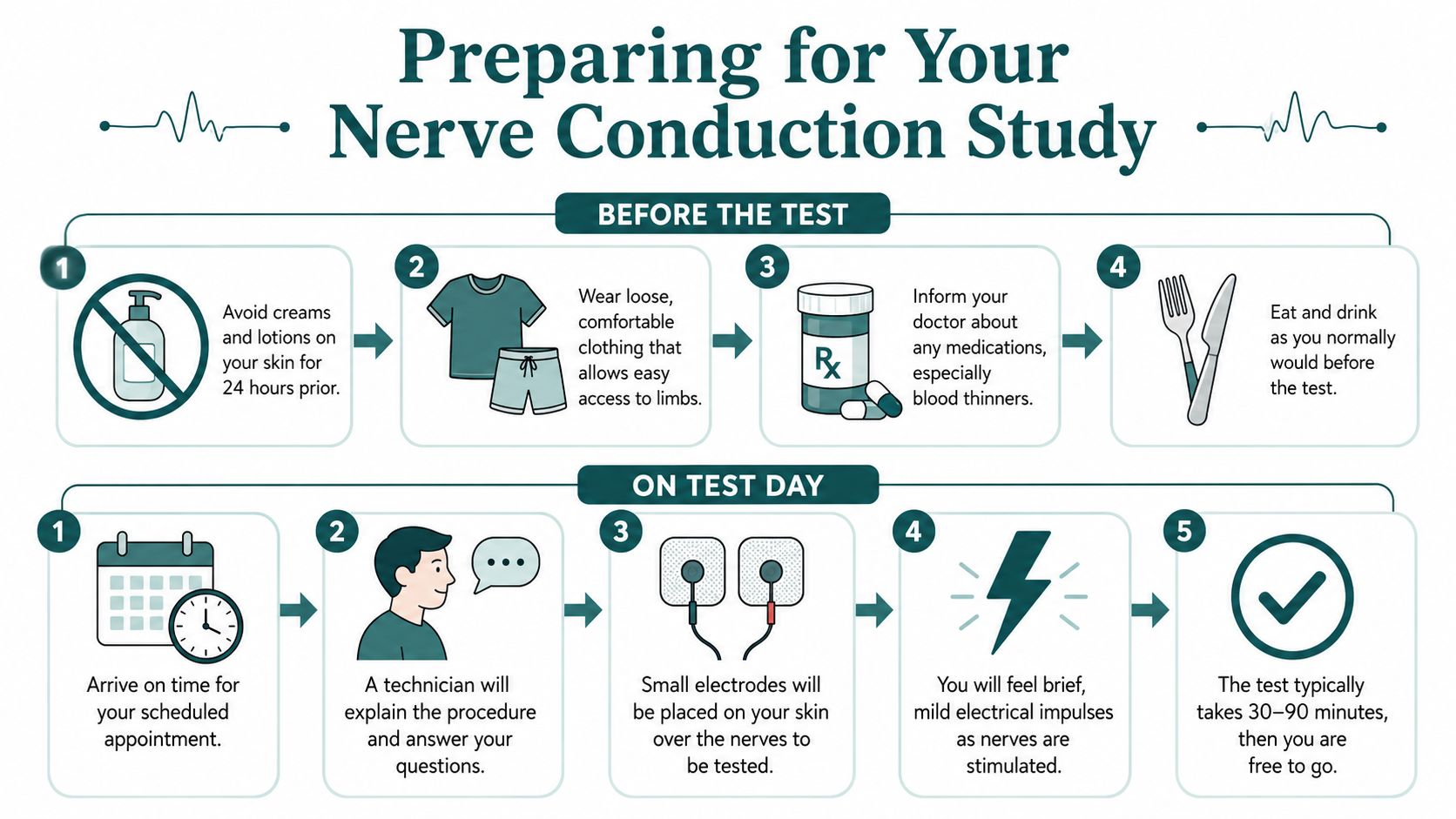
The good news is that preparation is usually simple. A nerve conduction study does not usually require fasting, sedation, or a recovery period. The aim is to help the clinician get clean recordings while keeping you as comfortable as possible.
Before you leave home
A few small choices can make the appointment easier:
- Avoid creams, oils, or lotions on the skin. Electrodes stick and record better on clean, dry skin.
- Wear loose, comfortable clothing. Sleeves or trouser legs that roll up easily save time and spare you awkward changing.
- Have your medical details ready. If you have a pacemaker, implanted device, diabetes, take blood thinners, or have a bleeding disorder, let the clinic know if they have not already asked.
- Eat and drink as you normally would, unless the clinic gave different instructions.
- Keep your hands and feet warm if you can. Cold skin can slow nerve signals, so warm limbs help the test reflect your usual nerve function more accurately.
If you are feeling tense, bring that up when you arrive. Anxiety is common, and a brief explanation before starting often makes the whole visit feel more manageable.
What usually happens once you arrive
Most appointments begin with a short conversation. The clinician will confirm which symptoms you have been having, where they are, and which nerves need to be tested. That matters because the study is targeted. It is not a one-size-fits-all checklist.
You will usually sit or lie down in a comfortable position. Small recording electrodes are placed on the skin, and the skin may be cleaned first so the signal is clear. The electrical stimulation is then delivered in short pulses at selected points along the nerve.
A useful way to picture it is a wire being checked at a few points along its path to see how well the message gets through. The clinician is not “sending electricity into your body” in a dangerous sense. They are using very brief stimulation to measure how your nerve responds.
Some parts feel only mildly strange. Other spots can feel sharper, especially if the area is already sensitive from your symptoms. The feeling lasts seconds, then stops.
What you can do during the test
You do not have to perform well. You do not need to be brave or perfectly still for long stretches. You just need to follow simple instructions and tell the clinician if something is worrying you.
These tips help:
- Arrive a little early so you have time to settle rather than rushing in tense.
- Say if you are nervous before the first stimulation. Knowing when each pulse is coming often helps.
- Try to keep the tested limb relaxed unless you are asked to move it.
- Speak up if a position is uncomfortable so it can be adjusted.
How long it takes and what happens after
The length of the study depends on how many nerves need testing and whether one limb or several areas are involved. Some appointments are quite short. Others take longer because the clinician is answering a more specific question.
After the test, you can usually return to normal activities straight away. There is no usual downtime. Your skin may feel slightly irritated where the electrodes were placed, but serious after-effects are not expected.
If another test is being done the same day, such as EMG, the team will explain that separately so you know which part of the appointment is which. That simple explanation can make the day feel much less mysterious.
Interpreting Your Nerve Conduction Study Results
When patients hear that a report contains numbers, they often worry they won’t understand any of it. In reality, most nerve conduction study reports are built around a few core measurements. Once those are translated into plain English, the results become much less intimidating.
The three measurements that matter most
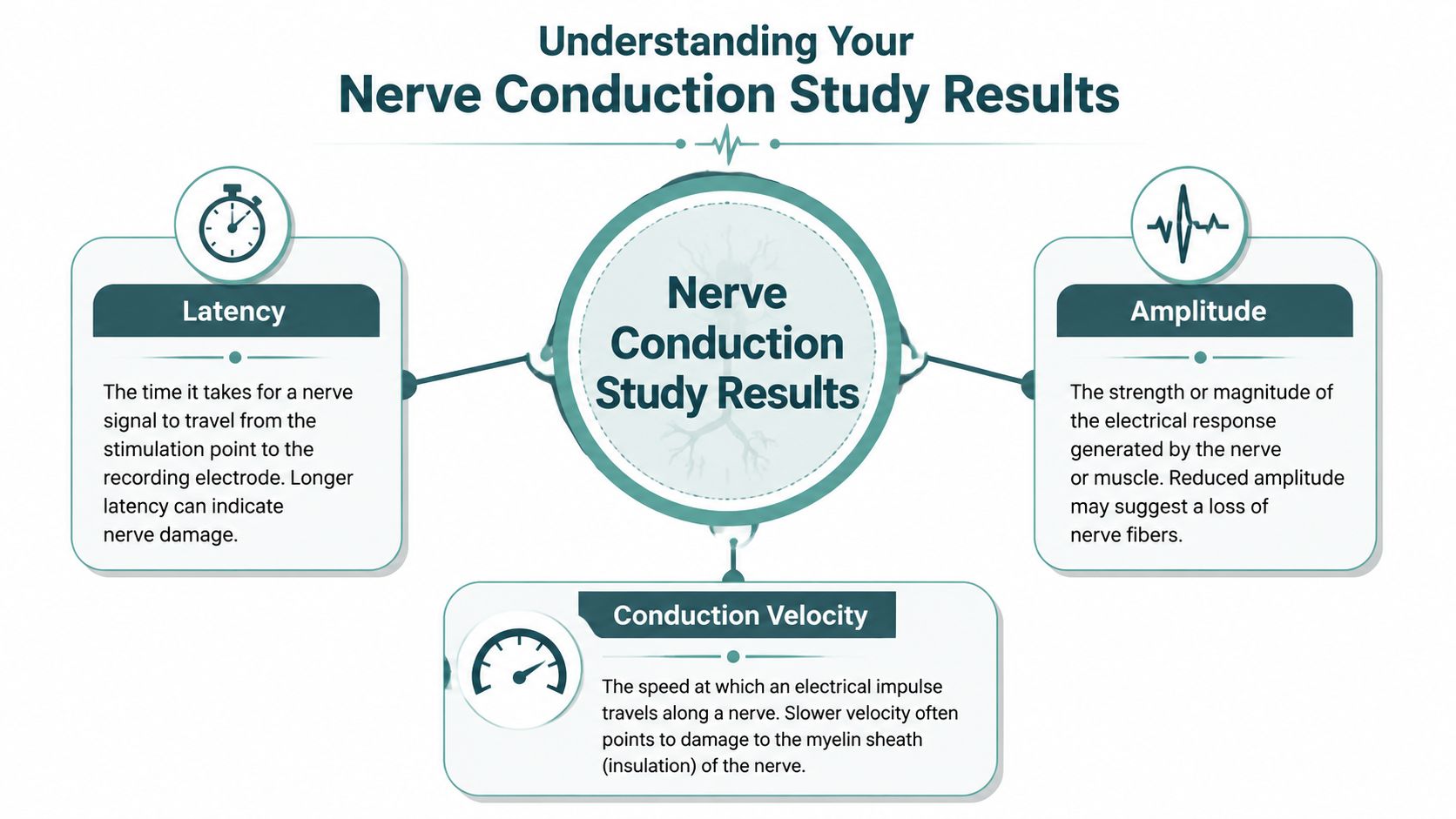
In UK practice, a nerve conduction study is a core electrodiagnostic test because it measures latency, conduction velocity, and amplitude, then compares them with reference ranges taken from healthy volunteers of similar age and limb temperature. Abnormal results help distinguish demyelinating injury, where conduction is slowed, from axonal injury, where the signal size is reduced, as explained in this guide to reading nerve conduction study results.
Here’s a patient-friendly way to think about those terms:
- Latency is the delay before the signal arrives, much like traffic slowing the start of a journey.
- Amplitude is the size or strength of the response, comparable to the volume of the signal.
- Conduction velocity is the speed of travel along the nerve, similar to the overall speed on a motorway.
What your clinician is looking for
These measurements are not read in isolation. Your clinician compares them with expected ranges and with the story your symptoms tell.
If the signal is mainly slow, the pattern may suggest damage affecting the nerve’s insulation. If the signal is mainly small, that can suggest injury affecting the nerve fibres themselves. If the findings are focused at one site, such as the wrist, that may support a compression problem in that area.
A report may also be described as normal, mildly abnormal, or showing a pattern that fits a particular diagnosis. That’s why your follow-up discussion matters as much as the test itself.
The report doesn’t diagnose you on its own. Your clinician interprets it alongside your examination, symptoms, and medical history.
Why reports can look more technical than they are
If you receive a copy of your report, don’t worry if some of the wording sounds formal. The most useful questions to ask are simple ones:
- Does this fit my symptoms
- Where does the test suggest the problem is
- How severe does it appear
- What does this mean for treatment or next steps
Those questions usually lead to a much clearer conversation than trying to decode every abbreviation on your own.
Nerve Conduction Study vs Electromyography EMG
Many patients are told they’re having “NCS and EMG” as if they were one single test. They’re related, but they are not the same thing.
A nerve conduction study checks the nerve pathways. An EMG checks how muscles behave electrically. If the nerve is the wiring, the muscle is the device being powered by that wiring.
Why they’re often done together
Sometimes your clinician needs to know two things at once. Is the nerve signal getting to the muscle properly, and is the muscle responding in the way it should? Doing both tests can help answer that more fully than either test alone.
A nerve conduction study uses electrodes on the skin. An EMG uses a very fine needle electrode inserted into selected muscles to record electrical activity at rest and during activation.
NCS vs EMG at a Glance
| Feature | Nerve Conduction Study (NCS) | Electromyography (EMG) |
|---|---|---|
| Main purpose | Checks how well electrical signals travel along nerves | Checks electrical activity within muscles |
| What it investigates | Peripheral nerve function | Muscle response and muscle electrical activity |
| How it's performed | Surface electrodes on the skin with brief electrical stimulation | Fine needle electrode inserted into the muscle |
| What it can help distinguish | Whether a nerve is conducting normally, slowly, or weakly | Whether a muscle shows changes suggesting nerve or muscle involvement |
| Sensation | Brief tingling or tapping from stimulation | Brief needle discomfort in selected muscles |
| Why it may be paired with the other test | Shows whether the signal is reaching the muscle | Shows what the muscle is doing with that signal |
Which one matters more
Neither is “better”. The right test depends on the question your clinician is trying to answer. Some people only need a nerve conduction study. Others need both for a complete picture.
If your referral mentions EMG as well, that doesn't mean something worse is suspected. It often just means the clinician wants a more complete assessment of both nerves and muscles.
Common Questions and Your Next Steps
By this stage, many patients feel two things at once. Relief that the test is finally being done, and worry about what the result might show. Both reactions are normal.
A nerve conduction study often helps by narrowing the possibilities. Even if it does not give a full answer on its own, it can show whether your symptoms fit with a nerve problem and what kind of follow-up makes sense.
Is it painful
Many patients say it is more uncomfortable than painful. The electrical pulses are brief and can feel like a quick zap, tapping sensation, or sudden jolt. It can catch you by surprise the first time, but each stimulus lasts only a moment.
If you are nervous, tell the person doing the test. A calm explanation and knowing when each pulse is coming often makes the experience easier.
Is it safe
For most patients, yes. A nerve conduction study uses electrodes placed on the skin, so there is no incision and no sedation.
Your team should still know about any implanted medical devices, bleeding problems, or other health issues before the appointment. That helps them choose the safest and most appropriate setup for you.
Can I drive home afterwards
Many patients can drive home and return to their usual routine the same day. The test does not usually leave you drowsy or impaired.
If you are having an EMG as well, have another procedure planned, or know that medical appointments make you very anxious, check with your clinic in advance. It is always better to ask than to wonder.
If the result is normal, does that mean nothing is wrong
A normal result does not always mean your symptoms have no medical cause. It means this particular test did not show a clear abnormality in the nerves that were studied.
That matters because nerve tests are only one part of the picture. Timing, the specific nerves tested, your body position, and how subtle the problem is can all affect what is seen. A 2024 study in Cureus found that median nerve measurements changed with different arm positions in some testing setups, which helps explain why borderline cases need careful interpretation, as shown in this study on arm position and median nerve conduction measurements.
A good way to think about it is this. The test is like checking traffic flow on selected roads. If traffic looks normal on those roads at that moment, but your symptoms suggest trouble elsewhere or under different conditions, your clinician may still need to look further.
What happens after the test
The next step depends on how the results fit with your symptoms, examination, and medical history. Some patients go on to treatment for a trapped or compressed nerve. Others need monitoring, imaging, blood tests, or a different explanation explored if the study points away from peripheral nerve disease.
This is also the point where many people want plain language, not just a report. Ask your clinician three simple questions. What did the test show. What did it not show. What happens next.
If you are still dealing with numbness, tingling, burning, or weakness and do not yet have a clear plan, a specialist assessment can help you decide whether this test is appropriate and what it is likely to add. One option is Haven Medical, which offers neurophysiology services including nerve conduction studies as part of consultant-led care.
The goal is not merely to complete a test. It is to leave with a clearer understanding of your symptoms and a sensible next step.