




You’ve cut out foods, swapped washing powders, blamed pollen, then blamed stress. Yet the bloating keeps coming back. The rash flares without warning. Your nose blocks up after meals, or your child develops hives and you’re left guessing whether it was milk, egg, or something else entirely.
That uncertainty is exhausting. It also leads people into the same trap over and over again. They start avoiding foods or environments based on suspicion instead of evidence. Sometimes they restrict too much. Sometimes they miss the actual trigger. Neither helps.
If you want answers, proper allergy testing food concerns need proper diagnosis. Symptoms alone aren’t enough. Food allergy, environmental allergy, intolerance, eczema flare patterns, and unrelated digestive issues can overlap. You need a method that gives clear, clinically useful information. In many cases, that means a blood allergy test UK patients can rely on, not guesswork and not a rushed skin reaction in clinic.
Tired of Unexplained Symptoms? The Rise of Allergies in the UK
A common pattern looks like this. An adult notices that certain meals seem to trigger itching or stomach upset, but not every time. A parent sees their child react after a snack, then stay completely fine with the same food a week later. Someone with hay fever starts wondering if raw fruit now causes a scratchy mouth. Another patient has eczema and wants to know whether food is making it worse.
These are real concerns. They deserve a structured answer.
The problem is that allergy symptoms don’t arrive in neat categories. Sneezing, hives, nausea, wheeze, itching, reflux-like symptoms, or throat discomfort can point in different directions. Some are allergic. Some are not. Some indicate cross-reactivity rather than a dangerous food allergy. Some suggest a higher-risk pattern that should never be ignored.
Why guessing goes wrong
People often make one of three mistakes:
- They over-restrict and remove multiple foods without proof.
- They under-react and dismiss repeated symptoms as coincidence.
- They chase the wrong test, including unhelpful tests that don’t diagnose true food allergy well.
That’s why allergy testing UK patients choose should be targeted, clinically interpreted, and based on symptom history.
Practical rule: If a reaction keeps recurring and you still can’t confidently name the trigger, you need testing rather than another round of self-experimentation.
What a better route looks like
A proper diagnostic pathway gives you three things. First, it identifies what’s worth testing. Second, it distinguishes likely sensitisation from clinically meaningful allergy. Third, it gives you a management plan you can use in daily life.
For people frustrated by delays or inconclusive experiences, private testing can offer a faster route to clarity. That matters when symptoms are affecting meals, school, work, or confidence around eating out. Done properly, testing doesn’t just produce a result sheet. It gives you a way forward.
Identifying the Culprit Common UK Allergies and Their Symptoms
Many readers searching for common allergies UK are trying to connect a symptom pattern to a likely trigger. That’s sensible, but symptoms overlap so much that pattern recognition is only the start.

Food allergies people commonly ask about
Food reactions often trigger the strongest anxiety because eating is unavoidable and accidental exposure happens.
- Peanuts and tree nuts can cause itching, hives, swelling, digestive upset, and in some cases breathing symptoms.
- Milk may be suspected when symptoms follow dairy, especially in children, but true allergy and other dairy-related problems are not the same thing.
- Eggs are another frequent concern, particularly when reactions happen after baked goods, breakfast foods, or mixed meals.
- Fish and shellfish can cause obvious immediate reactions, but the history still needs careful review.
- Wheat is commonly blamed, sometimes correctly, sometimes not.
Environmental allergies that often mimic other problems
Environmental triggers can look like repeated colds, “sensitive skin”, or constant sinus trouble.
- Pollen often causes sneezing, itchy eyes, runny nose, and seasonal flares.
- Dust mites may worsen overnight congestion or ongoing rhinitis.
- Pet dander from cats and dogs can trigger respiratory and skin symptoms.
- Mould spores can be relevant when symptoms worsen in damp environments.
Other allergies worth considering
Some reactions don’t fit the usual food or hay fever pattern.
- Insect stings, especially from bees or wasps, may cause anything from local swelling to more severe reactions.
- Certain medications can trigger allergic responses that need proper documentation.
- Latex can cause skin irritation, itching, and more significant reactions in sensitised people.
Symptoms alone can point you in the right direction, but they can’t confirm the diagnosis.
Symptoms that should prompt proper assessment
Watch for patterns such as:
- Upper airway symptoms like sneezing, blocked nose, or itchy throat
- Eye symptoms including redness and itching
- Skin symptoms such as hives or eczema flares
- Digestive symptoms including bloating or nausea
- Respiratory symptoms like wheeze or breathing difficulty
The key point is simple. Allergy testing food and environmental triggers should be based on history plus accurate diagnostics, not assumptions built from a symptom checklist.
How Modern Allergy Testing Uncovers the Truth
There are two main methods most patients hear about first. Skin prick testing and blood testing. Both have a place, but they are not equal in what they offer.

Skin prick testing has clear limitations
Skin prick testing works by placing small amounts of allergen on the skin and pricking the surface to look for a reaction. It’s familiar and quick, which is why many people assume it’s the best option.
It isn’t always.
Skin prick testing can be awkward or less useful when the patient has eczema, widespread skin disease, or is taking antihistamines. It can also be uncomfortable, especially in children or in anyone already anxious about testing. Most importantly, it doesn’t automatically give the depth of information needed to sort out a confusing food history.
Blood testing gives a more useful clinical picture
A blood allergy test UK clinicians use for specific IgE testing measures IgE antibodies in the blood rather than looking for a reaction on the skin. That matters because the test is laboratory-based and doesn’t depend on the condition of the patient’s skin.
Blood testing is especially helpful when:
- Eczema is present, making skin interpretation harder
- Antihistamines are being used, which can interfere with skin-based assessment
- Multiple allergens need reviewing from one sample
- Food reactions are unclear and need a more precise breakdown
For many patients, blood testing is the cleaner, more dependable route because it removes avoidable variables from the test itself.
Why component testing changes the conversation
Modern diagnostics offer substantially greater value. Advanced component-resolved diagnosis (CRD) allows clinicians to measure IgE responses to individual allergenic proteins within a single food source, rather than relying only on whole allergen extracts, as explained in this component-resolved diagnosis review.
That distinction matters in food allergy. CRD can help separate heat-labile allergens that may be tolerated from proteins associated with more serious systemic reactions. In peanut allergy, for example, component testing can identify sensitisation patterns to proteins such as Ara 1, 2, 3, 6, 8, and 9. Clinically, that means a more meaningful risk profile than a simple “positive peanut test”.
If you’ve ever been told you’re “allergic” based on a broad test but your real-life reactions don’t quite fit, this is exactly why more advanced blood-based testing matters.
Blood Test vs Skin Prick Test The Decisive Difference
If you want the blunt version, here it is. In many real-world clinical situations, blood testing is the better first choice. It’s broader, more standardised, and often more suitable for the people who struggle most to get clear answers.
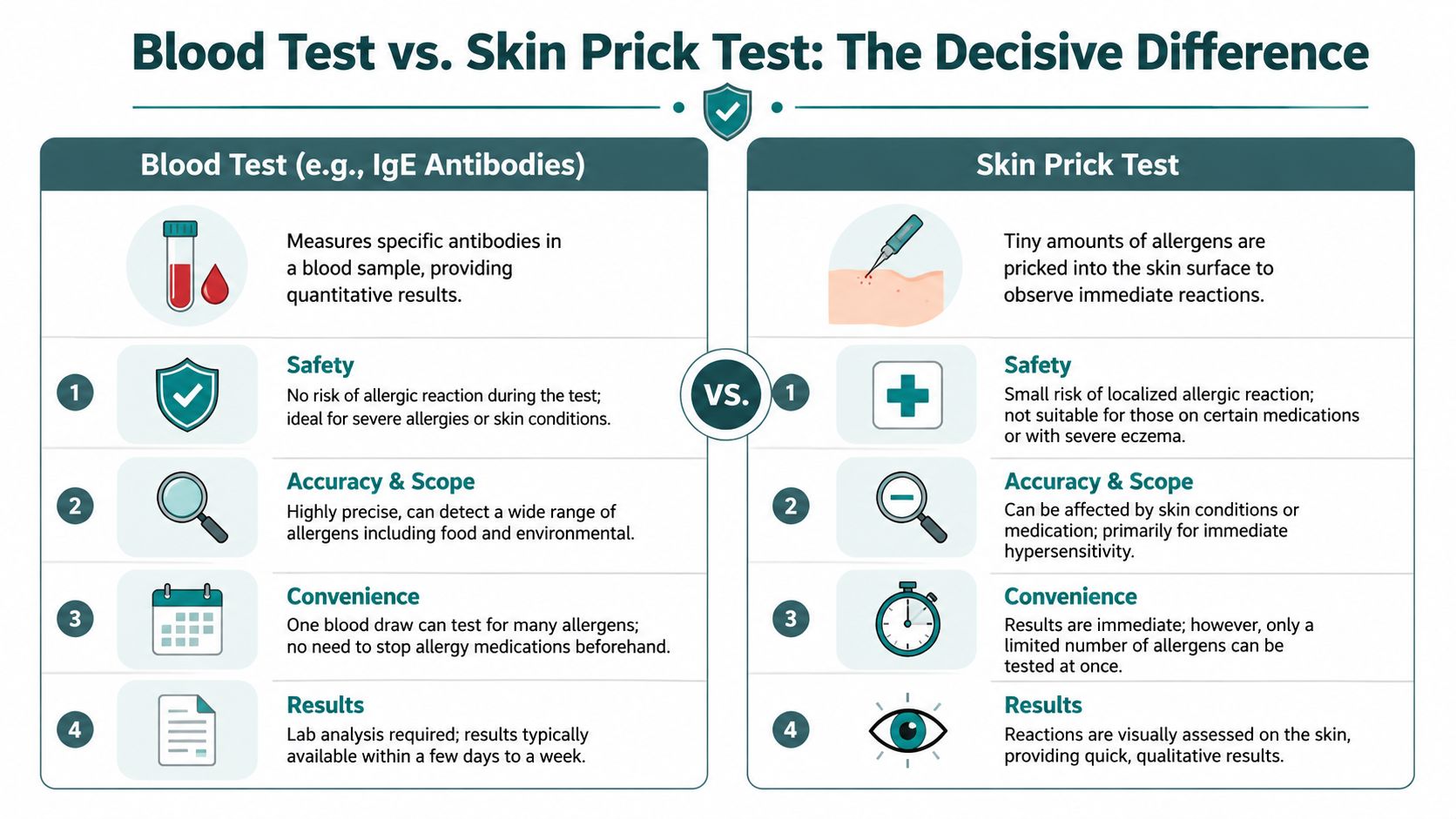
Blood Test vs. Skin Prick Test Comparison
| Feature | Blood Allergy Test (Preferred) | Skin Prick Test |
|---|---|---|
| What it measures | Specific IgE antibodies in blood | Skin reaction to applied allergens |
| Scope | Can assess a wide range of allergens from one sample | Usually more limited by practical panel size |
| Suitability | Useful for patients with eczema or those taking antihistamines | Less suitable when skin disease or medication interferes |
| Comfort | Single blood draw, no skin reaction required | Multiple skin pricks and visible local reactions |
| Reporting | Quantitative laboratory result | Immediate visual response on skin |
| Best use | Broader, more standardised assessment | Quick in-clinic screening in selected patients |
Why standardisation matters
Serum-specific IgE blood tests provide quantitative measurements in kU/L, and the interpretation thresholds are standardised in laboratory testing. The same testing guidance notes that results are not affected by antihistamines or skin conditions such as severe eczema, which makes them suitable for a broader range of patients, as set out in this serum-specific IgE testing overview.
That’s a major practical advantage. A test is only useful if it can be performed and interpreted reliably in the patient sitting in front of you.
Skin prick testing isn’t wrong. It’s often just less helpful.
Some clinics still lean heavily on skin prick tests because they’re quick. Quick doesn’t always mean best. If the patient has active eczema, needs regular antihistamines, or has a complicated food story, the test becomes less attractive immediately.
Blood testing also gives a more structured basis for interpretation. The same laboratory guidance describes thresholds such as under 0.35 kU/L indicating unlikely sensitisation, 0.35 to 0.69 kU/L suggesting doubtful significance, 17.50 to 49.99 kU/L indicating very likely sensitisation, and over 100.00 kU/L denoting extremely likely sensitisation in that testing framework. It also notes that these assays are very sensitive but can lack specificity, so results still need proper clinical interpretation.
That last point matters. A positive result is not a licence to panic. It’s a tool. Good clinicians use it in context.
Blood testing gives numbers, structure, and broader suitability. Skin testing gives speed. If your case is straightforward, speed may be enough. If your case is confusing, speed is not the priority.
If you’re choosing between skin prick test vs blood test, choose the option that gives the strongest information with the fewest practical compromises. For most patients asking about private allergy testing UK, that means blood testing.
Especially for allergy testing food concerns, blood-based assessment is the more sensible route when accuracy, comfort, and broader applicability matter.
What Happens After Your Diagnosis? A Plan for a Healthier Life
A diagnosis only helps if it changes daily life for the better. That means practical management, not vague advice to “be careful”.
Food, labels, and real-life decisions
Once a food allergy is confirmed, patients need to know what counts as strict avoidance and what may need more nuanced advice. That’s one reason accurate diagnosis matters so much. Over-restriction makes life harder. Underestimating risk is dangerous.
Post-diagnosis support is critical because navigating UK supermarket labelling and sourcing safe allergen-free foods can be difficult, and thorough private follow-up can help bridge that gap with guidance on nutrition and safer food choices, as highlighted in this review of food access and allergy equity.
Your management plan should be specific
A sensible allergy plan usually includes some combination of the following:
- Trigger avoidance advice that fits your confirmed diagnosis
- Medication guidance, such as antihistamines or emergency treatments when clinically appropriate
- Cross-contact discussion for shared kitchens, restaurants, and school settings
- Nutritional support if important foods need to be removed
The best diagnosis is the one that tells you exactly what to do next.
Daily support matters more than people expect
Many patients struggle after the test, not during it. Meal planning becomes awkward. Shopping takes longer. Social events feel risky. Families start reading every label twice.
For people adapting to new dietary restrictions, tools can help with the day-to-day side of planning meals. Some patients find AI-powered plans for dietary restrictions useful for organising elimination-style eating in a more practical way, alongside proper medical advice.
That kind of support doesn’t replace clinical care. It makes the plan easier to follow in everyday life.
Take Control of Your Allergies with Haven Medical
If you’re still guessing, you’re wasting time and increasing stress. Recurrent reactions need proper evaluation. For many patients, blood allergy testing is the clearest route to a reliable answer because it offers structured, laboratory-based assessment that suits a wider range of people than skin testing alone.
That’s especially true if you have eczema, take antihistamines, need multiple allergens assessed, or have had confusing results before. In those situations, a blood allergy test UK private patients can access promptly is usually the most sensible next move.
Why this route makes sense
Choose a private assessment when you want:
- Faster access without waiting indefinitely for answers
- A blood-based approach that avoids many of the practical limits of skin prick testing
- Clinician-led interpretation rather than raw numbers without context
- A plan after diagnosis, not just a test result
What to do now
If food, environmental, or mixed symptoms are disrupting your life, stop relying on trial and error. Get the right test and get it interpreted properly.
Haven Medical offers private allergy testing UK patients can access quickly, with consultant-led care and advanced blood-based diagnostics designed to give clear, actionable answers.