


If you’re waking with a numb hand, shaking your fingers out in the night, or noticing tingling when you drive, type, or hold your phone, it’s reasonable to wonder, do I have carpal tunnel? Many people aren’t sure. Hand and wrist symptoms can be vague at first, and they often come and go before they become more obvious.
The reassuring part is that carpal tunnel syndrome is common, well understood, and treatable. The most useful first step isn’t guessing. It’s getting clear about whether your symptoms fit the pattern, and whether you need assessment now rather than later.
Understanding Carpal Tunnel Syndrome and Your Symptoms

You may have had this thought already. The symptoms are real, but they are not always clear. A hand goes numb at night, tingles when you hold the steering wheel, then seems almost normal again by lunchtime. That stop-start pattern is one reason carpal tunnel syndrome is often missed or second-guessed at first.
Carpal tunnel syndrome happens when the median nerve is squeezed as it passes through a narrow passage in the wrist called the carpal tunnel. This nerve carries feeling from the thumb, index finger, middle finger, and part of the ring finger. It also helps power some of the small muscles that support grip and fine finger movement.
The wrist tunnel is a tight space shared by the nerve and the tendons that bend your fingers. If pressure builds in that space, the nerve becomes irritated. Nerves do not like being crowded. They tend to complain through tingling, numbness, discomfort, or weakness before anything is visible from the outside.
Why it can feel confusing at first
Early carpal tunnel symptoms rarely arrive as one dramatic event. They often drift in gradually. You might notice pins and needles while reading in bed, a strange buzzing in the fingers when using your phone, or a hand that feels clumsy and slow first thing in the morning.
That uncertainty is very common. People often put the symptoms down to posture, sleeping awkwardly, overuse, or poor circulation. Because the symptoms can come and go, it is easy to wonder if it is serious enough to get checked.
A helpful way to understand this is to think about how pressure affects a nerve over time. At first, the signal is only disrupted now and then. Later, the pattern usually becomes easier to recognise. That is why getting a proper diagnosis matters. It replaces guesswork with a clear answer.
If you have been waiting for an NHS appointment, or you are unsure whether your symptoms really fit carpal tunnel, private nerve conduction studies can help settle the question quickly. At Haven Medical, this fast-track assessment is often the point where uncertainty gives way to clarity.
How common is it in the UK
Carpal tunnel syndrome is common in UK clinical practice, and women are affected more often than men. The main point for patients is practical rather than statistical. If the same hand symptoms keep returning, especially in a recognisable finger pattern or during the night, they are worth assessing properly.
Practical rule: If your symptoms keep returning in the same fingers and are starting to interrupt sleep or daily tasks, it is sensible to get them checked rather than wait and see.
The reassuring part is that carpal tunnel syndrome is well understood and treatable. The challenge is not usually a lack of treatment. It is the gap between noticing symptoms and getting a firm diagnosis.
Key Symptoms and Common Causes of Carpal Tunnel
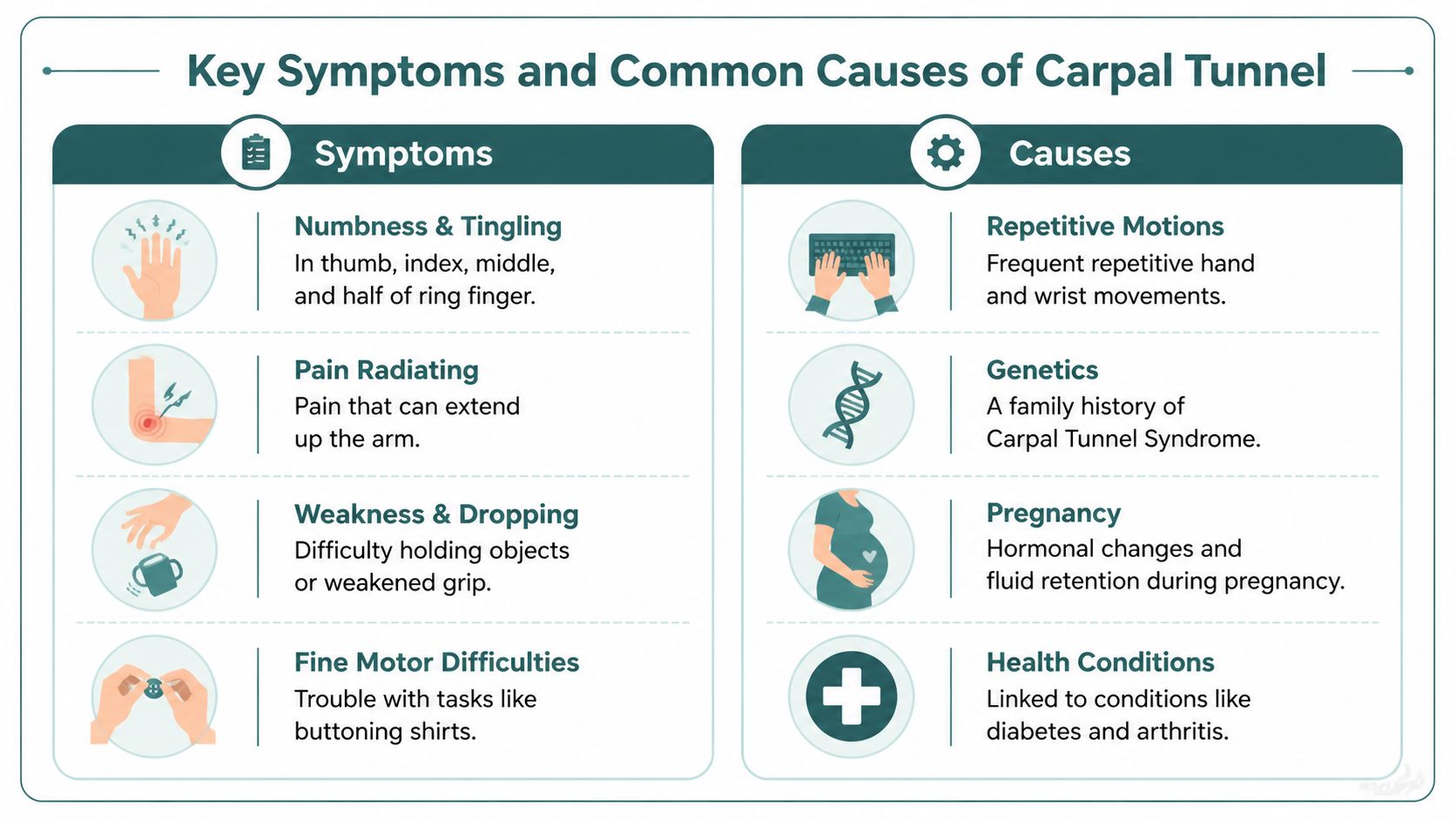
Carpal tunnel symptoms usually follow a recognisable pattern. The exact mix varies from person to person, but certain complaints come up again and again in clinic.
The symptom pattern to look for
The most typical symptoms involve the thumb, index finger, middle finger, and part of the ring finger. People often describe tingling rather than sharp pain at first. Others say the fingers feel dead, thick, fuzzy, or “asleep”.
Aching can sit in the wrist or palm, and sometimes the discomfort seems to travel up the forearm. You may also notice that your grip isn’t what it used to be. Mugs feel less secure. Lids are harder to twist. Objects slip unexpectedly.
- Tingling and numbness: often worst in the fingers supplied by the median nerve
- Symptoms at night or on waking: a classic clue, especially if shaking the hand helps
- Weakness: dropping items, struggling with opening packets or fastening jewellery
- Burning or aching: in the hand, wrist, or sometimes further up the arm
- Fine motor difficulty: trouble with buttons, zips, pens, coins, or keys
A symptom can still be significant even if it comes and goes. Intermittent doesn’t always mean mild.
Why these symptoms happen
The symptoms are caused by rising pressure around the median nerve. In severe cases, intraneural pressures can exceed 30 to 40 mmHg, compared with normal pressure of less than 10 mmHg, as described in this endoscopic carpal tunnel release explainer. You don’t need to remember the measurement. The practical meaning is simple. Too much pressure interferes with how the nerve works.
Common causes and contributing factors
Carpal tunnel isn’t always caused by one single activity. Often it’s a combination of anatomy, daily demands, and background health factors.
| Factor | How it may contribute |
|---|---|
| Repetitive hand use | Frequent typing, gripping, tool use, or wrist-heavy tasks can aggravate symptoms |
| Wrist anatomy | Some people naturally have less room in the carpal tunnel |
| Pregnancy | Fluid retention can increase pressure in the wrist |
| Medical conditions | Diabetes, thyroid problems, and inflammatory conditions can raise risk |
| Swelling around tendons | Inflamed tissues can crowd the tunnel and irritate the nerve |
One person might develop symptoms after long days at a keyboard. Another might notice them during pregnancy. Someone else may have a combination of diabetes, hand-intensive work, and a naturally tighter wrist anatomy. That’s why proper assessment matters. The pattern is common, but the reasons behind it aren’t identical for everyone.
When to See a Specialist for Your Wrist Pain
Not every sore wrist is carpal tunnel syndrome. Arthritis, tendon problems, neck-related nerve irritation, and other hand conditions can overlap with it. That’s why self-diagnosis often goes wrong.
People often wait because the symptoms seem manageable. They buy a support online, change their mouse, or hope a bit of rest will sort it out. Sometimes that helps for a while. Sometimes it doesn’t.
Signs that shouldn’t be ignored
A specialist review becomes more important when symptoms are persistent, progressing, or affecting function.
- Symptoms lasting weeks: if tingling or numbness isn’t settling, it needs checking
- Sleep disruption: repeated waking with hand symptoms is a strong reason to seek help
- Increasing weakness: especially if you’re dropping things more often
- Constant numbness: this suggests the nerve may be under more sustained pressure
- Loss of dexterity: writing, buttoning, gripping, and fine tasks becoming harder
A good rule is this. If the symptoms are repeating in a recognisable pattern, interfering with work, sleep, or confidence in your hand, they’re worth assessing properly.
If you’re unsure where to start
Some people want an early medical opinion before arranging specialist testing or surgery discussions.
Persistent numbness is more important than occasional discomfort. When sensation starts changing regularly, don’t leave it to chance.
Seeking help isn’t overreacting. It’s a sensible step when symptoms keep returning or start affecting everyday tasks. Early review can help separate carpal tunnel from lookalike conditions and point you toward the right treatment sooner.
How Carpal Tunnel is Diagnosed in the UK

A proper diagnosis usually starts with a conversation, not a scan. A clinician will ask which fingers are affected, when symptoms occur, whether the hand wakes you at night, and whether you’re noticing weakness or clumsiness. That history matters because the distribution and timing of symptoms can be very revealing.
The examination then helps build the picture. The wrist and hand are assessed for sensation, grip, thumb strength, and whether certain positions trigger symptoms. A clinician may also check the neck, elbow, and other parts of the upper limb if the story isn’t straightforward.
What nerve conduction studies do
When the diagnosis needs confirmation, or when severity matters for treatment decisions, nerve conduction studies are often used. These tests measure how well electrical signals move through the nerve. In carpal tunnel syndrome, the median nerve typically conducts more slowly across the compressed area.
For many patients, the idea sounds worse than the experience. The test is brief, structured, and designed to answer a clear question. Is the median nerve compressed at the wrist, and if so, how much?
Why objective testing matters
Nerve testing helps in two important ways. It confirms whether symptoms really fit carpal tunnel syndrome, and it helps separate mild compression from more advanced nerve involvement. That can guide whether splints and monitoring are reasonable, or whether injection or carpal tunnel surgery should be discussed.
One objective marker comes from nerve conduction evidence during successful decompression. Median motor latency falls from a diagnostic threshold of more than 5.5ms to less than 4.2ms in 92% of cases, according to this guide to carpal tunnel surgery and nerve testing. In plain terms, when the nerve is effectively released, its signal transmission improves.
| Part of assessment | What it helps answer |
|---|---|
| Symptom history | Does the pattern fit median nerve compression? |
| Clinical examination | Are there signs of altered sensation or weakness? |
| Nerve conduction study | Is the nerve compressed, and how severe is it? |
If you’re searching for nerve conduction study UK or carpal tunnel diagnosis private, the main benefit is speed and clarity. Private assessment can shorten the time between symptoms, confirmation, and a treatment plan, which is often the point that relieves anxiety most.
From Splints to Surgery Your Treatment Options

You may be at the stage where the question is no longer, “What is causing this?” but, “What do I do about it?” That can feel like a big step, especially if your symptoms come and go, or if you have been trying to manage them while waiting for a clear diagnosis.
Treatment works best when it matches the severity of the nerve compression. Carpal tunnel syndrome is a bit like a cable being squeezed in a narrow channel. If the pressure is mild and occasional, simple measures can settle things. If the pressure is stronger or more persistent, the nerve may need more direct treatment.
Early and milder treatment options
For symptoms that are intermittent, mainly at night, or still at an early stage, doctors often start with non-surgical treatment. The aim is to reduce pressure on the median nerve and give irritated tissues a chance to calm down.
Common options include:
- Night splints: these hold the wrist in a straighter, neutral position while you sleep, which can reduce tingling and numbness
- Activity changes: adjusting hand position at work, limiting prolonged gripping, and taking regular breaks may reduce provocation
- Anti-inflammatory treatment: this may help if there is local irritation around the wrist
- Hand therapy advice: practical guidance on exercises, pacing, and wrist use can make day-to-day tasks more comfortable
These measures can help a great deal in milder cases. They are less likely to solve the problem fully if numbness is becoming constant or hand strength is starting to drop.
When treatment needs to move on
A change in symptoms often signals that the treatment plan should change too. If you are waking most nights, dropping objects, struggling with buttons or jars, or noticing numbness that does not fully clear, it is sensible to review things promptly.
Steroid injection is sometimes used to reduce swelling around the nerve and can provide relief, particularly in selected cases. For some patients, though, surgery becomes the more reliable option because it deals with the source of the pressure rather than only settling the irritation around it.
This operation is called carpal tunnel surgery, or carpal tunnel release. The surgeon divides the tight ligament forming the roof of the tunnel, which creates more room for the median nerve. It is usually a straightforward procedure, commonly performed as day surgery.
How to think about surgery
Patients often worry that surgery means the condition has become severe or that they have somehow delayed too long. In reality, surgery is one treatment option on the pathway. It is usually considered when symptoms are more intrusive, when conservative treatment has not given enough relief, or when testing shows that the nerve is under meaningful pressure.
As noted earlier, surgery is generally regarded as a highly effective treatment for appropriately selected patients. The main goal is relief of numbness, night symptoms, and pain, while also helping protect hand function if the nerve has been compressed for some time.
Recovery is usually gradual rather than instant. Night symptoms may improve early, while grip comfort and hand confidence can take longer to return. A practical concern many patients raise is scar sensitivity after hand surgery.
One private option in this area is Haven Medical, which offers carpal tunnel decompression surgery through its day surgery service. For people stuck between persistent symptoms and long waits, the most helpful next step is often not rushing into surgery, but getting enough diagnostic clarity to know whether splints, injection, or an operation is the right choice.
Why Timely Diagnosis Matters The Haven Medical Pathway
You wake at 3am with a hand that feels numb and strange, shake it out, and tell yourself it is probably nothing. Then it happens again the next night, and a few weeks later you are still unsure whether this is a minor irritation or the start of something that needs proper attention. That period of uncertainty is where many people lose time.
Carpal tunnel syndrome often develops gradually. The median nerve is a little like an electrical cable running through a narrow passage at the wrist. If that passage becomes tight, the signal travelling through the nerve becomes less reliable. Early on, symptoms may come and go. With longer pressure, numbness can become more constant, grip can feel less dependable, and everyday tasks such as fastening buttons or holding a phone may start to feel awkward.
The problem with waiting too long
In the UK, patients can face 6 to 12 month NHS waiting times for carpal tunnel assessment, and during that time 20% of moderate-to-severe cases experience a functional worsening of their condition, according to the Royal College of Surgeons guide on carpal tunnel syndrome.
Not everyone worsens at the same pace. Some people remain fairly stable for a period. But waiting is not always a neutral pause, especially if sleep is repeatedly disturbed or the hand is starting to feel weak.
This is particularly important for people who are stuck on waiting lists, unsure whether their symptoms are serious, or caught in the frustrating cycle of symptoms improving for a few days and then returning. In that situation, the primary value of early assessment is clarity.
What a clear private pathway offers
A private pathway gives you a faster way to answer the question that matters most. Is this carpal tunnel syndrome, and if so, how much is the nerve being affected?
At Haven Medical, that usually means a prompt consultant review followed by fast-track nerve conduction studies where appropriate. Nerve conduction testing measures how well signals pass through the median nerve. It works a little like checking whether electricity is moving cleanly through a wire or being slowed at a pinch point. For patients who have been guessing, waiting, or trying to judge severity from symptoms alone, that test can turn uncertainty into a clear diagnosis.
The practical benefits are straightforward:
- Faster assessment: symptoms are reviewed before more time passes
- Objective testing: nerve conduction studies help confirm whether the median nerve is compressed
- Clear treatment planning: the next step can be matched to the findings, whether that is splinting, injection, monitoring, or surgery
- Continuity of care: the same team can explain results and answer questions in plain language
Do not judge the problem by pain alone. Night waking, loss of feeling, weaker grip, and reduced confidence using the hand can all matter just as much.
A timely diagnosis does not push you towards an operation. It helps you choose the right option with confidence, based on what is happening in the nerve rather than on guesswork.
Take Control of Your Hand Health Today
If you’ve been asking yourself, do I have carpal tunnel, the answer shouldn’t come from guesswork alone. A repeating pattern of numbness, tingling, night symptoms, weakness, or dropped objects deserves proper assessment. That’s especially true if the symptoms are becoming more frequent or are starting to affect sleep and daily tasks.
The good news is that carpal tunnel syndrome is treatable. Some people improve with splints and activity changes. Others need injections or carpal tunnel surgery. The important thing is getting the diagnosis right, at the right time.
You don’t have to stay stuck between discomfort and uncertainty. If your hand symptoms are persisting, call to book an assessment. If you’d like to understand the wider services available before arranging care, you can also visit website for more information.
A clinical assessment is the safest way to confirm whether your symptoms are due to carpal tunnel syndrome or another condition. If you’re concerned, seek personalised medical advice rather than relying on self-diagnosis alone.