




When you consider a private Kenalog hay fever injection, there’s a good chance you’re not mildly sniffly. You’re probably exhausted. Your eyes sting the moment you step outside, your sleep is broken, your nose feels blocked for weeks, and the usual pharmacy tablets haven’t touched the problem.
That level of hay fever can make summer feel like an illness rather than a season. It affects work, time outdoors, exercise, driving, concentration, and simple plans like sitting in a garden or attending a school sports day. People with severe symptoms often arrive at one question very quickly. Is there a stronger option that works?
There is, or at least there has been. Kenalog is a powerful steroid injection that some private clinics have used for severe hay fever. It can offer major relief. It has also become controversial for good reasons. If you’re considering it, you deserve a clear explanation of what it is, why some patients still ask for it, and why any responsible clinician treats it as a serious decision rather than a seasonal convenience.
When Summer Feels Like a Sickness
Severe hay fever doesn’t behave like a small nuisance. It can feel relentless. The sneezing is one part of it, but the primary burden is often the constant inflammation. Puffy eyes, streaming nose, blocked sinuses, post-nasal drip, poor sleep, irritability, and that washed-out feeling that makes your whole day harder.
For some people, standard treatment works well enough. For others, it doesn’t. They take antihistamines, use eye drops, try nasal sprays for a few days, then give up because they’re still miserable. By the time they look for a private hay fever injection, they’re usually not looking for a luxury. They’re looking for a way to function.
Why patients ask about injections
There are a few very understandable reasons this treatment keeps coming up:
- Daily treatment fatigue. Taking tablets every day, using sprays properly, and timing treatment around the pollen season can feel like a job in itself.
- Symptoms that break through everything. Some people still struggle despite trying more than one medicine.
- The appeal of one decisive treatment. A single injection sounds simpler than juggling multiple products for weeks.
- Memories of past relief. Many patients know someone who had “the hay fever jab” and felt dramatically better afterwards.
Severe hay fever is real suffering. But strong symptom relief doesn’t automatically mean a treatment is the safest or best choice.
That’s the point many clinics skip. Kenalog isn’t a lifestyle add-on and it isn’t a beauty-clinic product. It’s a systemic steroid injection. That means the possible benefit can be substantial, but the trade-off is that the whole body is exposed to the drug, not just the inflamed lining of the nose or eyes.
A sensible consultation doesn’t start with “yes” or “no”. It starts with a harder question. Have safer options been used properly and fully before moving to a treatment with wider consequences?
What Is the Kenalog Hay Fever Injection
Kenalog is a brand name for triamcinolone acetonide, a corticosteroid given as an intramuscular injection. For hay fever, the point of it is straightforward. It suppresses the immune-driven inflammation behind symptoms such as blocked nose, sneezing, streaming eyes, and sinus pressure.
What makes it different from standard hay fever treatment is where it acts. A nasal steroid spray works mainly on the lining of the nose. Kenalog is systemic. After the injection, the steroid circulates through the body and dampens inflammatory activity more widely. That broader effect is why some patients experience strong relief, and why careful doctors treat it with caution.
A stronger treatment with wider consequences
Local treatments aim at the tissues causing the symptoms. A depot steroid injection works at whole-body level and continues releasing medicine after the appointment. That is a very different proposition from taking an antihistamine tablet or adjusting a spray.
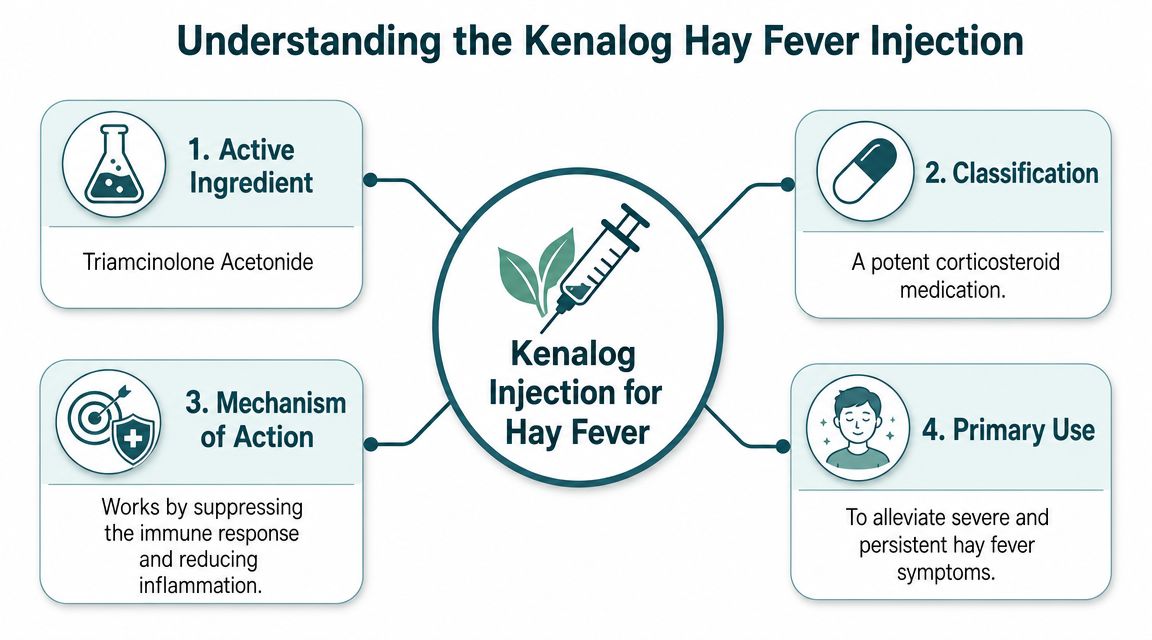
In UK patient information, the hay fever injection commonly discussed is triamcinolone acetonide 40 mg/1 ml.
The controversy starts here. This was never designed to be a convenient substitute for first-line hay fever treatment. It became controversial because the benefit is real, but the drug exposure is systemic and cannot be reversed once given. If a patient develops side effects, you cannot remove the injection or taper it back in the way you can with tablets.
That is also why NHS prescribing moved away from routine use for seasonal allergic rhinitis. The concern was not that Kenalog does nothing. The concern was that a potent depot steroid for a usually non-dangerous condition can carry a risk profile that is out of proportion for many patients, especially when safer options such as nasal steroids, antihistamines, eye drops, and allergy-focused treatment plans often work when used properly.
In practice, that means the right question is not “does it help hay fever?” It can. The right question is whether the likely benefit is strong enough, and the alternatives have been exhausted enough, to justify a whole-body steroid injection for this particular patient.
The Potential for a Pollen-Free Season
This is the reason people keep asking about private Kenalog. In the best-case scenario, symptom relief can feel dramatic. A patient who’s been struggling every day may suddenly sleep better, breathe more freely, and stop planning life around pollen exposure.
What matters isn’t just fewer sneezes. It’s what relief allows you to do. Walking the dog without dreading the next hour. Driving without streaming eyes. Sitting through meetings. Going to the park with your children. Opening windows at night and still sleeping.
Why the treatment has such a strong reputation
Kenalog built its reputation because it can suppress the allergic inflammatory response at a level stronger than many everyday hay fever treatments. For the right patient, that can mean:
- Broader relief across nasal, eye, and sinus symptoms
- Less dependence on constant top-ups with multiple over-the-counter products
- More stable control through the period when symptoms would otherwise peak
- A sense of normality during a season that usually feels unmanageable
There is no point pretending that this isn’t attractive. It is. That’s why a balanced medical discussion has to acknowledge the genuine potential upside before talking about safety.
What the promise gets wrong
The problem is that patients often hear only the phrase “one injection for the season” and not the clinical reality behind it. Relief is possible, but it doesn’t turn a systemic steroid into a casual treatment. The benefit that makes Kenalog appealing is the same feature that demands restraint. It acts widely and can last.
Good prescribing isn’t about whether a treatment can work. It’s about whether the benefit is worth the risk for that specific patient.
That distinction separates medical advice from product marketing.
Understanding the Risks and Controversy
By the time patients ask about Kenalog, they are often exhausted. They have tried tablets, sprays, eye drops, air filters, closed windows, and still feel ill for weeks every summer. That suffering is real. The controversy starts when a powerful whole-body steroid is offered for a condition that is miserable, but rarely dangerous.
The regulatory history matters
Kenalog’s place in UK hay fever care has never been straightforward. It was not licensed in the UK specifically for hay fever, it was later withdrawn from NHS use for this purpose because of safety concerns, and UK supply has since tightened further, as outlined in The Online GP summary of Kenalog’s UK regulatory history and current position.
That history is fundamental to understanding the current private market. This is not a routine mainstream treatment that merely moved from NHS to private practice for convenience. It sits in a more restricted category. Off-label prescribing, limited availability, and closer scrutiny from regulators all reflect the same underlying issue. The benefit can be real, but the risk profile is broader than many patients expect from a “hay fever injection”.
Why doctors are cautious
The concern is not whether steroids can work. The concern is what they do beyond the nose and eyes.
Kenalog is a depot steroid. Once injected, it cannot be taken back out if side effects develop. That single fact changes the prescribing conversation. A tablet can be stopped. A nasal spray can be reduced. A depot injection continues to release steroid after the appointment is over.
Potential problems discussed in clinical practice include:
- Immune suppression, which can make infections more concerning
- Mood and sleep disturbance, including agitation, low mood, or insomnia
- Raised blood sugar, especially relevant in diabetes or pre-diabetes
- Blood pressure and fluid retention issues in susceptible patients
- Eye complications, including concern about glaucoma or cataracts
- Bone effects with repeated steroid exposure
- Adrenal suppression, where the body’s own steroid regulation is affected
- Injection site problems, including local tissue changes
Some reactions are short-lived and manageable. Others are serious enough to rule the treatment out altogether.
The point patients are often not told clearly enough
Seasonal use does not make systemic steroids minor treatment. One injection per year may sound modest. Medically, it is still whole-body steroid exposure, with effects that are not confined to pollen symptoms.
That is why I regard Kenalog as a last resort option for a small subset of patients with severe hay fever, not a lifestyle convenience treatment. Good prescribing starts with the harder questions. How severe are the symptoms, exactly? What has already been tried properly? Is there asthma, diabetes, glaucoma, hypertension, infection risk, pregnancy, or a history of steroid side effects? Are you asking for relief, or are you being sold simplicity?
Safety principle: Convenience is never a sufficient reason to use a depot steroid.
An ethical consultation should feel careful, not persuasive. Patients deserve a plain explanation of the upside, the uncertainty, the known risks, and the reasons a responsible clinician may still say no.
Kenalog Compared to Other Hay Fever Treatments
Individuals considering a private Kenalog injection don’t need a lecture. They need a practical comparison. Where does it sit compared with tablets, sprays, drops, and longer-term allergy care?
The key distinction is local versus systemic treatment. Local options target the nose or eyes. Kenalog affects the whole body. That difference shapes both benefit and risk.
Hay Fever Treatment Comparison
| Treatment | Mechanism | Speed of Relief | Duration | Key Side Effects |
|---|---|---|---|---|
| Antihistamine tablets | Reduce histamine-driven allergy symptoms throughout the body | Often relatively quick for itching, sneezing, and runny nose | Works while you keep taking it | Drowsiness with some products, dry mouth, headache in some people |
| Steroid nasal sprays | Local anti-inflammatory treatment inside the nose | Usually better when used consistently rather than as a one-off | Ongoing control during regular use | Nasal irritation, dryness, occasional nosebleeds |
| Antihistamine eye drops | Local symptom relief for itchy, watery eyes | Often quick for eye symptoms | Short acting, repeated use often needed | Stinging or irritation on application |
| Saline rinses and barrier measures | Reduce pollen contact and clear nasal passages | Supportive rather than dramatic | Temporary, repeat as needed | Minimal, though benefit may be limited in severe cases |
| Immunotherapy | Retrains immune response over time for selected allergies | Slow, not a quick fix | Longer-term approach | Requires specialist assessment and commitment |
| Kenalog injection | Systemic corticosteroid that suppresses inflammation more broadly | Can be strong when it works | Longer acting than day-to-day symptom medicines | Systemic steroid risks, not just local side effects |
What usually works first
In ordinary practice, the most reliable first step is not an injection. It's usually a combination approach used properly:
- A non-drowsy antihistamine taken consistently during the relevant season
- A steroid nasal spray used with correct technique and enough lead-in time
- Eye drops if eye symptoms are prominent
- Pollen reduction habits such as showering after outdoor exposure and keeping windows managed during high-pollen periods
What doesn't work well is inconsistent use. A nasal steroid sprayed for two days in a rushed, incorrect way won't give a fair result. Many people conclude treatment has "failed" when the failure was due to timing, technique, or adherence.
Where Kenalog fits
Kenalog sits at the far stronger end of symptom suppression, but not because it's more elegant. It sits there because it is blunter. It uses whole-body steroid effect to quieten an allergic problem that is often better managed with targeted treatment.
That's why it should be understood as a last-resort style option, not a shortcut for people who haven't yet had their standard treatment properly optimised.
Is a Private Kenalog Injection Right for You
A private Kenalog injection may be considered only if your hay fever is severe, your quality of life is clearly affected, and safer options have been used properly without enough benefit. The right candidate is not someone who prefers an annual jab to daily treatment without other justification. The right candidate is someone in whom the burden is high enough, and the alternatives poor enough, that a clinician can justify the risk.
Questions worth asking yourself
Before you even discuss suitability, be honest about the basics:
- Have you used a steroid nasal spray correctly and consistently? Not just once symptoms were unbearable, but as a proper course.
- Have you tried an appropriate antihistamine plan? Including reviewing whether the product itself was the right one for your symptoms.
- Have eye symptoms been treated separately if needed? A lot of treatment "failure" is untreated eye inflammation.
- Have you had the diagnosis reviewed? Not every blocked or runny nose in summer is straightforward hay fever.
If the answer to several of those is no, the injection usually isn't the next sensible step.
Situations where Kenalog may be unsuitable
A careful clinician will usually be very cautious, and may advise against treatment altogether, in situations such as:
- Pregnancy or breastfeeding
- Recent or current infection
- Poorly controlled diabetes
- Significant psychiatric history, especially where steroids may worsen mood or behaviour
- Glaucoma or significant eye disease
- Osteoporosis or high fracture risk
- Stomach ulcer history
- Immune system concerns
- Recent live vaccination
- Current use of medicines that complicate steroid treatment
This isn't a complete prescribing checklist. It's a simple reminder that suitability depends on your broader health, not just the severity of your pollen symptoms.
If a clinic offers Kenalog with almost no questions asked, that's a warning sign, not a convenience.
The people who need a different plan
Some patients don't need Kenalog. They need better standard treatment. Others need allergy testing, specialist review, or consideration of immunotherapy. Some turn out not to have pollen allergy as the main problem at all.
The most responsible answer isn't always the one you hoped for. Sometimes the safest recommendation is to avoid a depot steroid and build a more targeted plan instead. That may feel less dramatic, but it's often better medicine.
Your Private Clinic Visit and Safety Advice
A proper private consultation for suspected Kenalog use should feel measured, not transactional. You should expect a detailed history, questions about what you've already tried, review of other medical conditions, medication checks, and a clear explanation of risks, benefits, and alternatives.

What should happen in clinic
A safe appointment usually includes:
- Assessment first. Your clinician should confirm that hay fever is the likely diagnosis and understand how severe it really is.
- Treatment review. Expect detailed questions about antihistamines, nasal sprays, eye drops, and whether they were used correctly.
- Risk screening. Medical history matters. So do previous steroid reactions, current illness, and other medication use.
- Informed consent. You should hear a plain explanation of the controversy, the off-label context, and why the decision isn't routine.
- If appropriate, injection technique. Kenalog is given as an intramuscular injection, typically as a straightforward procedure in clinic.
Aftercare and when to seek help
After any steroid treatment, ask what to watch for. You should seek medical advice promptly if you develop significant mood changes, troubling insomnia, signs of infection, visual symptoms, or anything else that feels markedly out of keeping with your usual health.
You should also know what the plan is if symptoms don't improve. A responsible clinic doesn't end care at the needle. It gives follow-up advice and a clear route back if things aren't going as expected.
If you'd like a careful discussion rather than a sales pitch, visit the Haven Medical website to learn more, click to book a consultation, or call to book if you'd prefer to speak to the team first.
A private Kenalog hay fever injection can offer powerful symptom relief, but it isn't a casual seasonal treatment. The controversy exists for good reasons. If you're considering it, the safest path is a thorough consultation with a clinician who treats informed consent as essential, not optional.