


A flutter in your chest at bedtime. A spell of dizziness on the stairs. A new breathlessness that makes you wonder whether you should get your heart checked sooner rather than later. In that situation, many people look for a private ECG because they want two things quickly. A prompt appointment and a clearer sense of what might be going on.
A private ECG can be a good first step. It is a quick, non-invasive test that records the heart's electrical activity and can help a clinician spot rhythm problems, signs of strain, or changes that need follow-up. For many patients, the appeal is simple. You can often be seen sooner, get the test done in a short appointment, and start answering an urgent question without a long wait.
Speed helps, but speed is only part of the story.
An ECG works a bit like a snapshot of your heart's wiring at one moment in time. That makes it useful, but it also means it has limits. A normal result does not always explain symptoms that come and go, and an abnormal result does not always point to one single diagnosis on its own. Knowing that from the start helps you set the right expectations. You are not just paying for a fast test. You are starting a process of understanding what the tracing can show, what it can miss, and what the next step might need to be.
That is what makes this guide different from a simple booking checklist. It will help you get a private ECG quickly, but it will also help you understand what the result may, and may not, mean for your longer-term heart health, so you can make calm, informed decisions after the appointment.
Understanding What an ECG Test Is
You sit down for the test, see a few stickers and wires, and wonder what the machine is measuring. That concern is completely reasonable. An ECG, or electrocardiogram, records the tiny electrical signals that coordinate each heartbeat, then turns them into a tracing a clinician can read.
Your heart beats because an electrical impulse starts in its natural pacemaker and travels through the heart muscle in an organised sequence. An ECG captures that sequence on paper or screen, a bit like writing down the rhythm of a piece of music so the timing can be checked beat by beat. It does not show the heart's structure in the way an ultrasound does. It shows how the heart's electrical system is behaving at that moment.
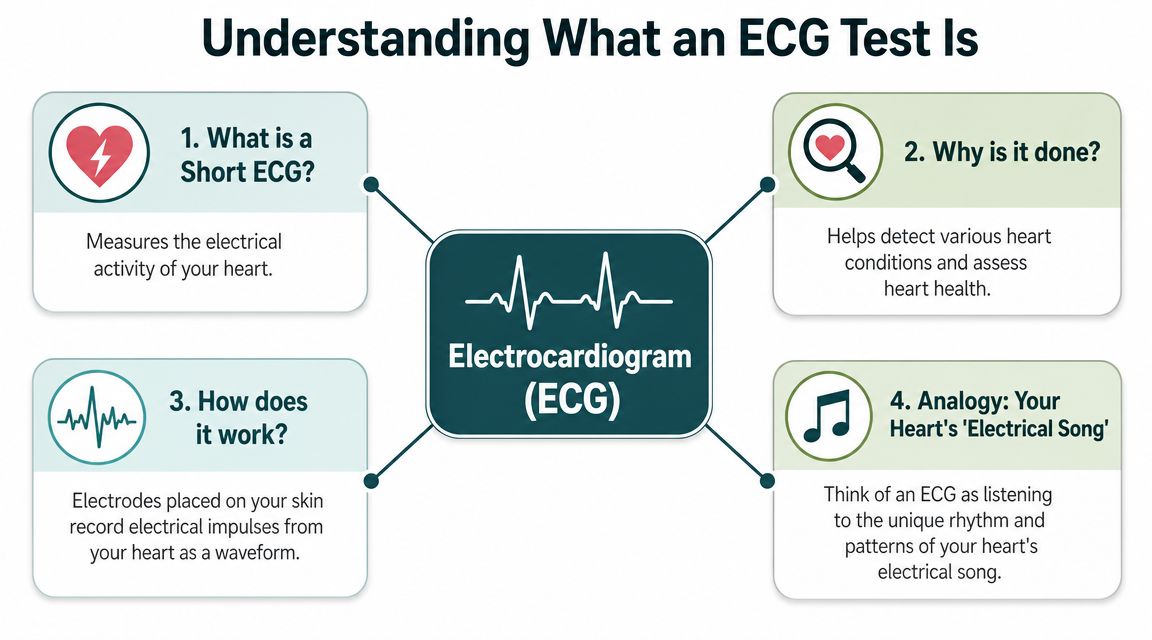
If you have ever seen the ECG line with its small bump, sharp spike, and broader wave, those shapes each represent a different stage of the heartbeat. The P wave reflects the upper chambers being activated. The QRS complex shows the main pumping chambers firing and contracting. The T wave reflects recovery, when the heart's cells reset for the next beat. You do not need to memorise these terms, but knowing they represent a sequence often makes the test feel less mysterious.
What the test can help show
A resting ECG can give useful clues about:
- Heart rhythm problems, such as beats that are too fast, too slow, or irregular
- Signs of strain or reduced blood flow, which can sometimes appear as changes in the tracing
- Previous or current heart injury, including patterns that may suggest a heart attack
- Medicine-related electrical changes, especially if a treatment can affect the heartbeat
It is still a starting point, not a final verdict.
That distinction matters. A normal ECG does not rule out every heart problem, especially if symptoms come and go. An abnormal ECG also does not automatically mean something dangerous is happening. It often means the tracing needs to be interpreted alongside your symptoms, examination, and sometimes other tests.
What the procedure feels like
The test itself is straightforward. Small adhesive electrodes are placed on your chest, arms, and legs, and the machine reads the electrical activity already produced by your heart. No electricity is put into your body. There are no needles, no shocks, and no recovery period.
For many patients, clear communication during simple tests makes a real difference to anxiety and trust. Good clinics understand that the quality of care includes explanation as well as speed, which is one reason wider conversations about enhancing healthcare patient experience matter.
Why clinicians use it so often
An ECG is widely used because it is quick, safe, and can point the next decision in the right direction. It helps answer practical questions. Is the rhythm normal right now? Are there changes that need urgent attention? Would longer monitoring or another type of heart test make more sense?
The useful thing to keep in mind is this. An ECG is one piece of the puzzle. It can be very informative, but its real value comes from combining the tracing with the story behind it, your symptoms, your history, and what happens next.
Why Choose a Private ECG Instead of the NHS
The biggest reason people look for a private ECG near me is usually speed. They don't want to sit with symptoms and uncertainty while waiting for the next available route through the system.
Private care doesn't replace the NHS. It gives you another option when time, convenience, or direct access matters most.
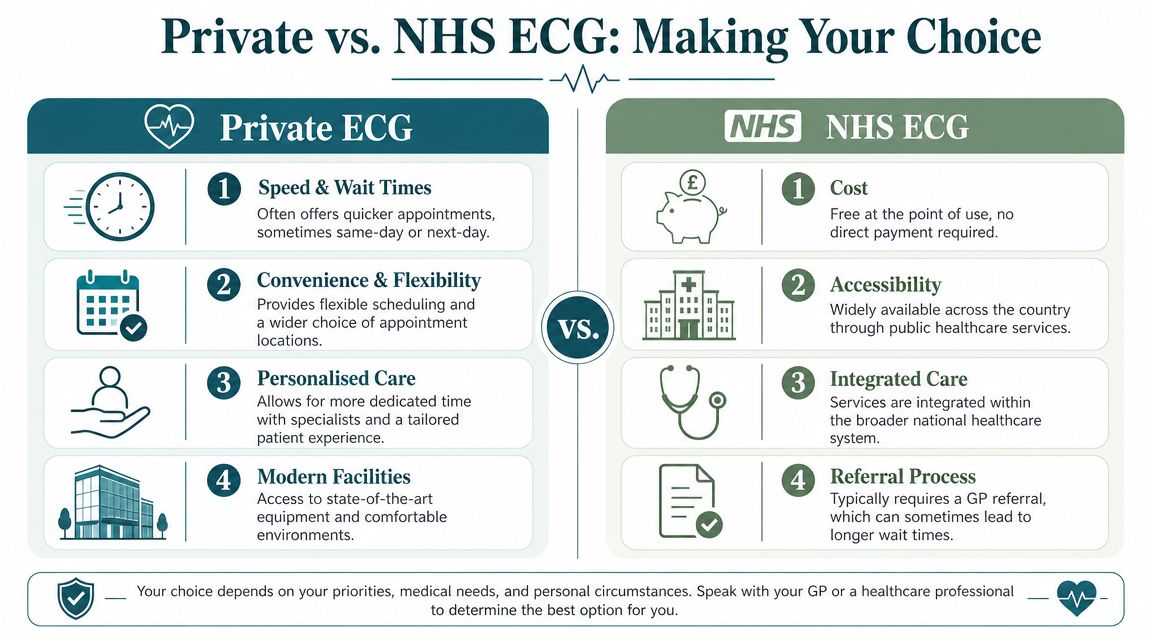
What private care often offers
Here's the comparison many patients are really making:
| Route | What often matters most |
|---|---|
| Private ECG | Faster booking, more appointment flexibility, easier choice of clinic, and often quicker reporting |
| NHS ECG | No direct payment at the point of use and care integrated into the wider NHS pathway |
For many people, the private route is less about luxury and more about access. If you work full time, care for family, travel often, or feel worried by symptoms, a flexible appointment can be a major advantage.
When private testing can be especially useful
Private providers may also be better placed to move quickly from a basic ECG to ambulatory monitoring if your symptoms come and go. That matters because brief resting ECGs can miss transient abnormalities.
That’s useful if your symptoms are sporadic. A person with daily palpitations may need something very different from a person with continuous symptoms.
Practical rule: If your symptoms are brief and unpredictable, ask before booking whether the clinic can also arrange longer monitoring if your resting ECG is normal.
The human side of the decision
People don’t just remember the test itself. They remember how clearly things were explained, whether they felt rushed, and whether someone told them what happens next if the result isn’t straightforward. Good communication is part of good care, and thoughtful clinics understand that. If you’re interested in the broader principles behind enhancing healthcare patient experience, that perspective can help you judge what to look for when choosing a provider.
Private care can be the right choice if you want speed and simplicity. It’s at its best when it combines convenience with proper clinical judgement.
How to Find and Book Your Private ECG
You search for private ECG near me after a weekend of skipped beats or a few days of chest fluttering. Several clinics appear at once, all promising fast appointments. The useful question is not only, “How soon can I get in?” It is also, “Will this clinic help me understand what the test can and cannot tell me?”
That second part matters. A private ECG can be quick to arrange, but it is only one snapshot of your heart’s electrical activity, rather like taking a single photograph rather than watching the full film. A good booking process should make that clear from the start, so you know whether a resting ECG is the right first step.
Start with the clinic, not just the calendar
Before choosing the earliest slot, check how the service is set up.
Look for:
- Qualified staff: The recording needs to be done properly, and the trace should be reviewed by a qualified clinician or cardiac physiologist.
- A clear plan for results: Ask whether you receive only the tracing, a written report, or an explanation of what the result means in context.
- Plain language on the service page: You should be able to tell exactly what you are booking, what it costs, and what happens if the ECG is normal but your symptoms continue.
- A straightforward booking journey: Clear appointment information usually reflects an organised clinic.
A clinic that explains its process well often explains test limits well too. That is a good sign.
Questions worth asking before you pay
You are not being difficult by asking questions. You are checking whether the service fits your situation.
Who reviews the ECG?
You want to know whether a qualified clinician or cardiac physiologist interprets it.Will I get a written report, an explanation, or both?
A normal-looking tracing without any context can leave patients more confused than reassured.What if the ECG is normal but my symptoms are still happening?
This question is often the most revealing. A careful clinic will explain that a resting ECG can miss intermittent problems.Can you arrange further monitoring if needed?
If symptoms come and go, a longer recording may be more useful than repeating the same short test.What is included in the price?
Check whether the fee covers the recording, interpretation, report, and any follow-up discussion.
A practical booking checklist
Use this as a final sense-check before confirming:
- Confirm the test type: Make sure it is a resting 12-lead ECG, not a different heart investigation.
- Check how quickly results are reviewed: Fast appointments help, but timely interpretation matters just as much.
- Read how the clinic explains limitations: Good providers do not present an ECG as a yes-or-no answer to every heart concern.
- Check what happens after an abnormal result: There should be a clear route for onward advice or urgent assessment if needed.
- Choose a location and time you can manage calmly: Rushing across town while anxious is rarely ideal.
A clinic that focuses only on speed may still be perfectly competent. But the better services also explain what the ECG can miss, who will interpret it, and what your next step would be if the answer is not simple.
What to Expect During Your ECG Appointment
Most patients arrive a bit tense and leave saying the same thing. “That was much easier than I expected.”
A standard private 12-lead ECG is typically a 5 to 10 minute in-clinic procedure, and the most important practical detail is that you need to lie still and not talk during the recording because movement can create artefact that distorts the tracing, as explained in this ECG procedure overview.
From arrival to recording
When you arrive, the receptionist will usually confirm your details and appointment. A clinician or technician may ask why you’ve come in, what symptoms you’ve noticed, and whether you’ve had an ECG before.
You’ll then be shown into a private room. For the recording, you’ll usually need to remove clothing from your upper body so the electrodes can be placed correctly. You may also need to uncover your ankles or lower legs.
During the test itself
The sticky pads go onto the skin and attach to the ECG leads. This shouldn’t hurt. Some people notice the stickers feel cold, but that’s about it.
Once everything is in place, the key job is simple:
- Lie still
- Breathe normally
- Don’t talk during the recording
Even small movements can affect the quality of the trace. If the recording has too much artefact, the clinician may need to repeat it.
The machine records your heart’s electrical pattern. It isn’t testing your pain tolerance, and it isn’t sending anything into your body.
After the recording
Once the ECG is complete, the stickers are removed and you can get dressed straight away. There’s no recovery period, no sedation, and no restriction on driving or returning to work unless your symptoms themselves make that unsafe.
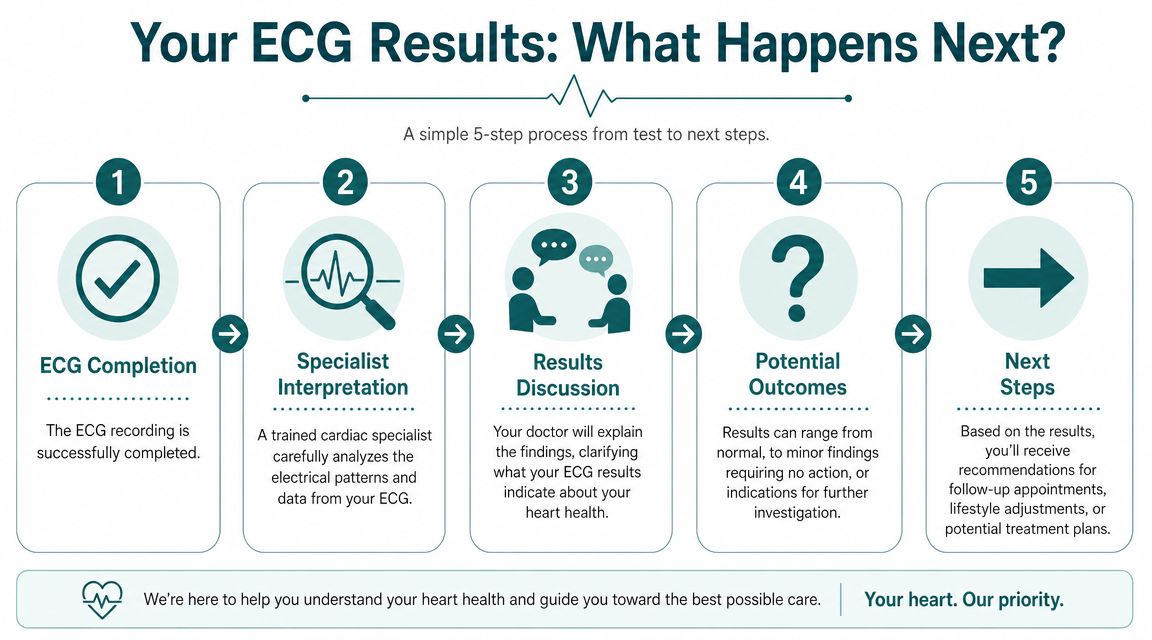
What happens next depends on the clinic. Some explain the result on the day. Others send the tracing for formal review and contact you afterwards.
Understanding Your ECG Results and Next Steps
The part patients often care about most isn’t the test. It’s what the result means.
An ECG trace is interpreted by a trained clinician who looks for patterns in the electrical activity. Your result may be described in simple terms such as normal, abnormal, or requiring further assessment. Those words can sound more dramatic than they are, so context matters.
If the ECG is normal
A normal result is reassuring, but it doesn’t always close the case. A resting ECG only records what the heart is doing during that brief recording.
That’s why one key point matters so much: a normal resting ECG does not exclude serious cardiac issues. Guidance discussed in relation to chest pain and suspected cardiac symptoms emphasises that the test can miss intermittent arrhythmias or early-stage disease, which is why the value of a private ECG is often rapid triage rather than a standalone final diagnosis, especially when symptoms are episodic, as noted on this clinical discussion of ECG limits and next-step assessment.
If the ECG is abnormal
An abnormal ECG doesn’t automatically mean you have a dangerous condition. Some findings are minor. Some reflect a known issue. Some need urgent follow-up.
What matters is the combination of:
- Your symptoms
- Your medical history
- The tracing itself
- Whether the finding matches what you’ve been experiencing
A person with fainting episodes and an unusual trace needs a different response from someone who feels well and has a minor variation with no symptoms.
If the answer is incomplete
Many people often get confused. They expect the ECG to say yes or no. In real life, it sometimes says, “We need a better look.”
That may lead to:
- Longer heart rhythm monitoring if symptoms come and go
- Further review by a GP or cardiology clinician
- Additional heart tests if the wider picture suggests another cause
A good ECG result discussion doesn’t just tell you what was seen. It tells you whether the test was enough.
The most useful mindset is this. A private ECG can move you forward quickly. It can reassure, identify a problem, or point clearly to the next investigation. Its strength is often in helping you avoid drifting with unexplained symptoms.
Frequently Asked Questions About Private ECGs
Do I need a GP referral?
Often, no. Many private clinics allow self-booking, so you can arrange a resting ECG without seeing your GP first. Still, booking rules vary, so check whether the clinic wants a short medical history before confirming your appointment.
Is a private ECG painful or dangerous?
No. A resting ECG is painless and non-invasive. Small sticky electrodes are placed on your chest, arms, and legs to record the heart’s electrical signals. They only listen. They do not put electricity into your body.
How long does the appointment take?
The recording usually takes only a few minutes, but the full visit is often longer. You may need time for check-in, getting positioned comfortably, and a brief discussion about your symptoms or results.
Will a private ECG tell me everything?
A resting ECG gives a snapshot of what your heart rhythm is doing at that moment. It works a bit like a photograph, not a full-length film. That means it can miss problems that come and go, such as occasional palpitations or brief rhythm changes.
This is one of the biggest misunderstandings about ECGs. A normal result can be reassuring, but it does not always explain ongoing symptoms by itself.
What does it mean if my ECG is normal but I still have symptoms?
This happens quite often. It does not mean your symptoms are imagined, and it does not always mean your heart is definitely fine either. It means the test did not catch an abnormality at the time of recording.
If your symptoms are intermittent, the next step may be a longer period of rhythm monitoring or a broader clinical review. The ECG is often the starting point, not the final word.
What symptoms should prompt me to book?
Common reasons include palpitations, chest discomfort, dizziness, shortness of breath, or blackouts. Some people also book because they have a family history of heart rhythm problems or they want a check before surgery or exercise.
If symptoms are severe, sudden, or feel like an emergency, seek urgent medical help instead of arranging a routine private appointment.
Will I get results straight away?
Sometimes yes, sometimes no. Some clinics can give you an immediate summary, while others send the trace for review before confirming what it shows. If you are booking privately for peace of mind, it is sensible to ask in advance who interprets the ECG and how results are explained.
What should I do after the test?
Your next step depends on the result and on why you had the ECG in the first place. If the trace is normal and your symptoms have settled, you may need reassurance. If the trace is unclear, abnormal, or does not match what you have been feeling, you may need follow-up with a GP, a cardiac physiologist, or a cardiology service.
The useful question is not only, “Was my ECG normal?” It is also, “Was this test enough to explain what has been happening?” That mindset helps you use a private ECG wisely, as one part of your longer-term heart health journey rather than expecting it to answer everything in one visit.