


Prostate cancer is the most common cancer in men in the UK, and around 52,300 men are diagnosed each year according to Cancer Research UK prostate cancer statistics. For many men, that fact is the moment this stops feeling like a distant issue and starts feeling personal.
The good news is that one of the first checks is simple. A PSA test is a blood test that can help assess prostate health and identify men who may need further investigation. It isn't a diagnosis on its own, but it can be a useful starting point.
If you've been searching for prostate cancer test psa, you're probably looking for straight answers. You may want to know what the test measures, whether you should have one, what a raised result means, and how quickly you can move things forward if something needs checking. That's exactly what this guide is for.
Taking Control of Your Prostate Health
A lot of men put off thinking about their prostate because they feel well. That's understandable. Early prostate problems, including early cancer, don't always cause obvious symptoms.
That is why the PSA test matters. It gives doctors another piece of information before a problem becomes more advanced.

What the PSA test actually is
PSA stands for prostate-specific antigen. It is a protein made by the prostate gland. The test measures how much of that protein is present in your blood.
A raised PSA can happen for several reasons. Prostate cancer is one possibility, but it can also rise because of a benign enlarged prostate or inflammation.
Why men often feel unsure about it
Many patients assume a blood test gives a simple yes-or-no answer. PSA doesn't work like that. It is better thought of as a signal.
PSA is useful because it helps identify who may benefit from closer assessment. It is not a label, and it is not a verdict.
That balance is important. The test has real value, especially when used thoughtfully, but it also has limitations. A normal result doesn't rule everything out, and a high result doesn't automatically mean cancer.
Why speed matters
One of the hardest parts for patients is often not the test itself. It's the waiting. Waiting for an appointment, waiting for results, waiting to know whether the next step is needed.
Private access can reduce that uncertainty by making the process more direct. For men who are worried, symptomatic, or want clarity sooner, that practical difference matters just as much as the blood test.
Prostate Cancer in the UK Understanding the Risk
Prostate cancer is a common part of everyday family life in the UK. Many men first take it seriously because someone close to them has been through tests, treatment, or months of uncertainty while waiting for appointments.
That familiarity can be misleading. A condition can be common and still deserve prompt attention.
Why risk matters in real life
Risk is the chance that something may affect you. With prostate cancer, that chance does not fall evenly across all men. It rises with age. It is higher in some families. It is also higher in Black men.
A helpful way to look at it is to picture risk like traffic on the road. Some drivers are on a quiet lane. Others are joining a busy motorway. Both can arrive safely, but one group needs closer attention, earlier checks, and faster action if warning signs appear.
This is one reason delays matter so much. On the NHS, men may wait for a GP appointment, then a blood test, then results, then referral if the PSA level needs further assessment. For someone who is already worried, each stage can add more uncertainty. Private access through services such as Haven Medical can shorten that gap and help men get answers sooner.
Early assessment can widen your options
Finding a possible problem earlier often gives doctors and patients more room to think clearly and choose the next step carefully.
That does not always mean immediate treatment. Some prostate cancers grow slowly and may be monitored over time. Others need faster investigation. The benefit of early assessment is that decisions can be made from a stronger position, before long waits add more stress or delay follow-up.
Risk is personal, not one-size-fits-all
Two men of the same age can have very different levels of concern. One may have no symptoms and no family history. Another may have a father or brother who had prostate cancer, or may belong to a higher-risk ethnic group. Their conversations about PSA testing should not be identical.
Here is a practical way to frame it:
| Situation | Why it matters |
|---|---|
| You have no symptoms | Risk can still rise with age, so a discussion may be reasonable even if you feel well |
| You have urinary symptoms | Symptoms often have non-cancer causes, but they still need proper assessment |
| You have a family history | A closer relative with prostate cancer can shift the balance toward earlier discussion or testing |
| You are in a higher-risk ethnic group | Higher background risk can make timely testing and follow-up more important |
A sensible PSA discussion starts with your own risk, your own concerns, and how quickly you want clarity. For many men in the UK, that last point matters more than it first appears.
What Is the PSA Test and Who Should Consider It
Around one man in eight will get prostate cancer during his lifetime, which is one reason the PSA blood test comes up so often in GP appointments. It is a useful test, but it is not a simple yes or no answer.
The PSA test measures the level of prostate-specific antigen in your blood. PSA is a protein made by the prostate. If the prostate is irritated, enlarged, inflamed, or affected by cancer, the level can rise. A raised result is a signal that deserves context, rather than a diagnosis on its own.

What the test can and cannot tell you
A simple way to view PSA is as an early warning light on a car dashboard. The light tells you to check what is going on under the bonnet. It does not tell you the exact fault.
A higher PSA level can be linked with:
- Prostate cancer
- Benign prostatic enlargement, which becomes more common with age
- Prostatitis, which is inflammation or infection of the prostate
- Recent pressure on the prostate, including some medical procedures or other temporary causes
That is why doctors do not use the PSA result in isolation. Your age, symptoms, family history, ethnic background, examination findings, and sometimes repeat testing all matter when deciding what the result means.
Who should consider a PSA test
A PSA discussion is usually most relevant for men who are getting older, men with urinary symptoms, and men whose background risk is higher than average. According to NICE guidance on prostate cancer assessment, men aged 50 and over should be able to discuss the pros and cons of PSA testing with their GP. Men aged 45 and over in higher-risk groups, including Black men and men with a family history of prostate cancer, should also be offered that conversation.
For patients, that often raises a sensible question. "If I feel well, why test at all?" The answer is that PSA can sometimes pick up a problem before symptoms become obvious. The limit is that it can also be raised for reasons that are not cancer.
Situations where it is reasonable to ask about testing
You may want to raise PSA testing if any of the following apply:
- You are older and want a clearer picture of your prostate health
- You have urinary symptoms, such as a weaker stream, urgency, frequency, or difficulty starting
- Your father, brother, or another close relative has had prostate cancer
- You are Black, because your background risk is higher
- You want quicker clarity than NHS waiting times may allow for an appointment, blood test, repeat test, or onward referral
That final point matters in real life. A PSA test is only the first step. If the result needs follow-up, delays can happen at several stages in the NHS. Some men are comfortable waiting. Others want answers sooner, especially if they are in a higher-risk group or have symptoms that are causing worry. In that situation, a private service such as Haven Medical can offer faster access to testing and the next discussion, which may shorten the time between concern and a clear plan.
Why the decision should be informed, not rushed
Some men ask for a PSA test straight away. Others put it off because they are worried about opening a door they cannot close. Both reactions are understandable.
A better starting point is a calm conversation with a clinician. Ask yourself:
- What is prompting me to consider testing now?
- Do I have factors that raise my risk?
- If the result is higher than expected, am I prepared for further tests or monitoring?
- How important is speed to me if NHS follow-up takes time?
The aim is clarity. For some men, that means arranging the test through their GP. For others, it means choosing a private route to avoid waiting and get earlier reassurance or earlier investigation.
Interpreting Your PSA Results A Balanced View
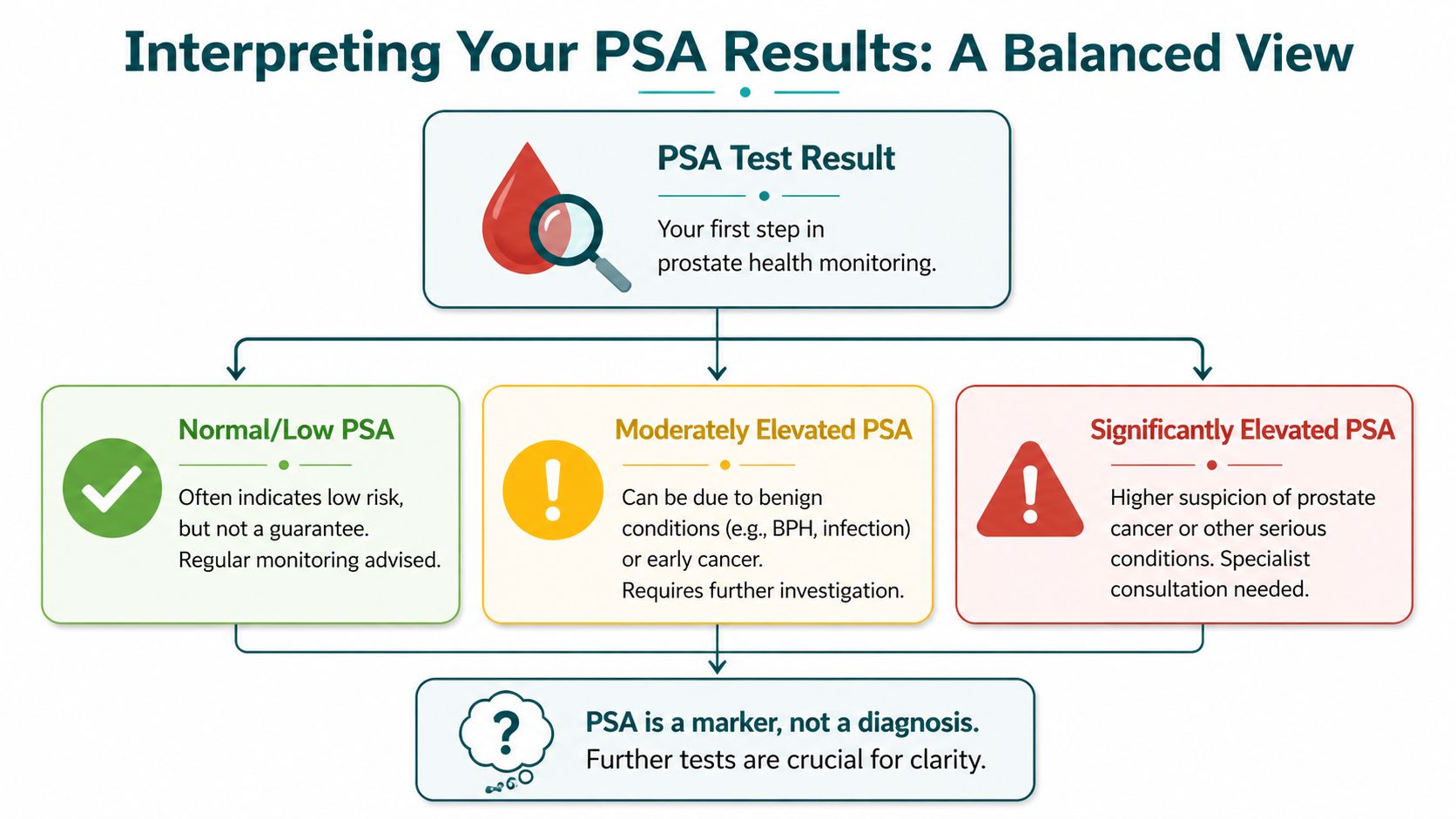
Around 1 in 8 men in the UK are expected to be diagnosed with prostate cancer during their lifetime, so it is understandable that a PSA result can feel loaded with meaning. The challenge is that a PSA number is more like a warning light on a dashboard than a final diagnosis. It tells your clinician something may need a closer look.
A PSA result needs context
Many men hope for a simple answer. Low means safe. High means cancer. Real life is not that tidy.
PSA is a protein made by prostate cells. A higher level can happen because of cancer, but it can also rise with an enlarged prostate, inflammation, infection, recent ejaculation, or even cycling in some cases. A lower result can be reassuring, but it does not rule cancer out completely.
That is why clinicians read the result alongside your age, symptoms, family history, examination findings, and whether your level has changed over time.
Why the same number can mean different things
Two men can have the same PSA result and need different advice. A mildly raised PSA in one person may reflect a naturally larger prostate. In another, the same number may be more concerning because it is increasing steadily or sits higher than expected for his age.
Doctors may also look at PSA density, which compares the PSA level with the size of the prostate, and at the overall pattern over time rather than one isolated blood test. As noted in Harvard Health's explanation of PSA testing, a raised PSA does not automatically mean cancer. That is one reason follow-up is often careful and step by step.
A practical way to read the result
| PSA result pattern | What it may mean in practice |
|---|---|
| Within the expected range for you | Reassuring, though not a guarantee |
| Slightly raised | Often needs review in context, and sometimes a repeat test |
| Clearly raised or rising over time | More reason to look further with a clinician |
A useful question is not just “Is my PSA high?” It is “What does this result mean for me, given my age, symptoms, risk, and trend?”
That phrasing helps people avoid two common traps. One is false reassurance from a lower number. The other is assuming a raised number confirms cancer before the rest of the picture is clear.
Why timing matters as much as the number
Interpretation is not only about medical knowledge. It is also about time.
If a result is borderline or unexpectedly raised, delays between the first blood test, a repeat test, and a specialist review can stretch the period of uncertainty. For some men in the NHS, that waiting is manageable. For others, especially those with symptoms or a strong family history, the waiting itself becomes part of the problem.
A private route such as Haven Medical can shorten that gap between result and discussion, which matters because PSA results often need explanation, not just reporting. Faster access does not change the biology of the test. It can change how quickly you get a clear plan.
For families trying to make sense of tests, appointments, and next steps, the Family Caregiving Kit guide may also help frame the wider picture of support.
The balanced view
PSA testing has real value. It can identify men who need closer assessment and can lead to earlier diagnosis in some cases. Its limits matter too. It cannot say on its own whether cancer is present, how serious it might be, or whether treatment will be needed.
The most helpful interpretation is calm, personalised, and timely. A number starts the conversation. Good care explains what that number actually means for you.
What Happens If Your PSA Level Is High
If your PSA comes back high, the next step is usually more clarity, not immediate alarm.
Doctors generally move through a sequence. Each stage is designed to answer a more specific question and avoid unnecessary procedures.

The usual pathway after a raised result
Review the result carefully
A clinician will consider your age, symptoms, medical history, and whether there could be another explanation for the PSA rise.Repeat the test if needed
Sometimes a repeat blood test helps confirm whether the rise is persistent.Arrange imaging
Current UK practice often uses multiparametric MRI before deciding on biopsy. This gives a clearer picture of the prostate and helps identify whether there is an area that looks suspicious.Specialist assessment
A urology review brings everything together, including the blood result, examination findings, and scan report.Biopsy when appropriate
Not every man with a raised PSA needs a biopsy. If the MRI suggests a concerning area, biopsy may be recommended to confirm whether cancer is present.
Why this step-by-step approach helps
Patients often fear that one abnormal blood test means a rapid slide into invasive procedures. In practice, the process is more measured than that.
Each step narrows uncertainty. A repeat test checks consistency. MRI improves decision-making. Biopsy is reserved for situations where tissue confirmation is needed.
If your PSA is high, the most useful question isn’t “Do I have cancer?” It is “What is the next test that will give the clearest answer?”
Why Choose Private PSA Testing at Haven Medical
For many men in the UK, the issue isn’t whether they want answers. It’s how long they’ll wait for them.
According to Prostate Cancer UK’s reporting on England cancer waiting times, 1 in 4 men wait too long from urgent referral to treatment, and the wait can exceed the 62-day target for many patients in England. When you’re worried about a raised PSA, that delay can feel very long.
Where private access changes the experience
Private care doesn’t change the biology of prostate cancer, but it can change the pace and organisation of care. That matters when the main burden is uncertainty.
Useful advantages often include:
- Faster appointments. Men can often arrange assessment sooner rather than waiting for a stretched pathway.
- Quicker diagnostics. Blood tests, result review, and onward planning can be coordinated more directly.
- Clearer continuity. It is easier when the same clinical team explains the result and guides the next step.
- Less administrative delay. Fewer handovers can mean fewer pauses between stages.
One practical private option
Haven Medical offers private PSA blood testing, consultant-led review, and a structured route into follow-up investigations when needed. For men who want to avoid prolonged waiting and get timely guidance, that is a practical option within the wider UK private healthcare sector.
When private testing may be especially worth considering
Private access may suit you if:
| Situation | Why private care may help |
|---|---|
| You have symptoms now | Waiting may add stress when you need prompt assessment |
| You have a strong family history | You may prefer quicker reassurance or earlier investigation |
| You've already had a raised PSA | Shorter delays can make follow-up feel more manageable |
| You simply want clarity | Some men value speed and continuity even without severe symptoms |
If you’re worried about your prostate health, it’s reasonable to act on that concern. You don’t need to wait until symptoms become disruptive or anxiety becomes overwhelming.
Frequently Asked Questions About PSA Testing
Does a high PSA definitely mean I have cancer
No. PSA is a signal, not a diagnosis. A raised result can be linked to prostate cancer, but it can also happen with a benign enlarged prostate, inflammation, infection, or even recent exercise or ejaculation.
A useful way to view it is as a smoke alarm. It tells your doctor to look more closely, but it does not tell you the exact cause of the smoke. Its value comes from combining it with your age, symptoms, family history, examination findings, and, if needed, scans or referral to a specialist.
Should I have a PSA test if I feel well
Possibly.
Early prostate cancer often causes no symptoms, which is why some men ask for testing before anything feels wrong. This discussion is especially relevant for older men, Black men, and men with a father or brother who has had prostate cancer.
In the UK, one practical issue is timing. NHS appointments and follow-up pathways can be stretched, and that delay can be difficult if you are already worried or know you are at higher risk. Some men choose private testing for that reason, so they can get the blood test, results, and next steps arranged more quickly.
Are there newer tests beyond standard PSA
Yes. Standard PSA is still widely used, but newer blood tests are being studied and introduced to improve risk assessment and reduce unnecessary follow-up for some men.
Recent UK pilot work on epigenetic tests such as epiSwitch, used alongside PSA, has shown encouraging early results, according to Oxford University Hospitals reporting on advanced prostate testing. These tests are promising, but they are not a simple replacement for PSA. They are another piece of the picture, and they still need careful clinical interpretation.
If my PSA is normal, does that rule out prostate cancer
No test gives a complete guarantee. A normal PSA lowers concern, but it does not rule out prostate cancer in every case.
That matters if you have symptoms that persist, such as urinary changes, blood in the urine, pelvic discomfort, or unexplained bone pain. In that situation, you should go back to a clinician even if the blood test was not raised.
Final thought
PSA testing is most helpful when it leads to a clear plan. For some men, that plan is reassurance. For others, it means repeat testing, imaging, or specialist review.
What matters is not only whether you have the test, but how quickly the result is explained and what happens next. If NHS waiting times are likely to leave you in limbo, a private route such as Haven Medical can offer faster answers and a more direct path to follow-up. Acting early does not mean overreacting. It means giving yourself the best chance of timely clarity.
If you’re concerned about symptoms, family history, or your personal risk, book a consultation, click to book, or visit website to discuss whether a PSA test is right for you.