




A lot of people first notice something is off in a very ordinary moment. You’re getting dressed and realise your lower tummy feels oddly full. Or you’re halfway through the workday and there’s a nagging ache low in your pelvis that doesn’t feel like your usual period pain. Sometimes it’s bloating that lingers. Sometimes it’s discomfort during sex. Sometimes it’s a sharp pain that makes you stop and think, “That wasn’t normal.”
That uncertainty can be unsettling. Pelvic symptoms are easy to second-guess because they overlap with so many everyday things, including periods, ovulation, bowel changes, stress, and bladder irritation. If ovarian cysts have crossed your mind, or if someone has already mentioned one on a scan, it helps to have a calm explanation in plain English.
Ovarian cysts are common, and many never cause trouble at all. What matters is knowing which symptoms of ovarian cyst are mild and watch-and-wait, which deserve a routine appointment, and which mean you should seek urgent help. Good information can take away a lot of fear.
Introduction Navigating Your Health Concerns
Many people expect a cyst to cause dramatic symptoms from the start. Often, it doesn’t. An ovarian cyst can remain undetected for some time and only become noticeable when it grows, presses on nearby organs, ruptures, or causes another complication. That’s one reason people feel confused. The signs can be vague at first, then suddenly much more obvious.
Why symptoms can feel hard to pin down
The ovaries sit in a crowded part of the pelvis. Nearby are the bladder, bowel, uterus, pelvic muscles, and ligaments. When something changes in that area, the body doesn’t always send a neat, easy-to-label signal.
You might notice:
- A dragging ache: low on one side or across the pelvis
- Fullness or bloating: especially if clothes feel tighter around the lower abdomen
- Pressure symptoms: needing to wee more often or feeling uncomfortable with bowel motions
- Cycle-related confusion: symptoms that seem to come and go around ovulation or your period
Sometimes the most useful clue isn’t one dramatic symptom. It’s a change from your normal pattern that persists.
What usually worries patients most
Individuals who read about symptoms of ovarian cyst want answers to a few immediate questions:
- Is this dangerous?
- Do I need a scan?
- Could it affect fertility?
- When is pain an emergency?
Those are exactly the right questions. The answers depend on the type of cyst, its size, whether it looks simple or complex on imaging, and what symptoms it’s causing. That sounds technical, but it becomes much easier once you break it down step by step.
Understanding Ovarian Cysts A Simple Guide
An ovarian cyst is a fluid-filled sac, or a sac containing thicker material, that develops in or on an ovary. A helpful comparison is a small bubble or pocket on the ovary. Some cysts form during the normal monthly cycle. Others develop for different reasons and may remain for longer.

For many patients, the word “cyst” sounds more alarming than the cyst itself. In clinic, one of the first things I explain is that an ovarian cyst is a description, not a verdict. It tells us there is a structure on the ovary that needs to be understood. The next questions are the ones that matter most. What type is it? Does it look simple or complex on ultrasound? Is it causing symptoms, and if so, what kind of symptoms?
That is why ovarian cyst care works best step by step. We do not judge a cyst by its name alone. We match the type of cyst, the timing of symptoms, and the scan appearance to decide whether reassurance, monitoring, or treatment is the right next move.
Functional cysts and why they are often low risk
The most common cysts are functional cysts. These are linked to ovulation. The ovary prepares and releases an egg each month, and the small structures involved in that process can sometimes hold onto fluid and grow larger than expected.
This is a bit like a tiny monthly work area in the ovary that does not tidy itself up as quickly as usual.
Many functional cysts settle on their own. Some cause no symptoms at all and only appear on a scan done for another reason. If symptoms do occur, they are often mild and may improve over the following weeks.
Typical features of functional cysts include:
- A link to the menstrual cycle, especially around ovulation
- A simple appearance on ultrasound, meaning they look mainly fluid-filled
- A tendency to resolve naturally, which is why a repeat scan is often more useful than rushing into treatment
Other cyst types you may hear about
Some cysts are not part of the normal ovulation process. These may behave differently and may need a different plan.
Common examples include:
- Dermoid cysts, which are usually benign and often do not disappear on their own
- Endometriomas, which are linked with endometriosis
- Cystadenomas, which can grow larger and sometimes need specialist assessment
The medical names can sound intimidating. What they really do is help your clinician sort cysts into groups. That guides follow-up, tells us which cysts are more likely to settle, and helps us judge when surgery is worth discussing.
Why ultrasound is such a useful next step
Ultrasound gives us a clearer picture of what is happening. It helps show whether a cyst looks small or large, simple or complex, unchanged or evolving. That information is often more useful than symptoms alone.
For example, two patients may both say they have pelvic discomfort. One may have a small functional cyst that is likely to disappear. Another may have a cyst type that is more persistent and better reviewed by a specialist. The symptom matters, but the scan tells us what situation we are dealing with.
Practical point: the safest plan comes from putting together your symptoms, examination findings, and ultrasound result.
Why understanding the type of cyst changes what happens next
Patients are often told they have an ovarian cyst and are left wondering what that means for the next few days or weeks. The answer depends on the situation.
A functional cyst may only need time and a repeat scan. A persistent cyst may need planned follow-up. A cyst that ruptures or causes torsion, where the ovary twists, can cause a sudden change in symptoms and needs urgent attention. This is why the article focuses on more than a list of symptoms. The same word, “cyst,” can describe very different situations.
At Haven Medical, that difference shapes the care pathway. A patient may start with a GP review, move to ultrasound, then on to gynaecology assessment if the cyst looks persistent, complex, or troublesome. If treatment is needed, that may range from watchful waiting to planned specialist day surgery.
The reassuring part is this. Many ovarian cysts are manageable once we know which type we are dealing with. Clear diagnosis comes first. Good decisions follow from that.
The Spectrum of Ovarian Cyst Symptoms
A common pattern goes like this. You notice a dragging ache low in the pelvis for a week or two, then a day when your trousers feel tighter and your bladder seems irritated for no clear reason. Another person with an ovarian cyst may feel nothing at all until one sudden episode of pain stops them in their tracks.
That is why symptoms can feel confusing. An ovarian cyst does not cause one neat, predictable set of signs. It behaves more like a small fluid-filled sac in a crowded room. If it stays quiet, you may notice very little. If it stretches the ovary, presses on nearby organs, leaks, or bleeds, the pattern changes.
The useful question is not only, “What symptom do I have?” It is, “What kind of symptom pattern is this, and how quickly is it changing?”
Pelvic pain and what different pain patterns can mean
Pelvic pain is the symptom patients mention most often, but the character of that pain matters.
A cyst that is sitting on the ovary may cause a dull, one-sided ache or a heavy feeling in the lower abdomen. Patients often describe it as a dragging sensation rather than a sharp pain. It may come and go over days or weeks and feel more noticeable around exercise, sex, or certain points in the menstrual cycle.
A cyst that bleeds into itself or leaks fluid can cause a more sudden change. The pain may become sharper over minutes or hours. Some patients say they were coping with mild discomfort, then felt a distinct stab or worsening pain on one side.
Common descriptions include:
- A dull ache low in the pelvis
- A feeling of heaviness or pressure
- Twinges that come and go
- Sudden sharper pain that feels different from usual period pain
That difference in timing is often helpful. Slow, nagging discomfort suggests one situation. Sudden change suggests another.
Fullness, bloating, and the sense that something is taking up space
Bloating is easy to misread because bowel symptoms and pelvic symptoms often overlap.
If a cyst is large enough to occupy space or irritate the tissues around it, you may feel swollen or unusually full in the lower abdomen. Some women describe this as puffiness by the end of the day. Others say waistbands feel tight, even when eating patterns have not changed.
This does not automatically point to an ovarian cyst. Premenstrual changes, constipation, and irritable bowel symptoms can feel similar. The clue is the pattern. New lower abdominal fullness, especially when paired with pelvic pain, pressure, or cycle changes, deserves a proper review.
Bladder and bowel symptoms that do not sound gynaecological at first
The ovaries sit close to the bladder and bowel. If a cyst pushes into that limited space, nearby organs can complain.
You might notice:
- Needing to pass urine more often
- A feeling that the bladder does not empty fully
- Pressure during bowel motions
- A vague sense of pelvic crowding
This is one reason ovarian cysts can be mistaken for bladder or digestive problems at first. The symptoms are real. They are coming from pressure in the pelvis rather than from the bladder or bowel itself.
Pain during sex
Sex may feel painful when a cyst makes the ovary more sensitive or changes where pressure is felt in the pelvis. Doctors call this dyspareunia. In plain language, it means sex hurts.
The discomfort is often:
- deeper in the pelvis
- worse on one side
- more noticeable with deeper penetration
- followed by an ache afterwards
If this happens repeatedly, please mention it. Many patients stay silent because they are embarrassed or assume it is something they should tolerate. It is neither.
Pain during sex deserves assessment, especially if it is new, one-sided, or linked with other pelvic symptoms.
Period changes and symptoms that follow a timeline
Some cysts are discovered in women whose periods have changed. Others are found even though the cycle is completely normal.
You may notice:
- Heavier bleeding than usual
- Bleeding at an unexpected time
- Pelvic pain that continues after the period ends
- The same one-sided symptoms returning month after month
The timeline matters here. A functional cyst may cause symptoms for part of a cycle, then settle. A cyst that keeps causing the same problem over several weeks or across repeated cycles is more likely to need follow-up rather than simple reassurance.
This is often the point where patients feel stuck. They know something is different, but they cannot tell whether it is hormonal, digestive, urinary, or gynaecological. That uncertainty is exactly why an examination and ultrasound are so useful. They turn a vague symptom story into a clearer clinical picture.
Appetite changes and early fullness
Some women say they feel full sooner when eating, or that there is less room in the lower abdomen. That can happen if a cyst is adding pressure in the pelvis.
On its own, this symptom is non-specific. Paired with bloating, pelvic discomfort, or a visible change in abdominal fullness, it becomes more informative. It helps us understand how much physical pressure the cyst may be causing.
Matching the symptom to the likely cyst situation
Patients often feel calmer when symptoms are placed into a simple framework.
- Mild or no symptoms can happen with small cysts, including cysts found by chance
- A dull ache, heaviness, or pressure over time can fit with a cyst that is persisting and pressing on nearby tissues
- A sudden increase in pain can happen if a cyst bleeds, leaks, or ruptures
- Pain plus pressure symptoms over weeks often leads to review with ultrasound and follow-up planning
That does not replace a diagnosis. It gives you a way to understand what your body may be signalling.
At Haven Medical, this symptom pattern helps shape the next step. A patient with mild ongoing discomfort may start with a GP review and scan. A patient whose symptoms are persistent, disruptive, or changing may need specialist gynaecology assessment. If a cyst continues to cause trouble, treatment can then be planned in a measured way, including day surgery where appropriate.
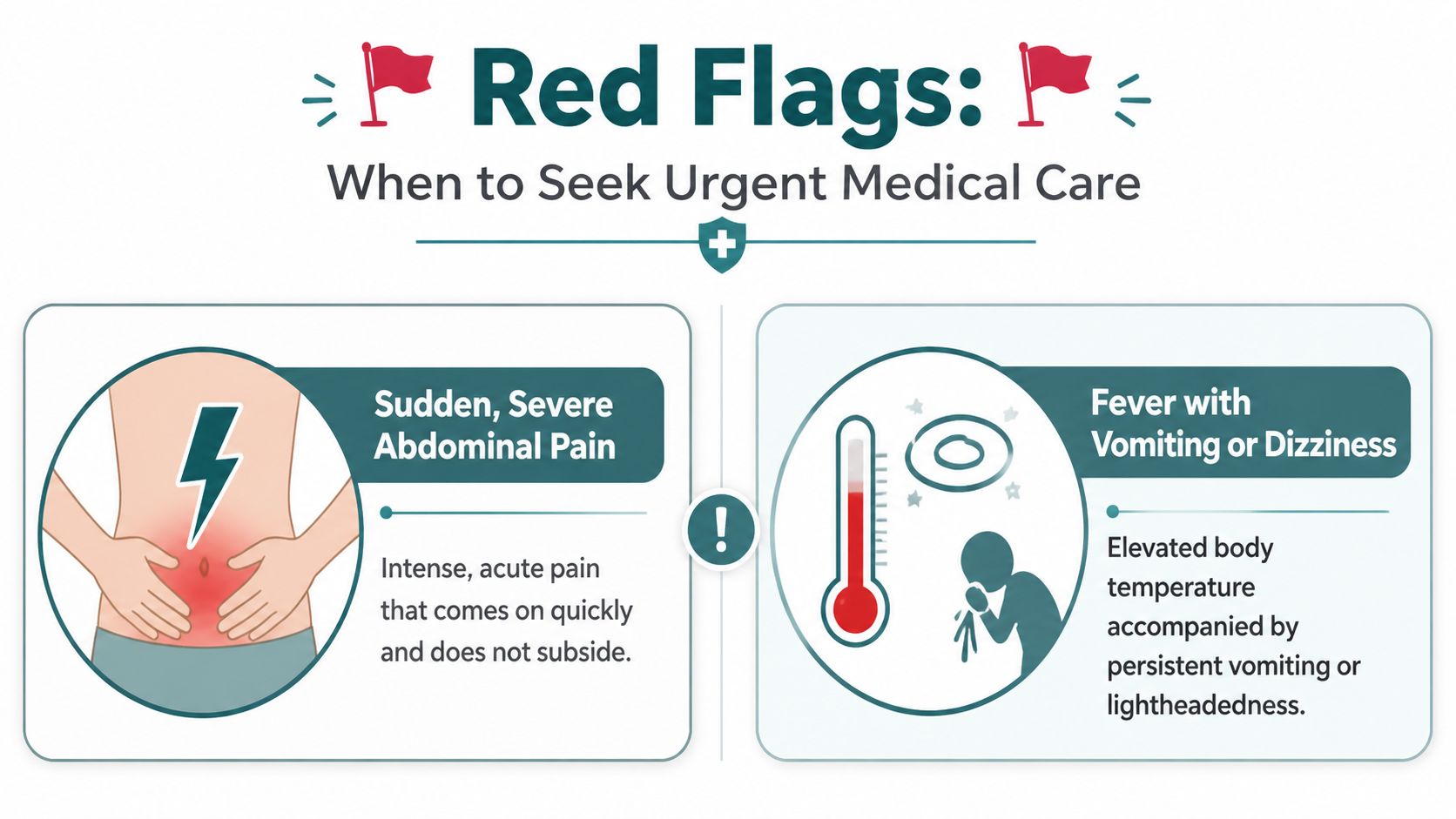
Red Flags When to Seek Urgent Medical Care
A common scenario is this. You have had some pelvic discomfort for a while, then one day the pain changes suddenly. It becomes sharper, stronger, and harder to ignore. That change matters.
Most ovarian cysts do not cause an emergency. The problem is that a small number do, and the symptoms often shift quickly rather than gradually. The main complications we worry about are ovarian torsion, where the ovary twists, and cyst rupture, where a cyst bursts or leaks. Knowing which pattern fits your symptoms can help you decide whether to call for advice, seek urgent assessment, or go straight to emergency care.
Ovarian torsion and why it is an emergency
Ovarian torsion means the ovary has twisted on its supporting tissues. A cyst can make the ovary heavier or alter its shape, which makes twisting more likely. The simplest way to picture it is a garden hose that has kinked. Once the twist happens, blood flow can be reduced, and the ovary can become damaged if treatment is delayed.
The pain is usually hard to miss. It tends to be sudden, often on one side, and may come with nausea or vomiting. Some people also feel feverish or become very distressed because the pain is so intense.
This needs same-day emergency assessment. Severe one-sided pelvic pain with sickness should never be dismissed as a bad period or a stomach upset.
Urgent advice: if you develop sudden severe pelvic pain, especially on one side, with nausea or vomiting, seek emergency care.
Ruptured cysts and what they can feel like
A ruptured ovarian cyst is a cyst that has burst or leaked fluid. Some ruptures cause short-lived pain and settle with observation. Others cause internal bleeding or irritation inside the abdomen, which can make the situation more serious.
The pattern is often different from the slower pressure symptoms many patients describe with an unruptured cyst. Rupture pain usually starts quickly and feels clearly different from your usual cramps or bloating. Some women notice spotting, dizziness, nausea, or a sharp pain that seems to spread. Shoulder-tip pain can happen if blood or fluid irritates the diaphragm, which is a clue doctors take seriously.
Possible rupture symptoms include:
- Sudden sharp pelvic pain
- Feeling faint or dizzy
- Nausea
- Vaginal bleeding or spotting
- Shoulder-tip pain
- A sense of abdominal pressure
When to call urgently and when to go straight to emergency care
A useful way to judge the situation is to focus on speed, severity, and whole-body symptoms.
If the discomfort has been building over days or weeks, a GP review is usually the right starting point. If the pain has arrived suddenly, is intense, or is making you vomit, feel faint, or become pale and shaky, you need urgent medical assessment. In practical terms, urgent GP or NHS 111 advice is appropriate for sudden significant pelvic pain when you are stable enough to speak, travel, and wait briefly for instructions.
Go to A&E or call 999 if severe pain is accompanied by:
- Dizziness or faintness
- Persistent vomiting
- Fever
- Paleness, weakness, or feeling acutely unwell
- Heavy bleeding
- Pain that is escalating rapidly
Symptom checker routine vs urgent
| Symptom to Monitor (Contact Your GP) | Urgent Red Flag (Seek Immediate Care) |
|---|---|
| Ongoing dull pelvic ache | Sudden severe one-sided pelvic or abdominal pain |
| Bloating or lower abdominal fullness | Severe pain with nausea or vomiting |
| Pain during sex that keeps recurring | Severe pain with fever or feeling faint |
| Frequent urination from pelvic pressure | Sudden pain with dizziness, collapse, or marked weakness |
| Heavier or irregular periods | Sharp pain with possible vaginal bleeding and rapid worsening |
A simple way to tell the difference
Symptoms that can usually wait for planned review tend to be persistent, recurring, or pressure-like. Symptoms that need urgent attention are more often sudden, severe, and accompanied by nausea, faintness, fever, or rapid worsening.
If you are unsure, use this rule. A cyst causing pressure behaves more like a slowly filling bag in the pelvis. A torsion or rupture behaves more like a sudden mechanical problem. The timeline changes fast, and your body often tells you that something is wrong.
At Haven Medical, we would always rather you seek urgent help early than stay at home trying to push through severe pain.
Your Path to a Clear Diagnosis at Haven Medical
Individuals feel better once they know what the diagnostic process involves. It’s usually much less mysterious than they fear.
The first appointment
It often starts with a conversation. When you call to book, the aim is to arrange the right first step rather than send you in circles. At the consultation, a doctor will usually ask about:
- Where the pain is
- When it started
- Whether it changes with your cycle
- Any bloating, bladder, bowel, or sexual symptoms
- Whether the pain was gradual or sudden
A clinician may also ask whether you could be pregnant, whether you’ve had cysts before, and whether there are any associated symptoms such as bleeding, nausea, or fever. These details help separate likely benign causes from situations that need urgent investigation.
Examination and what it can show
Sometimes a physical examination helps. A gentle abdominal or pelvic examination can identify tenderness, fullness, guarding, or signs that suggest another diagnosis should also be considered.
That said, examination alone can’t confirm the nature of a cyst. It gives clues. Imaging gives the clearer picture.
Ultrasound and why it is usually the key test
Ultrasound is the main test used to assess an ovarian cyst. It can show whether the cyst is simple or more complex, where it sits, and whether there are features that suggest follow-up or specialist review is needed.
You may be offered one or both of these:
Abdominal ultrasound
A probe is moved over the lower abdomen. This gives a wider overview of the pelvis.Transvaginal ultrasound
A slim probe is placed inside the vagina for a closer look at the ovaries and uterus. This often gives more detailed images.
Patients are often anxious about the transvaginal scan, but it’s usually quick and it provides valuable information. You can always ask questions beforehand so you know exactly what to expect.
A scan doesn’t just say “yes” or “no” to a cyst. It helps clinicians judge what kind of cyst it is and what should happen next.
What happens after the scan
Once imaging is done, the plan usually falls into one of a few clear categories:
- No concerning features and symptoms are mild: monitoring may be enough
- A likely benign cyst but ongoing symptoms: review with a gynaecologist may be sensible
- Features that need quicker attention: urgent specialist assessment is arranged
- Signs of an emergency complication: immediate hospital management is needed
This is the point where patients often feel the most relief. Uncertainty starts to shrink when there’s a name for the problem and a plan attached to it.
Why consultant-led review can help
If symptoms continue, or if the scan suggests a cyst that isn’t likely to resolve on its own, a consultant gynaecologist can explain the options clearly. That may include repeat imaging, symptom management, or planning surgery if necessary.
Good care should feel joined up. You shouldn’t have to piece together the story on your own.
Navigating Treatment From Watchful Waiting to Day Surgery
Treatment for ovarian cysts isn’t one-size-fits-all. The right approach depends on what sort of cyst it is, how troublesome the symptoms are, whether it seems to be changing, and whether there are any warning features on imaging.
Watchful waiting when a cyst is likely to settle
For many simple cysts, the safest and most sensible approach is watchful waiting. That means monitoring symptoms and, if needed, arranging a repeat scan later rather than rushing into treatment.
This is often appropriate when:
- The cyst looks simple
- Symptoms are mild
- There are no emergency features
- The clinical picture suggests a functional cyst
Patients sometimes worry that “watching” means “doing nothing”. It doesn’t. It means making a measured decision based on the fact that many cysts improve without intervention.
Medical management and symptom control
In some cases, treatment is less about removing the current cyst and more about reducing future problems. Hormonal contraception may be discussed in selected patients to help prevent certain new functional cysts from forming.
When surgery becomes the better option
Surgery may be recommended if a cyst is:
- Persistent
- Causing significant symptoms
- Large or technically difficult to monitor
- Suspicious in appearance
- Associated with complications such as torsion
The operation is often done by laparoscopy, also called keyhole surgery. Small cuts are made in the abdomen, and instruments are used to remove the cyst while aiming to preserve healthy ovarian tissue where possible.
What day surgery means in practice
Day surgery means you come in for your procedure and go home the same day when it’s safe to do so. For the right patient and the right operation, this can make treatment feel much more manageable.
Typical advantages include:
- Smaller cuts
- Usually quicker recovery than open surgery
- Less disruption to daily life
- A clear treatment pathway when monitoring is no longer enough
The best treatment plan is the one that matches the cyst in front of you, not a generic rule.
Ovarian Cysts FAQs and Expert Answers
Can ovarian cysts affect fertility
Usually, fertility is not affected by a simple ovarian cyst. In the verified NHS-based data, 30% of symptomatic UK women report fertility concerns despite usual unaffected fertility, which reflects how common the worry is even when the outlook is generally reassuring.
Some specific cyst types, such as those linked to endometriosis, can raise more individual fertility questions. If pregnancy is on your mind, say so early. It helps shape the treatment plan.
Are ovarian cysts linked to cancer
Most ovarian cysts are benign, especially during the reproductive years. The word “cyst” itself does not mean cancer.
What matters is the scan appearance, your age, your symptoms, and whether the cyst is simple or complex. That’s why ultrasound and proper review are so valuable. They help distinguish a common benign cyst from something that needs closer investigation.
If I’ve had a cyst once, will I get another
You might. Some people have one cyst and never deal with it again. Others are more prone to developing cysts over time, especially functional cysts related to ovulation.
A previous cyst doesn’t automatically mean future trouble, but it does mean you’re more likely to recognise symptoms earlier if they return.
Can ovarian cysts cause sudden pain during pregnancy
They can, although it’s uncommon. The verified data notes that rupture incidence is about 1 in 1,000 pregnancies in the UK, with symptoms including sudden sharp pelvic pain, vaginal bleeding, nausea, and abdominal pressure.
Any severe abdominal or pelvic pain in pregnancy needs prompt assessment, whatever the cause may be.
What if I still have pain after treatment
Persistent discomfort after treatment doesn’t always mean the cyst has returned. Recovery can involve pelvic muscle tension, scar sensitivity, or other pain sources that need separate care.
When should I stop reading and actually get help
If you have sudden severe pain, especially with nausea, vomiting, dizziness, fever, or bleeding, seek urgent medical care. Don’t wait for the pain to “declare itself”.
If your symptoms are milder but persistent, book an appointment and get it checked properly.
If you’re worried about symptoms of ovarian cyst and want a clear next step, you can call to book, click to book to an appointment with our consultant gynaecologist, or visit website through Haven Medical.