




Booking a trip is the easy part. You choose the flights, compare hotels, sort the transfers, and start thinking about what to pack. Then the health questions start. Do I need travel vaccines? Which ones? Can my GP do them? What if I’m going somewhere for only a few days?
That’s where many travellers go wrong. They look for a static list, match a country name to a few jabs, and assume the job is done. In practice, travel vaccines UK advice is never that simple. Risk changes with your exact itinerary, time of year, length of stay, planned activities, accommodation standards, and your own medical history.
A short city break and a rural backpacking trip in the same country can carry very different risks. So can a healthy adult travelling for business compared with a pregnant traveller, an older adult, or a family taking young children abroad. Good travel medicine is about judgement, not just ticking boxes.
Introduction Planning Your Trip and Your Health
Travel health has been part of international journeys for a very long time. The formal requirement for proof of vaccination for international travel dates back to the 1933 International Sanitary Convention for Aerial Navigation, and it evolved into the International Certificate of Vaccination or Prophylaxis, often called the Yellow Card. UK travellers still use it for required vaccines such as yellow fever, and over 130 countries in Africa and South America required it from UK travellers as of 2023, according to this historical review of international vaccination certificates.
That history matters because it shows something important. Travel vaccination isn’t an optional extra invented by clinics. It sits inside a long-established system designed to protect both the traveller and the destination country.
Why online lists often mislead
A country page can give you a starting point, but it can’t assess your real risk. It won’t know whether you’re:
- Staying in resorts only or moving between rural villages
- Travelling for a week or several months
- Likely to have animal exposure through trekking, volunteering, or outdoor work
- Already protected by previous vaccines or routine UK immunisations
- At higher risk of complications because of age, pregnancy, immune status, or long-term conditions
It also won’t always reflect what changes quickly. Outbreaks shift. Entry requirements change. Seasonal disease patterns matter. A travel consultation turns general guidance into advice you can use.
Practical rule: Don’t choose travel vaccines the way you choose luggage. The right answer depends on exposure risk, timing, and your medical history.
What a specialist assessment looks at
A proper pre-travel review usually includes more than destination names. It should cover:
| Factor | Why it matters |
|---|---|
| Exact route | Risk can differ sharply within the same country |
| Season | Some infections are more active at certain times of year |
| Trip length | Longer stays usually increase cumulative exposure |
| Activities | Trekking, animal contact, healthcare work, and remote travel all change recommendations |
| Medical background | Previous vaccines, allergies, pregnancy, and immune conditions affect what’s suitable |
If you’re asking, “which vaccines do I need for travel?”, the safest answer is this. Start with the trip details, not the vaccine list.
Understanding Key Travel Vaccines and Their Importance
Some travel vaccines protect against food and water-borne disease. Others reduce the risk from mosquitoes, animal bites, or blood and body fluid exposure. Each vaccine addresses a specific pattern of risk, which is why one traveller may need a very different plan from another.
The vaccines travellers ask about most
Hepatitis A is commonly discussed because it spreads through contaminated food and water. Even careful travellers can be exposed in places where sanitation standards differ from the UK.
Hepatitis B is usually more relevant for longer trips, medical work, new sexual partners, tattooing or piercing abroad, and destinations where urgent healthcare may be needed unexpectedly.
Yellow fever matters because it’s both a health risk and, in some destinations, an entry requirement. This is one of the clearest examples of where DIY research can fall short. Travellers may focus on whether a country is on a map of risk areas, while missing whether the route they’re taking triggers a certificate requirement.
Rabies is often underestimated. Many people think of it as a rare problem affecting only very remote travellers. In clinic, the primary concern is usually behaviour and access. If a traveller is likely to be around dogs, monkeys, bats, or other mammals, and post-exposure care may be hard to obtain quickly, pre-travel planning becomes much more important.
Japanese encephalitis tends to be relevant for selected itineraries rather than every trip to Asia. Rural stays, extended travel, and time outdoors can all shift the discussion.
Why typhoid is a good example of real-world trade-offs
Typhoid is one of the most useful vaccines to discuss because it shows both the value and the limits of vaccination. Typhoid vaccines offer 50 to 80% protection, and this review of typhoid vaccination evidence also notes that UK cohort studies found that combining vaccination with rigorous food and water hygiene can reduce typhoid incidence by over 85% in travellers to high-risk areas.
That’s a practical lesson, not a weakness. Good travel medicine doesn’t promise perfect protection. It layers protection.
Vaccination works best when it’s paired with behaviour that reduces exposure.
For typhoid, that means the vaccine matters, but so do food and water decisions. Travellers who assume the injection gives them permission to relax all precautions often misunderstand what the vaccine is for.
What works and what doesn’t
What works:
- Booking early enough to allow time for vaccines that need spacing or planning
- Discussing the actual itinerary, not the simplified version
- Keeping routine vaccines up to date alongside destination-specific vaccines
- Using vaccine advice with practical prevention, such as bite avoidance and food hygiene
What doesn’t:
- Choosing vaccines from internet forums
- Assuming a country-wide rule applies equally everywhere
- Treating travel vaccines as interchangeable
- Waiting until the week of departure and expecting every option to remain open
If you know the names of the main vaccines, that helps. It still doesn’t replace a clinical risk assessment. The purpose of a consultation isn’t to complicate things. It’s to stop you paying for the wrong vaccines, missing the right ones, or travelling with false reassurance.
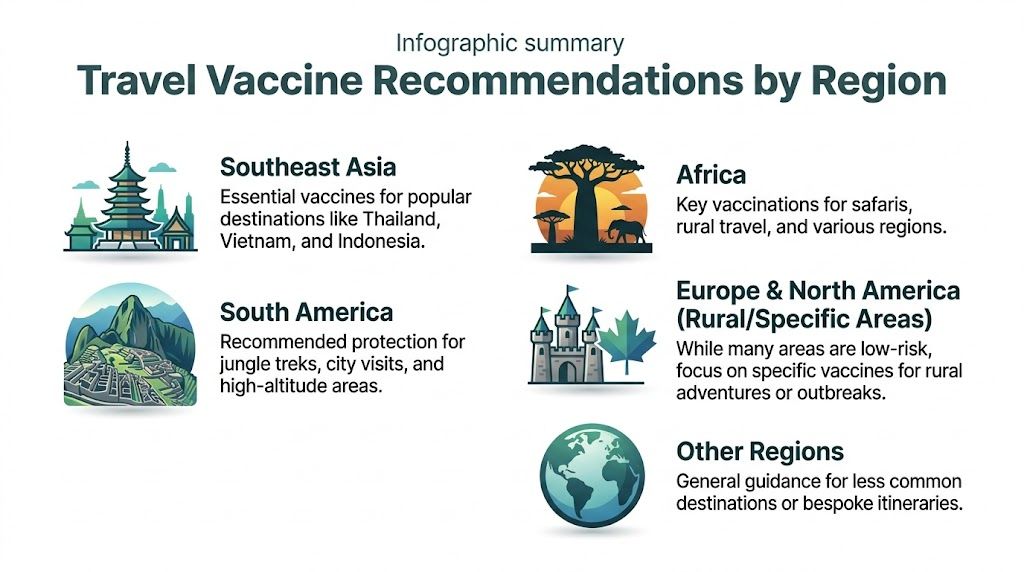
Travel Vaccine Recommendations by Region
Regional guidance helps you understand the likely conversation, but it is not a substitute for individual advice. Within the same region, one itinerary may need only routine updates while another may justify several travel vaccines.
Europe
For much of Europe, the main priority is often routine vaccine status. Travellers should make sure standard immunisations are up to date, particularly if they’ll be mixing closely with others, staying for extended periods, or visiting areas with active outbreaks.
Extra travel vaccines are less commonly needed for a standard city break, but risk rises with more specialised travel such as rural outdoor activity, volunteering, or long stays in less developed settings.
Asia
Asia produces some of the broadest variation in travel risk. A resort-based trip may call for a different discussion from backpacking, rural visits, or long-term travel.
Vaccines that may be discussed include:
- Hepatitis A, especially where food and water exposure is part of the route
- Typhoid, particularly for parts of the Indian subcontinent and other higher-risk settings
- Hepatitis B, more often for longer stays or increased exposure risk
- Rabies, when animal exposure is plausible or access to urgent treatment may be limited
- Japanese encephalitis, mainly for selected rural or extended itineraries
Africa
Africa also varies substantially by country and by style of travel. Safari lodges, major cities, business hotels, overland routes, and humanitarian work all create different patterns of exposure.
A consultation may include discussion of:
| Vaccine | Common reason it may be considered |
|---|---|
| Yellow fever | Health risk or entry requirement in some itineraries |
| Hepatitis A | Food and water exposure |
| Hepatitis B | Longer stays or higher-risk exposure |
| Typhoid | Travel in settings with sanitation concerns |
| Rabies | Animal exposure risk, especially in remote areas |
| Meningococcal vaccine | Relevant for some sub-Saharan travel and pilgrimage-related planning |
South America
South America often raises questions about yellow fever, because risk can be region-specific rather than country-wide. Travellers may assume they don’t need to think about it if they’re visiting a major city, then add internal flights, jungle excursions, or border crossings later.
Common discussions include hepatitis A, hepatitis B, typhoid, yellow fever, and rabies, depending on route and activities.
The country name on the booking confirmation is only the starting point. Vaccine advice changes when the itinerary expands beyond the city airport.
Middle East
Travel to the Middle East ranges from short business trips to pilgrimage travel and extended family visits. Depending on itinerary and conditions, hepatitis A, hepatitis B, and typhoid may come into the discussion.
For some pilgrims travelling to Saudi Arabia, meningococcal vaccination is required. That’s a good reminder that travel medicine isn’t only about health risk. Entry rules matter too.
Oceania
For Australia and New Zealand, many travellers need only routine vaccine review. The discussion changes if the trip includes higher-risk work, remote settings, or onward travel to other parts of the region.
A simple way to think about travel vaccinations by country
When people search for travel vaccinations by country, they usually want certainty. In medicine, the safer approach is to ask better questions:
- Where exactly are you going?
- How long are you staying?
- What will you be doing there?
- What standard of food, water, and accommodation should you expect?
- Are there any entry certificate requirements on your route?
That’s the framework that produces sensible recommendations. Not a generic country list.
Your Travel Vaccine Timeline and Appointment Guide
The best time to book is usually 4 to 6 weeks before travel. That gives enough space to review your records, decide what’s needed, and start vaccines that may need planning or spacing.
If your departure is sooner than that, it’s still worth booking. Late isn’t ideal, but late is often better than not assessed at all. A shorter window still allows for prioritisation, practical advice, and sometimes same-visit vaccination.
When to act
A useful timeline looks like this:
As soon as flights are booked
Check whether your destination may involve travel vaccines, malaria advice, or certificate issues.Several weeks before departure
Bring together your itinerary, prior vaccination history, and any details about medical conditions or regular medicines.Close to departure
Don’t cancel the appointment just because time is short. A clinician can still identify the highest priorities and advise on what remains useful.
What to bring to the appointment
A good consultation runs more smoothly if you have:
- Travel details such as countries, stopovers, dates, and rural versus urban plans
- Vaccine records if you have them
- Medical information including allergies, pregnancy, immune conditions, and regular medications
- Activity plans such as trekking, animal contact, volunteering, diving, or healthcare work
What happens during a travel health consultation
The appointment should feel structured, not rushed. Expect questions about route, trip style, accommodation, medical background, previous vaccines, and timing.
You should leave with a clear plan covering:
- Which vaccines are recommended, optional, or required
- What can be given that day
- Whether follow-up doses are needed
- Advice on malaria prevention, bite avoidance, and food and water precautions
- Any certificate or documentation issues
If you want a broader refresher on routine adult vaccine planning before a trip, this immunization schedule for adults can help frame the discussion, although destination-specific travel advice still needs a personalised review.
If you’re travelling with children, older relatives, or anyone with complex medical history, bring that detail into the appointment early. It often changes the plan more than the destination itself.
Book Your Expert Travel Health Consultation at Haven Medical
By the time many travelers search for do I need travel vaccines, they’re already working against the clock. Flights are booked, plans are fixed, and they want a quick answer. What helps is a clinician who can sort the essential from the optional and match the advice to their specific journey.
A nurse-led service can be particularly useful where travellers need support that is practical, clear, and adapted to different levels of health literacy. That includes family travel, school groups, workplace travel programmes, and people who haven’t found standard advice easy to access.
If you’re comparing options, look for a clinic that can provide:
- A proper itinerary-based assessment, not just a vaccine menu
- Private access to travel vaccines that may not be routinely available through your GP
- Clear documentation and certificate support where needed
- Straightforward follow-up planning if your course involves more than one visit
Travel health works best when it’s done early and done properly.
Call to book if you want your itinerary reviewed by a travel health professional.
Click to book if you already know your dates and want to arrange an appointment.
Visit website to check clinic details, travel services, and next steps before you fly.