



You notice a mole you’re sure wasn’t there before, or one that’s started catching on clothing, bleeding after shaving, or bothering you every time you look in the mirror. That’s usually the moment people start searching for mole removal and trying to work out what’s sensible, what’s urgent, and what’s cosmetic.
Most moles are harmless. A changing mole still isn’t automatically cancer, and a raised mole that irritates your collar or bra strap may be benign but still worth removing. The important step is getting the right assessment before anyone decides how to treat it. In practice, the safest pathway isn’t to guess from a photo or rely on an app. It’s to have the lesion examined properly by a clinician who can decide whether it should be monitored, removed cosmetically, or excised as a possible skin cancer.
What Are Moles and Why Consider Removal
Moles are collections of pigment-producing skin cells. They can be flat or raised, smooth or slightly rough, light brown through to very dark, and they can appear almost anywhere on the body. Many people have moles from childhood, while others develop new ones over time.
In clinic, the first thing I usually need to do is reduce anxiety. Most moles are benign. They don’t need treatment for their existence alone. What matters is whether the mole looks suspicious, behaves differently from your other moles, or causes practical problems.
Medical reasons for removal
A mole may need removal for medical reasons when there’s concern about suspicious mole signs. That includes change in shape, colour, size, or symptoms such as bleeding or crusting. In those cases, removal isn’t just about getting rid of something visible on the skin. It’s about obtaining a proper diagnosis and, where necessary, treating a lesion early.
When there’s a cancer concern, the removal method matters. A quick cosmetic approach can be the wrong choice if the lesion needs proper pathological assessment.
Cosmetic and comfort reasons for removal
Not every removal is about cancer. Many people seek private mole removal because a mole catches during shaving, rubs under clothing, gets inflamed, or affects confidence. A raised mole on the jawline, neckline, or back can be completely harmless but still irritating enough to justify treatment.
Common reasons include:
- Appearance concerns when a facial or visible mole affects confidence
- Repeated irritation from razors, jewellery, waistbands, or school and work uniforms
- Peace of mind after a professional assessment confirms the lesion looks benign and suitable for cosmetic treatment
A harmless mole can still be a reasonable candidate for removal if it’s uncomfortable or affecting day-to-day life.
At Haven Medical, patients can book a consultation within a week or two for assessment and discussion of appropriate removal options in a day surgery setting.
When You Should Get a Mole Checked
The simplest rule is this. If a mole is changing, symptomatic, or just doesn’t look right compared with your other moles, get it assessed. A proper mole check UK appointment is often the fastest way to replace uncertainty with a clear plan.
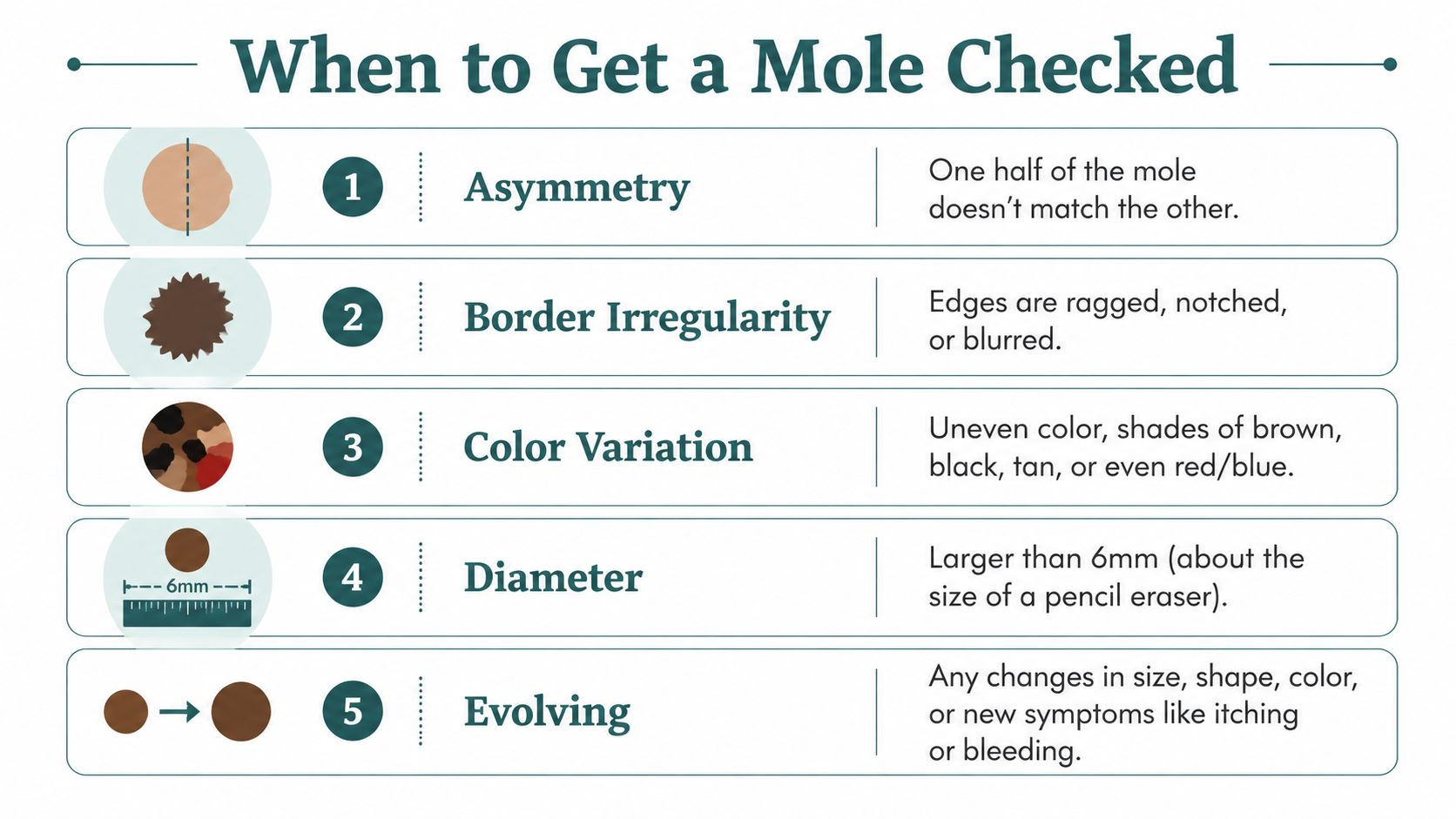
The most useful self-check tool is the ABCDE rule.
The ABCDE rule
- Asymmetry means one half of the mole doesn’t match the other. Benign moles are often fairly even. A lopsided shape deserves attention.
- Border irregularity means the edges look ragged, blurred, notched, or uneven instead of smooth and clear.
- Colour variation means the mole isn’t one consistent shade. Different browns, black, tan, red, or blue tones in the same lesion can be a warning sign.
- Diameter refers to size. Larger lesions can be more concerning, especially if they’ve grown.
- Evolving is often the most important feature. Any change in size, shape, colour, surface, or sensation should be checked.
Other warning signs people often miss
Not every concerning lesion fits neatly into the ABCDE rule. Some of the moles that worry clinicians present in more subtle ways.
Watch for:
- Bleeding or crusting without obvious injury
- Itching or tenderness that persists
- Rapid growth over a short period
- A new mole in adulthood that stands out from the rest
- A lesion that looks different from your usual pattern of moles
A useful practical question is whether it’s the “one that looks different”. Patients often notice that before they can describe exactly why.
Practical rule: If a mole has changed recently, or if you keep checking it because it worries you, that’s reason enough to book an assessment.
Why app-based checking isn’t enough
Public awareness has clearly increased. At-home mole checking apps such as SkinVision saw a 300% surge in UK downloads in 2025, but the MHRA warns these apps can have up to a 25% false positive rate, and a 2025 British Journal of Dermatology study found that 15% of UK melanomas were misdiagnosed by apps.
Apps may prompt someone to seek help, which can be useful. They shouldn’t replace a clinical examination, and they certainly shouldn’t determine whether a lesion can be removed cosmetically.
What a clinician adds
A clinician doesn’t just look at colour and outline. They assess your history, how long the lesion has been there, whether it has changed, your age, the body site, and whether the lesion is appropriate for observation, cosmetic removal, or formal biopsy.
That’s the difference between reassurance and guesswork.
UK Skin Cancer Statistics and Early Detection
A common clinic scenario is simple. Someone notices a mole has changed, waits a few months because they hope it is nothing, then books only when the worry starts to interfere with sleep. That delay is understandable, but it is also the point where a clear, fast assessment matters most.
Melanoma is the skin cancer people worry about most, and for good reason. Cancer Research UK reports that melanoma skin cancer is projected to reach around 20,800 new cases a year in the UK by 2023 to 2025. The same source shows that incidence has risen over time, which is one reason clinicians take a changing mole seriously even when it may still prove benign.
Why early detection changes outcomes
Early review gives you more room to act. Cancer Research UK states that 86% of melanoma skin cancer cases in the UK are preventable, largely through reducing ultraviolet exposure, but prevention is only part of the picture. Prompt assessment matters because suspicious lesions caught early are usually simpler to treat and less likely to require more extensive surgery.
That is where the difference between pathways becomes very real for patients. In private practice, assessment can often happen quickly, with dermatoscopic examination and a clear plan made in the same visit. On the NHS, many patients do receive excellent care, but access can involve GP review, referral thresholds, waiting times, and more uncertainty about when you will be seen. For an anxious patient with a changing mole, speed is not a luxury. It often brings peace of mind.
Low awareness is still a problem
Public awareness remains patchy. A survey highlighted by Melanoma UK found that only 20% of UK adults felt confident identifying melanoma symptoms, 58% of men recognised changes in an existing mole as a warning sign, and 30% said they checked their moles monthly. In practice, that fits what many clinicians see. People often monitor a lesion informally, ask family members what they think, search online, or compare it with advice written for harmless skin tags, even though a changing mole needs a different level of caution.
Delay usually does not happen through neglect. It happens because people are busy, uncertain, or worried about wasting someone’s time.
What this means for you
A changing mole does not automatically mean cancer. It does mean the safest next step is a proper examination by someone trained to assess pigmented lesions.
That is the practical message behind the statistics. Early detection improves the chance of straightforward treatment, and fast access to expert review reduces the long stretch of uncertainty that many patients find hardest.
Mole Removal Options Medical vs Cosmetic
People often use one phrase for very different situations. Uk mole removal can mean removing a suspicious lesion because cancer needs to be ruled out, or removing a harmless mole because it catches on clothing and annoys you daily. The intention determines the method.
Medical removal
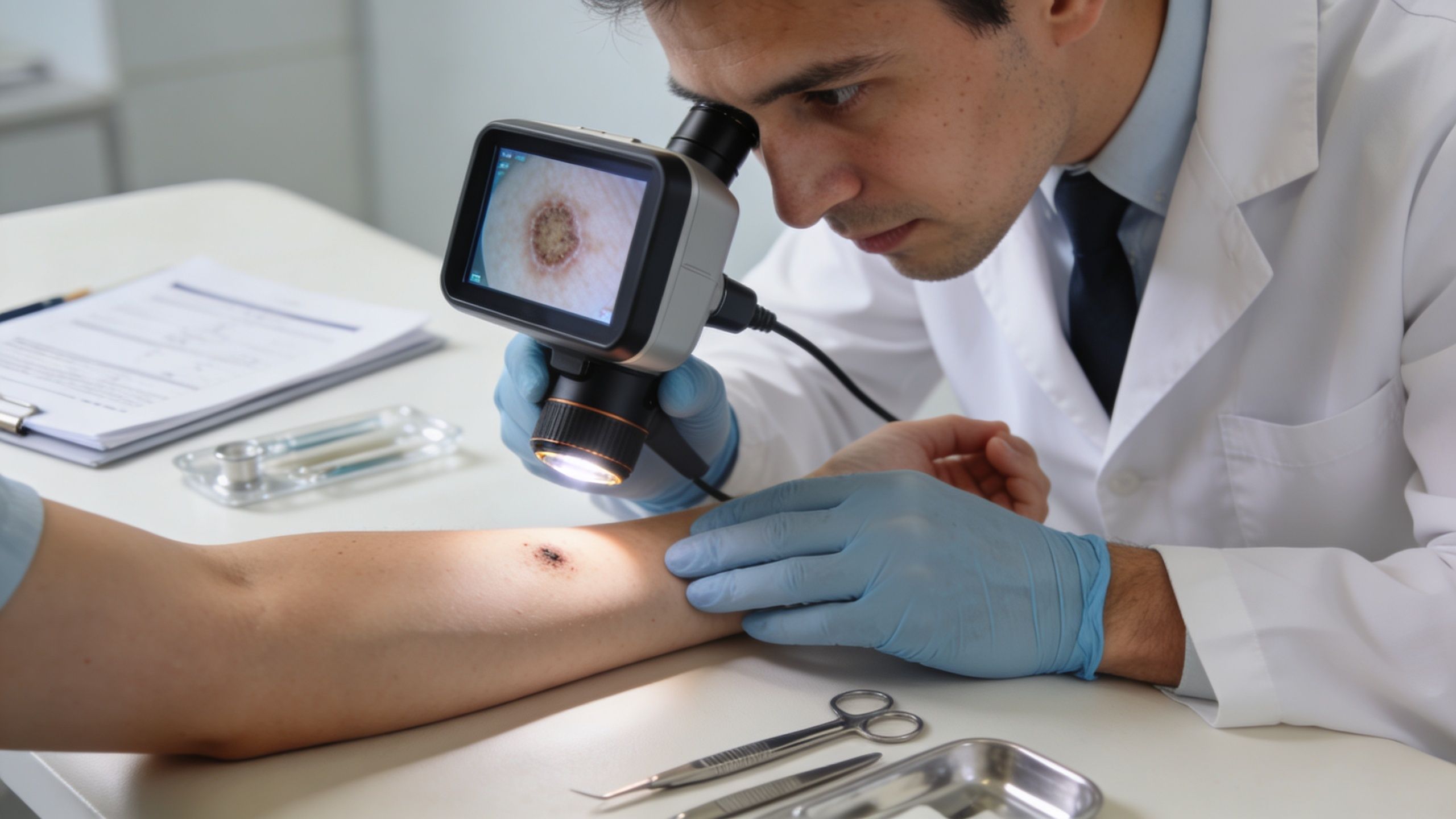
A mole biopsy UK pathway is appropriate when the lesion looks suspicious or has a concerning history. In that setting, the priority is diagnosis first, appearance second. The removed tissue is usually sent for histology so a pathologist can confirm exactly what it is.
Medical removal is usually chosen for:
- Changing lesions with concerning features on history or examination
- Symptomatic lesions that bleed, crust, or ulcerate
- Moles that look atypical under dermatoscopic review
This isn’t the place for shortcuts. If a lesion might be melanoma, the specimen must be removed in a way that preserves diagnostic value.
Cosmetic removal
Cosmetic removal is different. Here, the lesion has been assessed and appears benign, and the reason for treatment is appearance, comfort, or convenience. A raised benign mole on the face, neck, torso, or scalp might be suitable for a simpler method with a different scar profile.
Patients usually request cosmetic treatment because of:
- Confidence when the mole is prominent or visually distracting
- Friction from shaving, waistbands, bras, collars, or sports kit
- Repeated trauma from brushing, scratching, or grooming
Common techniques and when they work
Different lesions suit different methods. A safe clinic doesn’t start with a preferred procedure. It starts with the diagnosis.
Surgical excision
This removes the whole lesion with a scalpel and closes the skin with stitches. It’s the standard option when a lesion is suspicious, deeper, or needs complete removal for diagnosis. It leaves a linear scar, but it provides the most complete specimen.
Shave excision
This removes the raised portion of a benign mole flush with the skin surface, usually under local anaesthetic and without stitches. It can be a good cosmetic choice for selected raised lesions, especially when minimising a linear scar is a priority.
Why “quick cosmetic removal” can be the wrong approach
If cancer is a possibility, superficial treatment may compromise diagnosis. A lesion can look straightforward to a patient and still require a more formal excision.
That’s also why it helps to understand the difference between lesions. For example, people often confuse moles with skin tags.
What doesn’t work well
The wrong treatment choice usually comes from trying to solve a diagnostic problem cosmetically. If a lesion is suspicious, don’t choose a treatment because it sounds faster, cheaper, or leaves less visible scarring. Choose the method that answers the clinical question properly.
That’s the point many people miss when comparing providers. A good result isn’t just “mole gone”. It’s “mole assessed correctly, removed appropriately, and diagnosed accurately”.
Your Mole Removal Journey at Haven Medical
Patients are usually most anxious before the first appointment because they don’t know whether they’re walking into a cosmetic consultation or a cancer conversation. A well-run clinic makes that process structured and clear.
Consultation and assessment
The first step is a proper history and examination. That includes when you first noticed the lesion, whether it has changed, whether it bleeds or itches, whether it has been traumatised, and whether similar lesions are present elsewhere.
The lesion is then examined clinically, often with dermatoscopic assessment where appropriate. This examination clarifies the plan. Some lesions are suitable for cosmetic removal. Some should be formally excised. Some should not be treated as routine cosmetic cases at all.
At Haven Medical, patients can usually arrange a consultation within a week or two, which is often the main reason people choose the private route when they’re worried or uncomfortable.
The procedure itself
Most mole removals are performed under local anaesthetic. That means the area is numbed thoroughly, so you shouldn’t feel sharp pain during treatment, although you may notice pressure or movement.
The exact technique depends on the lesion. For a benign raised mole, shave removal may be appropriate. For anything suspicious, the standard is much more specific.
For any suspicious mole, the gold standard in UK practice is a complete excisional biopsy with 2–5 mm margins of normal skin and a cuff of subcutaneous fat so the pathologist can accurately measure Breslow thickness, which is critical for melanoma staging, as outlined in UK procedural guidance on suspicious lesion removal.
That technical detail matters. A proper excision doesn’t just remove what’s visible. It preserves the specimen in a form the pathologist can interpret accurately.
Histology and why it matters
Histology is the step many patients underestimate. If a lesion is removed because there’s any medical concern, laboratory analysis is what confirms whether it’s benign or malignant.
A service that offers removal without clear diagnostic thinking can leave patients with uncertainty rather than reassurance. A clinician-led pathway should tell you:
- Why this lesion can be removed
- Which technique is appropriate
- Whether histology is recommended
- What the next step is if the result isn’t benign
That’s what turns a procedure into a proper medical pathway rather than a simple cosmetic transaction.
What patients usually want to know
Patients often ask the same practical questions during consent.
| Question | Straight answer |
|---|---|
| Will it hurt? | The local anaesthetic stings briefly, then the area becomes numb. |
| Will I have stitches? | Sometimes. It depends on whether you need excision or shave removal. |
| Can it be done quickly? | In many cases, yes, subject to assessment and suitability. |
| Will it be tested? | If clinically indicated, the tissue can be sent for histology. |
The combination people usually want is simple. A quick appointment, a clear opinion, the right technique, and a definite answer where needed.
Aftercare Recovery and Minimising Scarring
The healing phase is usually much easier than patients expect, but good aftercare does affect the final cosmetic result. Most problems after mole removal come from friction, picking, poor dressing care, or sun exposure on a fresh scar.
What normal healing looks like
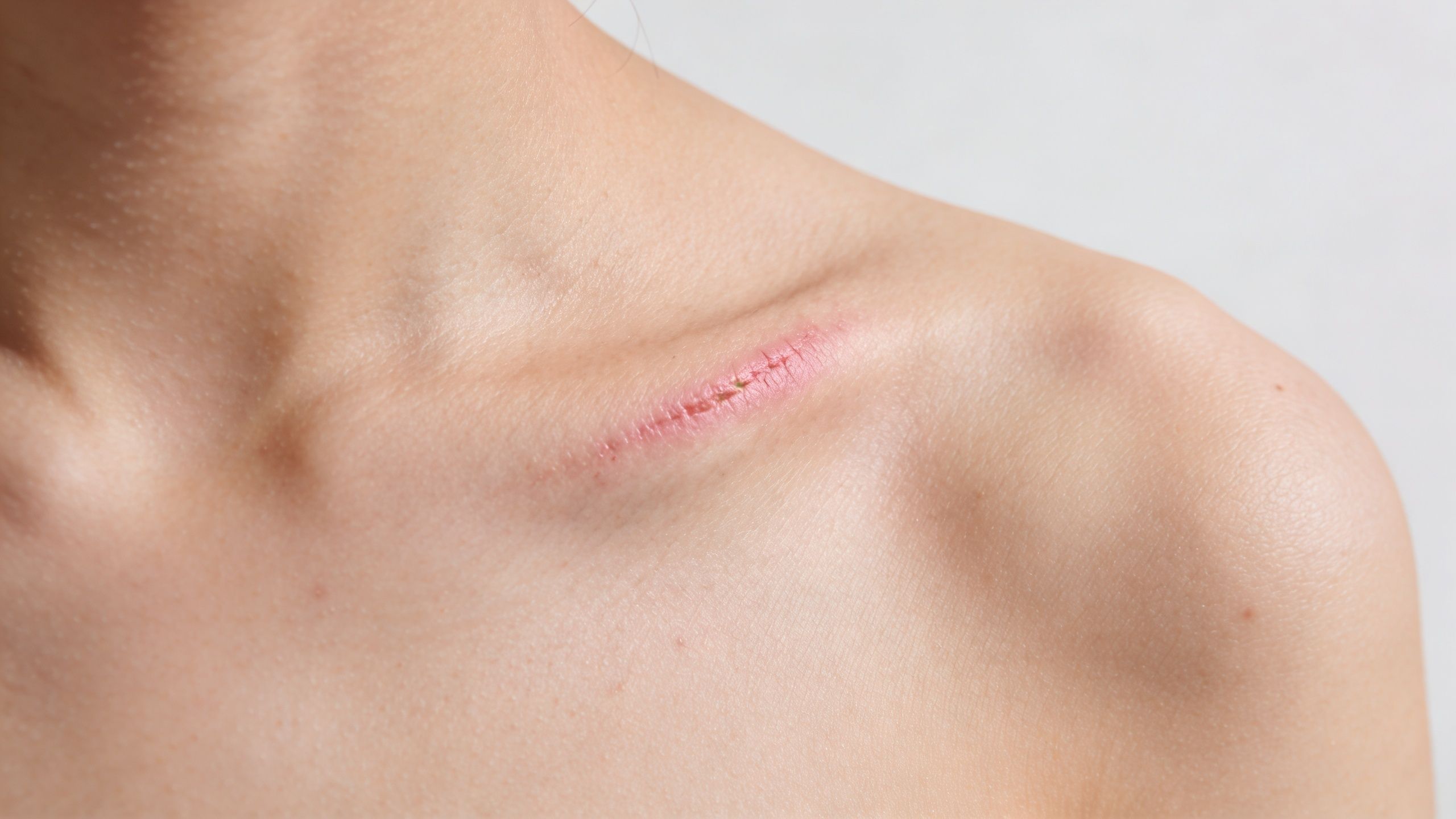
The wound should settle gradually, not instantly. Some redness, tenderness, and mild swelling early on can be normal. The exact appearance depends on whether you’ve had a shave excision or a full surgical excision with stitches.
For raised moles removed by shave excision, the wound typically heals within 7–10 days, with mild pinkness persisting for 3–4 weeks before fading, and the final scar is often minimal.
Practical aftercare that helps
Good wound care is rarely complicated. It’s mostly about consistency.
- Keep it clean and dry as advised in the first phase of healing
- Avoid picking scabs or crusting because that increases inflammation and worsens scarring
- Reduce friction from collars, straps, shaving, or sport where possible
- Protect the healing area from sun exposure because fresh scars can darken more easily
- Follow review advice carefully if you have stitches or if histology has been sent
A scar usually looks worst before it looks better. Early pinkness doesn’t predict a poor final result.
Technique affects the scar
This is worth understanding before treatment. A shave excision often avoids the thin straight-line scar associated with a full excision because it doesn’t require stitches. A full excision may leave a more defined line, but it can be the correct and safest choice when complete removal and diagnosis are more important than cosmetic convenience.
When to ask for advice
Contact the clinic if the wound becomes increasingly red, swollen, painful, or starts discharging, or if the dressing repeatedly fails and the area is being traumatised. Patients usually do best when they ask early rather than waiting for a small issue to become a larger one.
Most healing is straightforward. The key is matching expectations to the method used.
Mole Removal UK FAQs and Your Next Steps
Does mole removal hurt
Most procedures are done under local anaesthetic. The numbing injection can sting briefly, then the area becomes numb. Afterward, discomfort is usually mild and manageable with routine aftercare.
Will I have a noticeable scar
Any skin removal procedure can leave a mark. The type of scar depends on the technique, the body area, your skin, and how well the wound heals. Cosmetic methods may reduce visible scarring in suitable benign lesions, but suspicious lesions should be treated with the method that gives the safest diagnosis.
Can more than one mole be removed at once
Sometimes, yes. That depends on the type of lesions, where they are, how they need to be removed, and whether histology is required. It’s best decided during consultation rather than assumed in advance.
Should I book even if I’m not sure it’s serious
Yes. Uncertainty is exactly why assessment exists. A proper review can confirm that a lesion is harmless, suitable for cosmetic removal, or in need of a different pathway.
If you’ve noticed skin cancer mole symptoms, a changing lesion, or a mole that keeps catching and irritating, the sensible next step is to call to book, click to book, or visit the website to arrange an assessment.
This article is for general information only and isn’t a substitute for personal medical advice. If you’re worried about a mole, book a clinical consultation and have it examined properly.
If you want a clear answer rather than more online searching, arrange a consultation and get the lesion assessed.