
Living with ongoing joint pain can make ordinary days feel unnecessarily hard. You might notice it first when getting out of bed, climbing the stairs, reaching for a shelf, or trying to sleep on one side. Over time, pain can start to shape your routine, your confidence, and even how active you feel able to be.
For many people, joint injections offer a targeted way to calm pain and inflammation without a general anaesthetic or a long recovery. They’re widely used in musculoskeletal care, and the need is clear. Global Burden of Disease data from 2019 showed that around 1.71 billion people worldwide live with musculoskeletal conditions.
In a private clinic setting, the process is usually focused, practical, and personal. The aim isn’t just to give an injection. It’s to understand the source of your pain, decide whether an injection is appropriate, and build a treatment plan that supports movement, function, and day-to-day comfort.
Introduction
Persistent joint pain rarely stays in one part of life. A sore knee can change how you walk. A painful shoulder can stop you dressing easily or sleeping well. Hand or wrist pain can make work, driving, and lifting feel much harder than they should.
That’s why many patients start looking for something more targeted than tablets alone. Joint injections can place treatment directly into or around the painful area, which may help settle inflammation and improve movement. For the right patient, they can be a useful part of a broader joint pain treatment plan.
Practical rule: An injection works best when the diagnosis is clear. The first question isn’t “Which injection should I have?” It’s “What exactly is causing the pain?”
What Joint Injections Are and Conditions They Treat
A joint injection is a procedure where medication is placed directly into or around a painful joint, tendon, bursa, or soft tissue structure. Because the treatment goes to the area causing the problem, it can provide more focused relief than medicines taken by mouth. These are outpatient procedures, done in a clinical setting, and they don’t require a general anaesthetic.
In everyday practice, they’re already a familiar part of musculoskeletal care. A 2023 survey found that over 72% of general practitioners had performed at least one joint or soft tissue injection in the previous year, with experienced clinicians often carrying out a median of 20 to 30 injections annually (survey of Irish and UK general practitioners).
Conditions commonly treated
Joint injections may be used for a wide range of musculoskeletal problems, including:
- Osteoarthritis in the knee, hip, shoulder, elbow, wrist, or ankle
- Rheumatoid arthritis flare-ups affecting a joint
- Frozen shoulder
- Rotator cuff-related shoulder pain
- Shoulder bursitis and impingement
- Tennis elbow and golfer’s elbow
- De Quervain’s tenosynovitis
- Trigger finger or trigger thumb
- Carpal tunnel syndrome
- Greater trochanteric pain syndrome around the hip
- Achilles tendinopathy
- Patellar tendinopathy
- Sacroiliac joint pain
- Plantar fasciitis
- Gout-related joint inflammation
Exploring the Types of Joint Injection Available
Joint injections are not a single treatment. They are a group of tools, and each one is chosen for a different reason. In a private, consultant-led clinic, the goal is to match the injection to the structure causing pain, then deliver it with precision, usually under ultrasound guidance, so the treatment reaches the intended target.
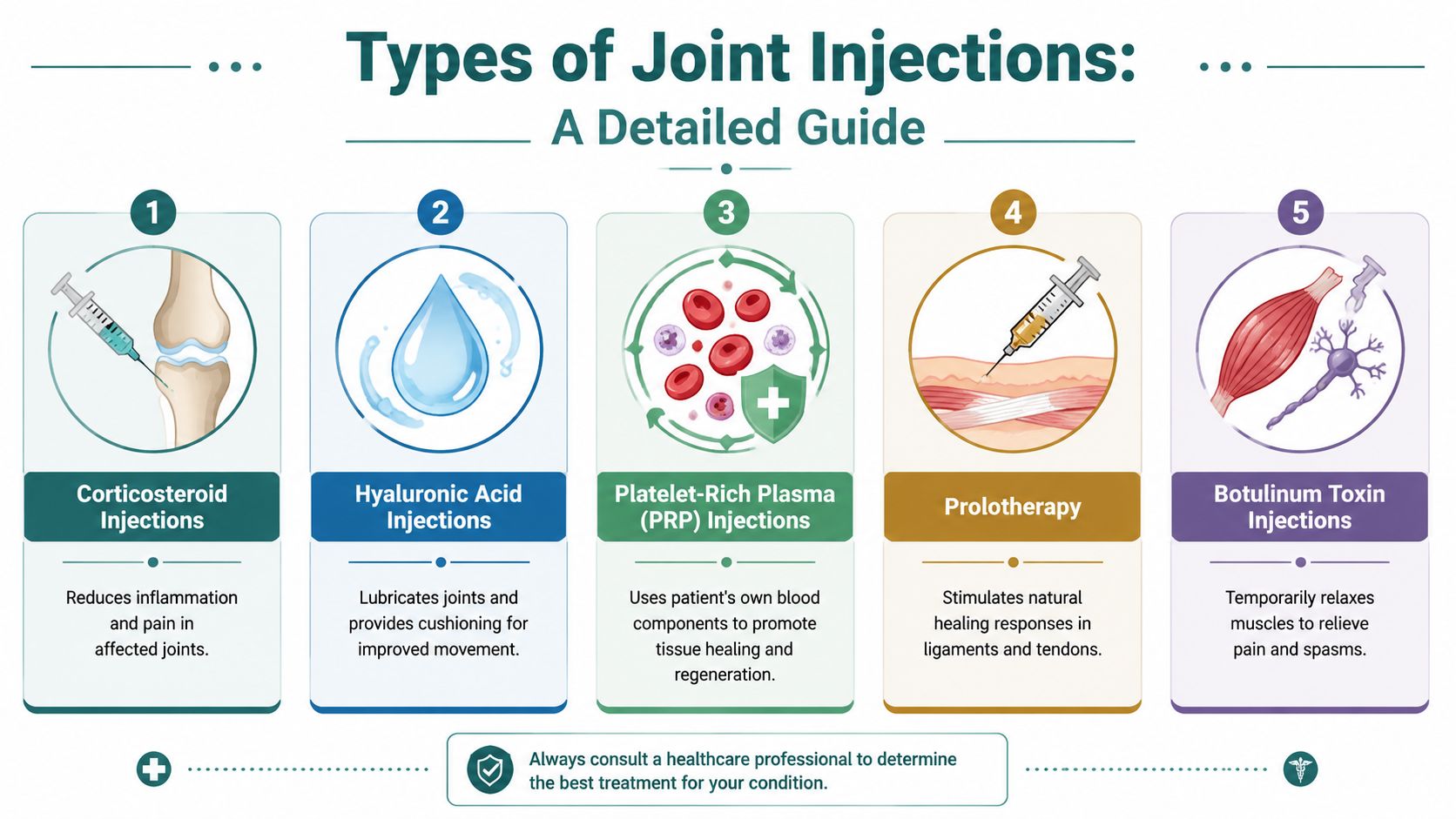
A useful way to understand the options is to ask a simple question. Are we trying to calm inflammation, improve lubrication, stretch a stiff capsule, or treat irritated tissue around a tendon or ligament? That clinical reasoning shapes the recommendation far more than the name of the injection alone.
Corticosteroid injections
A corticosteroid injection places anti-inflammatory medicine into a joint or nearby soft tissue. It is often used when swelling and irritation are driving pain, such as in arthritis, bursitis, or some tendon-related conditions.
Steroid injections work a bit like turning down an overactive alarm system. The tissue is still there, but the inflammatory response becomes quieter, which can reduce pain and make movement easier. Some patients notice improvement within a few days, while others feel the benefit build more gradually.
Hyaluronic acid injections
A hyaluronic acid joint injection is mainly used to support lubrication inside a joint, especially the knee in osteoarthritis. Rather than focusing on inflammation in the same way a steroid does, it aims to improve how the joint surfaces move against each other.
This is why consultation matters. Some people are looking for short-term pain relief. Others want to improve comfort with walking, stairs, or exercise over a longer stretch. In a private clinic setting, that discussion helps decide whether hyaluronic acid is a sensible option or whether another treatment would fit better.
Combined injections such as Cingal
Some injections combine a corticosteroid with hyaluronic acid. The logic is straightforward. One part is intended to settle inflammation earlier, while the other is intended to support lubrication within the joint.
These products are usually considered for knee osteoarthritis. They can suit patients who want one treatment that addresses both pain relief and day-to-day function, provided the joint, symptoms, and examination findings all point in that direction.
Hydrodistension
Hydrodistension, also called hydrodilatation, is most often used for frozen shoulder. During this treatment, fluid is introduced into the joint capsule under imaging guidance to stretch the tight, restricted tissue.
A helpful comparison is a stiff jacket sleeve that has gradually tightened around the arm. The problem is not only pain. The space for movement has become limited. Hydrodistension aims to open that space, and it tends to work best when paired with the right follow-up exercises and guided aftercare.
High volume injection
A high volume injection is usually used around a tendon rather than inside a joint. It may be considered for long-standing tendon pain, such as Achilles or patellar tendinopathy, where the painful area often involves irritated tissue around the tendon rather than classic joint inflammation.
Here, accuracy matters. Ultrasound guidance helps the clinician place the fluid in the planned area and avoid nearby structures, which is one reason many patients prefer this treatment in a specialist clinic rather than a more general setting.
Prolotherapy
Prolotherapy uses a dextrose-based solution and is sometimes discussed for selected tendon or ligament problems. It is generally considered when the pattern of pain suggests tissue irritation, strain, or laxity rather than a swollen, inflamed joint.
Results are not usually immediate, so expectation-setting is part of good care. A consultant-led assessment can help clarify whether prolotherapy fits the diagnosis, whether a different injection would be more appropriate, or whether injection treatment should be combined with rehabilitation for a better outcome.
For patients comparing approaches for elbow pain, The Lagom Clinic offers a useful example of how one condition may need a different injection plan from shoulder, knee, or hip pain.
Comparison of common joint injections
| Injection Type | Primary Use | Onset of Relief | Typical Duration |
|---|---|---|---|
| Corticosteroid | Reduce inflammation and pain in joints or soft tissues | Often begins over the first few days | Varies by condition and person |
| Hyaluronic acid | Joint lubrication, especially in osteoarthritis | Usually slower in onset | May last longer for some patients |
| Combined steroid and hyaluronic acid | Blend earlier anti-inflammatory effect with joint lubrication | Early effect may come from steroid component | Varies |
| Hydrodistension | Frozen shoulder with significant stiffness | Depends on capsule tightness and follow-up rehab | Varies |
| High volume injection | Tendon-related pain | Varies | Varies |
| Prolotherapy | Selected tendon or ligament problems | Usually not immediate | Varies |
Some injections are chosen to settle inflammation. Others are chosen to improve movement, create space, or support rehabilitation. In practice, the best choice depends on the diagnosis, the exact tissue involved, and the aftercare plan that follows.
Who Is a Good Candidate for Joint Injections
A good candidate is usually an adult with persistent joint or soft tissue pain that hasn’t improved enough with rest, activity changes, oral anti-inflammatories, or [link: physiotherapy]. Injections can be especially useful when pain is blocking sleep, movement, work, or progress with rehabilitation.
They do have limits. Joint injections don’t cure arthritis, rebuild damaged cartilage, or replace strength work and movement-based recovery. If relief is brief or absent, that can be clinically useful information. It may suggest the pain is coming from a different structure, or that further imaging and specialist review are needed.
When extra caution is needed
An injection may not be suitable, or may need careful individual assessment, if you have:
- An active infection near the injection site
- Broken skin or suspected joint infection
- Poorly controlled diabetes, because steroids can affect blood sugar
- Blood-thinning medication, especially at higher doses
- A history of repeated recent steroid injections in the same area
- Pregnancy, where treatment decisions should be individualised
Spinal injections are a separate area and usually require a dedicated specialist pain setting rather than a standard musculoskeletal clinic.
The Joint Injection Procedure A Step-by-Step Guide
A private clinic appointment for a joint injection is designed to answer two questions clearly. Is an injection the right treatment for this pain, and if so, how can it be delivered as accurately and comfortably as possible?

For many people, the anxiety comes from not knowing what will happen once they walk into the room. In a consultant-led setting, the appointment is usually more than a quick injection slot. It is a focused assessment, a targeted procedure when appropriate, and a chance to leave with a clear plan.
What usually happens at the appointment
Consultation and review of your symptoms
The appointment starts with a discussion. Your clinician will ask where the pain is felt, how it behaves during the day, what activities trigger it, and what treatments you have already tried. This helps confirm that the painful structure has been identified correctly before any injection is considered.Examination of the joint or surrounding tissue
A careful examination follows. Movement, tenderness, swelling, strength, and the pattern of pain can help separate a joint problem from irritation in a tendon, bursa, or nearby nerve. That matters because the right medicine in the wrong place is unlikely to help.Ultrasound assessment when useful
If ultrasound is being used, you can usually watch the process on the screen as it happens. Ultrasound works like a live map. It shows the clinician the joint, soft tissues, and needle position in real time, which helps guide treatment to the intended target rather than relying on surface landmarks alone.Skin cleaning and numbing the area
The skin is cleaned carefully to reduce infection risk. A small amount of local anaesthetic may be used first, so the injection is more comfortable. Patients often expect this part to be worse than it is. In practice, it is usually brief.Delivering the injection
Once the target is confirmed, the medication is injected slowly and with control. You may feel pressure or a sense of fullness more than sharp pain, especially in a tight joint space. If anything feels unusual, you can say so straight away, and the clinician can pause, adjust, and explain what is happening.Immediate checks and personalised advice before you leave
After the injection, the clinician will make sure you feel well, explain what to expect over the next couple of days, and tell you when to restart normal activity, exercise, or rehabilitation. In a private clinic, this aftercare advice is usually specific to your diagnosis, work demands, and goals rather than given as generic instructions.
Aftercare Recovery and Expected Results
Many can go home shortly after the appointment. The first day or two is usually about protecting the area rather than testing it.
Sensible aftercare
- Rest the area briefly for the first 24 to 48 hours
- Avoid strenuous activity at least during the early recovery period
- Use ice if needed if there’s mild soreness or swelling
- Return to gentle movement once advised by your clinician
- Follow your rehab plan if exercises or [link: physiotherapy] form part of your treatment
A short flare of soreness after the injection can be normal. Relief from a steroid injection for joint pain may come on over days and may last from a few weeks to several months, depending on the condition and the individual. Hyaluronic acid often has a slower onset. Results vary, and injections usually work best when paired with exercise, load management, and a clear diagnosis.
Taking the Next Step Towards Pain Relief
You may have reached the point where joint pain is shaping your day around it. Stairs need planning, sleep is lighter, and exercise starts to feel like a risk instead of a help.
At that stage, the next step is not limited to asking for an injection. It is to get a clear diagnosis and a treatment plan that fits you. In a private, consultant-led clinic, that usually means starting with a detailed assessment, checking how the joint moves, understanding what has and has not helped, and using ultrasound guidance when precision matters. That process works like using a map before setting off. It helps the clinician treat the right structure, for the right reason, at the right time.
If you are still deciding, it can help to look at practical exercise strategies for joint discomfort alongside medical treatment. For some people, exercise and load adjustment are enough. For others, an injection creates a window where pain settles enough for rehabilitation to start properly.
If you would like specific advice on whether a joint injection is suitable, you can book a private consultation at The Haven Medical. From first assessment to ultrasound-guided treatment and a personalised plan afterwards, the aim is clarity, accuracy, and care that helps you return to daily life with more confidence.
Frequently Asked Questions
How soon can I return to work after a joint injection
That depends on the job and the joint treated. If you have a desk-based role, many people can return quite quickly, provided they can sit comfortably and avoid stressing the treated area. If your work is physical, involves lifting, climbing, kneeling, or repetitive arm movements, you may need a longer period of modified duties.
Your clinician’s advice should take priority, because shoulder, hand, hip, knee, and foot injections all behave differently afterwards.
What should a student athlete think about before having an injection during the season
Timing matters. An injection may help pain, but it should fit into a bigger plan that includes diagnosis, rehab, training load, and return-to-sport decisions. In some cases, masking pain too early can lead a player to overload the same area again.
A student athlete should discuss the sport, position, competition schedule, and current training demands with the treating clinician before deciding.
Can an employer arrange private treatment for a work-aggravated joint problem
Yes, in many cases an employer can support assessment and treatment when an employee’s symptoms are affecting work. The useful starting point is a proper clinical review so the diagnosis is clear and the treatment is appropriate.
For businesses, the most practical approach is often to focus on three things:
- Diagnosis first so treatment is matched to the actual problem
- Function at work such as grip, lifting, walking, driving, or keyboard use
- Aftercare planning so the employee knows what restrictions or adjustments may be needed after treatment
Are joint injections guaranteed to work
No. Some patients improve well, some improve partially, and some don’t respond as hoped. That doesn’t mean the consultation was wasted. A poor or short-lived response can still guide the next step in diagnosis and management.
Are joint injections safe
No medical procedure is completely without risk, but joint injections are commonly performed and generally considered low risk when carried out by an appropriately trained clinician with proper assessment and sterile technique. Your clinician should also screen for reasons not to proceed, such as infection or other contraindications.